Both Russia and Malta have experienced government crises in recent months.
After accusations of corruption and citizens' outrage, members of our governments resigned (although, a few years passed between protests on this issue and the resign of government in Russia).
Since in Russia all decisions are made by the President - the government's resignation did not cause social stress. In the minds of Russians, the assignment of new ministers was intermingled with the Oscars: some enthusiastically wondered which of the nominees would take the prize, while others did not, arguing their apathy with the lack of change in general. They created a previously non-existent state post for former Prime Minister Medvedev. He unsubscribed from government accounts in social networks and chose a beautiful pre-revolutionary mansion as his office, just a stone's throw from the Kremlin. Some political analysts openly claim that Medvedev left for a short time for... figuratively speaking, a wine-tasting session between jobs, but since I wasn't invited, I won't state so. All the dismissed ministers were immediately assistants and counsellors in government agencies, which eventually led to an even bigger size of the government system. People call the reshuffle a "pencil pusher sandwich". And the new ministers have already managed to become a topic for discussion. Screenshots of posts in the social networks of the Minister of Culture have popped up, where she calls herself an uncultured person and admits that she does not like exhibitions and theatres. There was a discussion: should the Minister of Culture be cultural, the Minister of Health be healthy and the Minister of Education be educated at all? In any case, many citizens, with varying degrees of perseverance, expressed distrust towards the government, and they were heard.
In May 1964, the Maltese adopted by referendum the basic law of their State: the Constitution. The Russian Federation obtained its main document in 1993. There had been both the Stalinist and Brezhnevist ones, yet the sign of freedom and the symbol of the country was this very last one, the one that "belongs to people". In fact, it was written for one person - Boris Yeltsin. Even though almost no one has read the Constitution, the citizens have lived almost 30 years with the understanding that it should be "protected" (though several additions were made by Dmitri Medvedev, who amended the presidential term). However, every school student firmly knows: "The President is the guarantor of the Constitution." Vladimir Putin has emphasised that he is not going to change it, he "made this decision when he became president for the first time". However, it was so long ago that it could have slipped his mind.
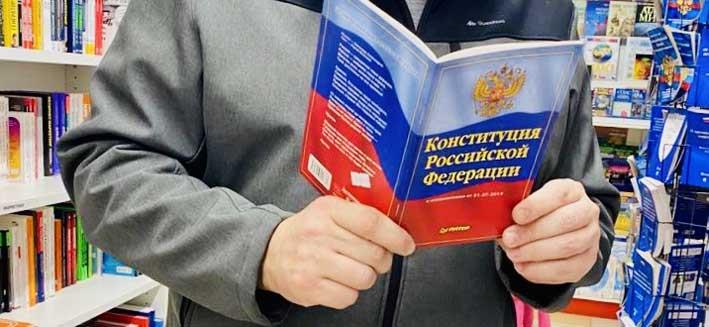
After the long New Year holidays, the Russian middle class had fun with the most trendy "game": "that's how many countries I've already visited" (some people base their choice of vacation destination on novelty of the location, wishing to "mark" all the countries on the globe). At that time, President Putin proposed numerous amendments to the Constitution. Why, which ones, how and when? If these questions are left unanswered in Russia, the expression "the details will be mailed later" is utilised. As long as the working groups have been summoned, different suggestions are being offered. They started with administrative proposals on the functioning of the Federation Council. The patriarch claimed that he would like to take the opportunity to document God's presence in the country, somebody asked to prescribe protection from poverty, a provincial resident - a pensioner - have trolled them: I request that you say hello to my friend, my phone has not been working for a week... However, behind all the jokes and pranks, there is an important process. If any of the authors make a mistake, at least one letter, it will not be Russia on the world map anymore. The voting is planned to be held in April after the Easter, probably on Lenin's 150th birthday.
And while we are waiting for clarity, for those who love history, I will tell a touching story from the 19th century on the first real talks about the Russian Constitution. Do you remember the war in Europe unleashed by Napoleon Bonaparte? Of course, because back in 1797 he wrote about Malta, considering conquering it: "this island is priceless for us". The Russian Empire was a cult of everything related to French and the blossoming era of Romanticism. At that time, Russians rarely travelled to Europe. However, in 1812 there was a war with Napoleon. The northerners fought desperately and even burned Moscow, not to give the enemy the pleasure of living comfortably in their beloved city.
The conqueror's army had got cold and hungry, the Russians chased the enemy back home, passed through Europe and entered Paris. The young heroes of the war, who returned to their homeland, were displeased by the system of slavery applied to the main mass of the empire population - peasants. Officers made friends with ordinary people in the war, a couple of years they slept under the same overcoat, shared meals and died nearby. For young elites - rich heirs, whose eldest was about 30 years old, it seemed right to limit autocracy in the country, urging the king to sign the first Constitution. Provide freedom to the people. Long story short - in December 1825, several regiments in St Petersburg and several in today's Ukraine refused to swear the new Emperor Nicholas.
When the rebellion was suppressed, the authorities discovered an entire network of secret societies promoting democratic values in different degrees (there was no consensus among the participants, everyone saw the reforms in their own way). Five plotters were hanged in public, the rest were deprived of their privileges and exiled to work on mines in ice cold Siberia. I consider the Decembrists (the so-called participants of the societies, even those who never attended the rebellions in December 1825) as heroes, with reservations and clarifications, however. Yet the plot is important and interesting because no authorities can abandon it in any way. Each regime uses the rebellion and its consequences as an instructive propaganda story.
Thus, under the Tsars, the fate of the Decembrists used for intimidation; in the USSR, they were glorified and sung and exactly one month before Putin's announcement about the constitutional amendments, they were made the major topic for several months. In December, the main horn of the state, TV Channel 1, released the feature film Union of Salvation. The movie was followed by many reflections on the topic on YouTube, social media, newspapers and private conversations. The Russians were attempting to figure out how sincere the motives of the young nobility had been and what the success of the plan would have led to. In the opinion of those who watched the film, its motive was as follows: people were misled by a group of pro-Western, champagne-drunk, bored, but not bad, and confused young people. And there was a terrorist idea to change the order. The payback was serious, however. So, filmmakers hint: be vigilant, all suggestions for change must come from "the top".