The Idea of the Grotesque understood as the Fundamental Basis of the Process of Transmogrification formed part of a joint exhibition entitled Strada Stretta Occupy by Students which was held at Società Dante Alighieri in Old Bakery Street as well as The Splendid in Strada Stretta, Valletta. The exhibition was organised by the Fine Arts Programme within the Department of Art and Art History at the University of Malta and the Strada Stretta Concept under the artistic direction and coordination of Prof. Giuseppe Schembri Bonaci.
The works exhibited by Filippa de Bono formed part of her B.A. (Hons.) History of Art and Fine Arts dissertation, under the supervision and guidance of Prof. Schembri Bonaci. The main research question of this dissertation was the analysis of the process of transmogrification and its relationship, among others, with the significance of the grotesque. Special emphasis was given to the importance of the transformational process itself, that being the time during which a phenomenon changes and transforms itself into its grotesque final creation, whatever that may be. In simpler terms, the process of transmogrification refers to a grotesque transformation. An established definition of the grotesque, however, is debatable, since, as the examination of artworks throughout the centuries has shown, its meaning has changed and evolved with the times and has proved to be subjective, varying from person to person as well as one culture to another.
De Bono has also engaged with modern meanings of the grotesque and transformation which were later combined into a transmogrification process, from a visual as well as from various emotional and conceptual viewpoints, breaking away from that which is strictly visible towards that which is intangible. Transmogrification, being a relatively new term without a clear attributed definition, has only ever been mentioned in the Calvin and Hobbes comic series by Bill Watterson from the 1980s through the 1990s. De Bono took on the task of clarifying her own understanding of the idea of the grotesque within the process of transmogrification, which is encapsulated in her final project, The Transmogrifier.
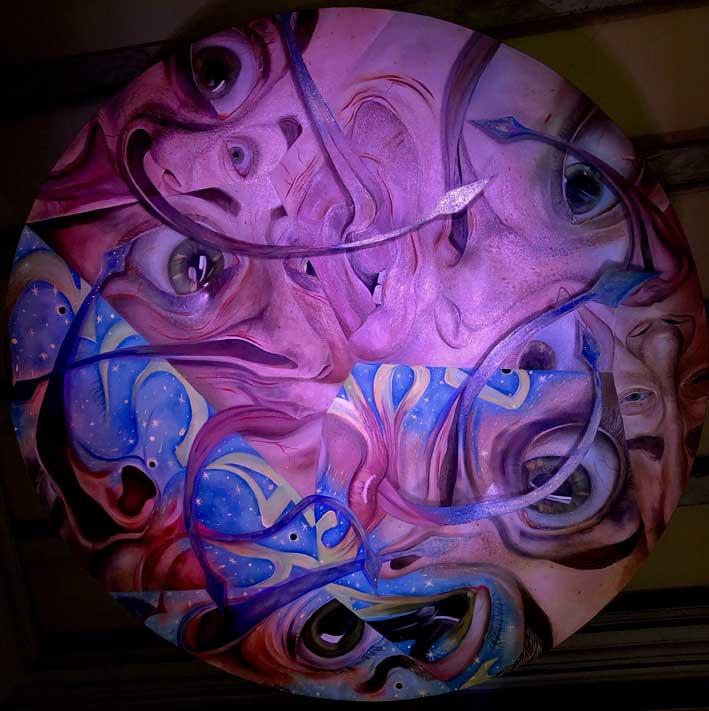
Through the final project, de Bono has transformed one of the rooms found within The Splendid into a cardboard box called the Transmogrifier mentioned in the Calvin and Hobbes comics. In the comics the reader is never able to visibly see the transmogrifications taking place, and therefore, this project aimed at offering the onlooker a chance to step underneath this cardboard box and come face to face with four portraits caught mid-act in the process of transmogrifying into their grotesque final state. The cardboard box served as a metaphor for the initial grotto where the discovery of the pitture grottesche were found. However, in this case, within the cardboard box we have the discovery of unfamiliar transmogrifications.
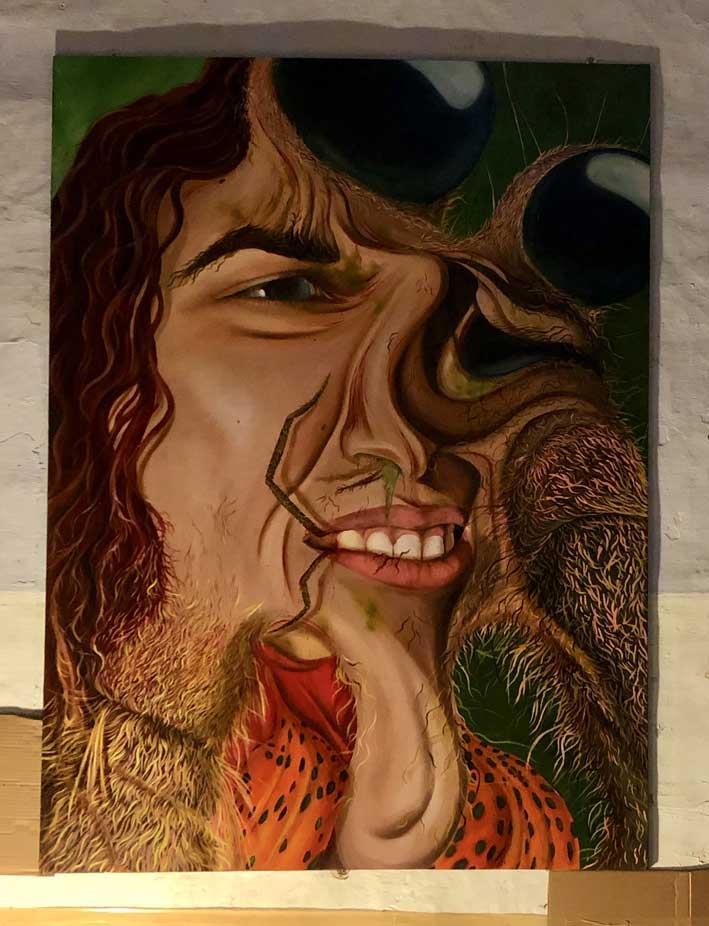
Each portrait engages with different connotations of the grotesque under a contemporary light, displaying themes of body horror, the carnivalesque body, body dysmorphia, mythological revenge and rivalry, nocturnal animals, natural occurring grotesques, society's high standards of female beauty and the stigmatisation of ageing as well as existentialism and the meaningless of time. Thus, the idea of the grotesque evolves from the conventual towards the intangible, where the grotesque is attributed to thoughts and concepts which are not seen, but only felt and experienced. This recalls Geoffrey Harpham's argument that the grotesque can serve as a thematic metaphor for confusion, insanity, loss of perspective, social collapse and angst, and pulls us beyond the boundaries of the world we know, and even reminds us of the limits of our own mortality. The idea for all the portraits to be of female subjects was indirectly used to provoke Aristotle's argument about the natural monstrosity of the female body, as well as the other extreme of the representation of women in light of the male gaze by using the process of transmogrification in an exaggerated way to display the in-between state of beauty transforming into the grotesque.
The narrative for the set-up of the installation was also inspired by one of Harpham's definitions of the grotesque - that a true grotesque must arouse three responses of laughter, disgust and astonishment, combined with fear, and therefore, each image is reacting to the other in its respective emotion with the third image looking up towards the floating circular canvas which was displayed hovering below the ceiling in the centre of the space. Above all other factors, the grotesque is used as a tool to mock the weakness and foolishness of society using monstrous and abject themes to turn our laughter against us by what the Romantics referred to as "infernal laughter", where we are the ones mocked by our fate and our own weaknesses by images and concepts which threaten our idea of normality. With all this being said, the motive for this exhibition was to instigate the viewers to contemplate their own understanding of the grotesque as they walked around this unexpected world of the grotesque.
Strada Stretta Occupy by Students was organised by the Department of Art and Art History, the University of Malta and The Strada Stretta Concept, as part of the Valletta Cultural Agency 2021 programme, in collaboration with the Società Dante Alighieri.