If you are older than 40, you may feel overwhelmed with nostalgia and happy childhood memories when hearing the name Amiga. Most probably you had one in the early 90s to play games on, print out letters or draw funny stickmen using pixels and a mouse. Indeed, it was the first multimedia machine. While you were doing that, other professionals were using it to generate 3d sequences and composites for popular TV series of the day like Babylon 5 and Young Indiana Jones Chronicles. One day you threw the whole thing away or sold it for 20 Maltese Lira if you were lucky enough and replaced it with a Windows PC or a Playstation. Wrong move, because that piece of plastic and silicon, has a substantial monetary value in today's retro computer community.
The Amiga was always daubed in colourful history. In 1979, one Larry Kaplan left Atari and founded Activision. In 1982, Kaplan was approached by several investors who wanted to develop a new game platform. Kaplan hired the 50-year-old Jay Miner to run the hardware side of the newly formed company, Hi-Toro. This computer system was code-named Lorraine. When Kaplan left the company late in 1982, Miner was promoted to head engineer and the company relaunched as Amiga Corporation. In 1983 Commodore offered $24m to purchase Amiga outright. A breadboard prototype of the first Amiga was largely completed by late 1983 and shown at the January 1984 Consumer Electronics Show, featuring an astounding demonstration of a red and white bouncing boing ball with stereo sound.
Introduced on 23 July 1985, during a star-studded gala featuring Andy Warhol and Debbie Harry held at the Vivian Beaumont Theatre at Lincoln Center in New York City, the first Amiga, the Amiga 1000 began shipping in September 1985, but a series of production problems kept it from becoming widely available until early 1986. It had a base configuration of 256 kilobytes of RAM at the retail price of $1,295.
The Amiga 500 was first announced at the winter Consumer Electronics Show in January 1987, at the same time as the high-end Amiga 2000. In Europe, the Amiga 500 was released in May 1987 for £499. In the Netherlands, the A500 was available from April 1987 for a list price of 1,499 HFL. In December 1987 it was already being advertised in the student magazine Saghtar despite the prohibitively high price compared to the 8-bit Spectrum and Commodore 64 of the time. Yet, this cost-reduced version of the A1000 soon became one of the most sought-after home computers among gamers, content creators and video professionals of the time. If you have been reading this far, most probably you experienced all that first hand!
In early 1992 Commodore released the short-lived A500 Plus. It was an exercise in cost reduction, with minor changes to the motherboard. The new version of the Amiga Operating system 2.04 was also introduced... and with it a number of incompatibilities with several existing games.
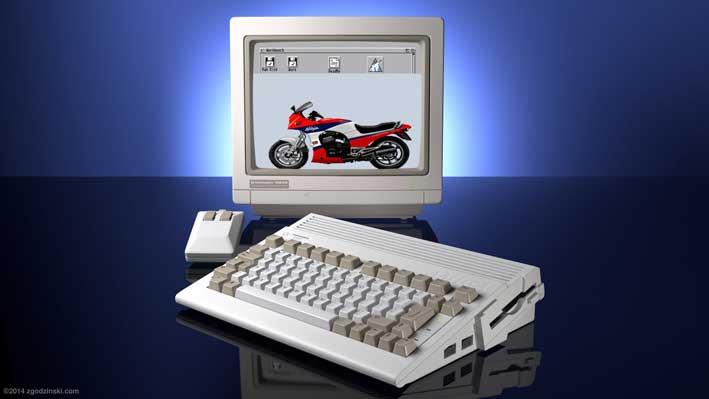
The Amiga 600 was introduced at the CeBIT show in March 1992. It was the final model based on the Motorola 68000 CPU and the ECS chipset. The A600 was the first Amiga model to be manufactured in the UK, in a factory in Irvine, Scotland, although some later examples were manufactured in Hong Kong and the Philippines.
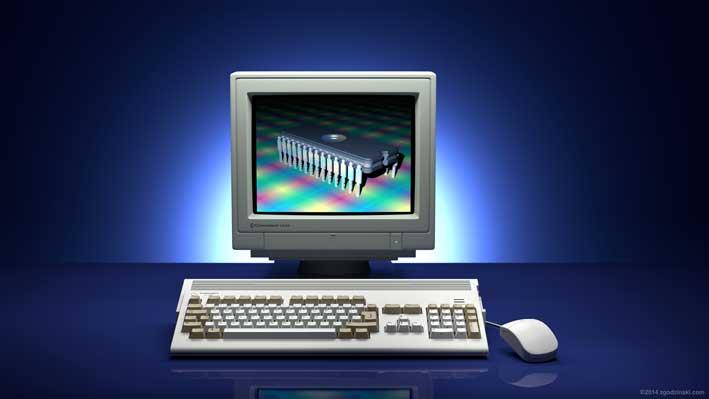
The Amiga 1200 was Commodore's third-generation Amiga computer and was launched on 21 October 1992, at a base price of £399 in the United Kingdom. It featured an Advanced Graphics Architecture with a depth of 8 bits per pixel with 256 colours and hi-res smooth scrolling and 262,144 colours in a proprietary Hold-And-Modify mode. Yet by 1994, only the operations in Commodore Germany and the United Kingdom were still profitable. Commodore declared bankruptcy on 29 April 1994 and ceased to exist. Miner, Amiga's father passed away due to complications from kidney failure at the age of 62, just two months later. After 7 million units sold, was the Amiga over and done with? Well, not just yet...
In April 1995, Escom bought Commodore International for $14m, primarily to get the Commodore and Amiga brand names. It won a bid for the company over and above a rival bid from Commodore UK's managing director, David Pleasance, who had earlier helped popularise the Amiga in Malta thanks to packs featuring a combination of productivity software and games. Escom started using the Commodore name on computers sold in Europe and established a separate division for Amiga-related technologies.
After Commodore's demise in 1994, the A1200 almost disappeared from the market but was later relaunched by Escom in 1995. The new Escom A1200 was priced at £399 and it came bundled with two games, seven applications and AmigaOS 3.1. It was initially criticized for being priced £150 higher than the Commodore variant that had been sold for two years prior. The A1200 was finally discontinued in 1996 as the parent company folded.
Escom grew too quickly and lost 185 million German Marks in 1995. With no bailout from its shareholders, the company declared bankruptcy on 15 July 1996 and was liquidated. The Commodore trademarks were purchased the following year by Tulip Computers, while the remaining trademarks, together with the full set of patents, copyrights and other intellectual property, were acquired by Gateway 2000.
On 16 October 2007, Acer acquired Gateway. Companies like Hyperion and Cloanto would license parts of the Amiga brand name from Acer to produce third-party products and wage an intellectual property war for years to come!
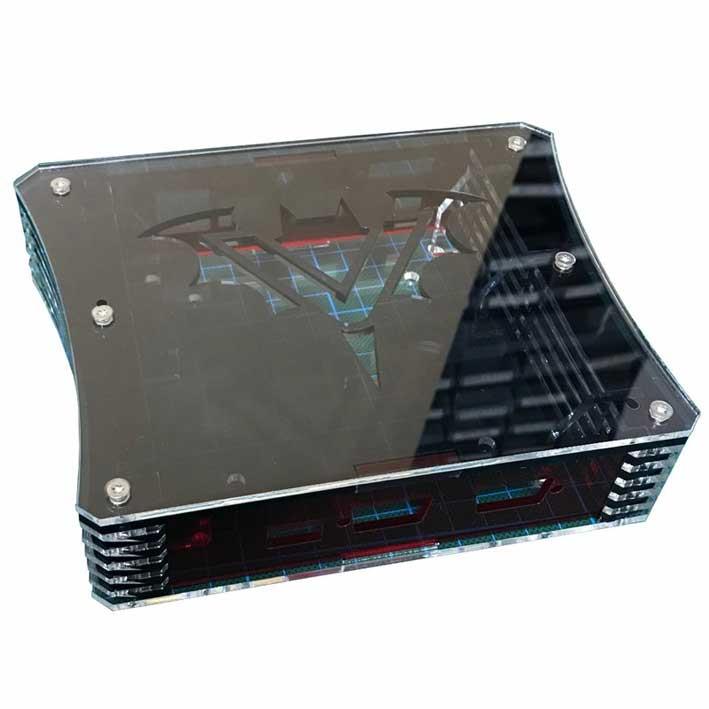
Notwithstanding, the Commodore 64 and Amiga retained a cult following among retro computer lovers and the demoscene (a UNESCO-heritaged digital culture of coders and media artists), decades after Commodore's demise. Amiga people never lost hope. Linus Torvalds of Linux fame even cried out "Will that thing never die?" And Amiga people promptly replied "No"! And that brings us full circle to more present times. The Vampire V4 from Apollo first went on sale at the Amiga34 conference on 12 October 2019 in Neuss, Germany. It's the newest and most powerful Amiga ever based on an Altera (now owned by Intel) FPGA device, which recreates a Motorola 68060 CPU and all of the custom Amiga chipset. The Vampire's performance exceeds any 1990s Amiga and incorporates additional capabilities that were never available on the actual system. Hardcore speed lovers drooled and saved up for this new biscuit-box sized form factor full of wonders that retailed for around €600.
Another popular option is the MISTer, an open-source project, also built upon field-programmable gate array FPGA technology. It makes use of the Terasic DE10-Nano featuring an Altera Cyclone V with two ARM Cortex-A9 CPU cores to become a shape-shifting wonderbox that can change its own logic to make itself run like countless retro machines as accurately as possible. From old coin-op arcade boards to vintage consoles... it was originally intended as an academic tool for tech students to learn how to work with FPGAs, but hackers hacked the heck out of it, and that's how we got a working Amiga core for under $450.
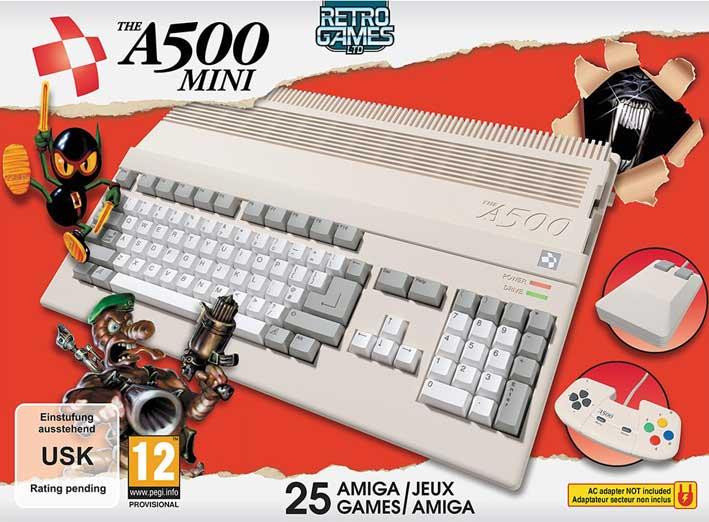
This brings us to today, the culmination of five years of hyper buzz surrounding the Amiga. For the 35th anniversary of the Amiga's launch, Retro Games Ltd will release a compact reimagining of the A500 in March 2022. Priced at €130, the A500Mini features an arm-based CPU and software emulation of the original A500 (OCS) chipset and the Advanced Graphics Architecture (AGA) of the A1200. You also get a mouse and a gamepad. Due to copyright reasons, the word "Amiga" is never used in this new product. Even the red and white "boing ball" gets a sort of variant representation, again due to copyright reasons.
Will you get one?
Noel Baldacchino is a software programmer and tech writer by profession. He acquired his first Amiga computer in 1989 and has been using it ever since to produce retro pixel artwork, that is regularly featured in digital arts events around all Europe