It is noted that the civil war in Russia included a forced seizure of grain, nationalization of all trade and industry and strict control of labour. As a result of this program and the ravages of the First World War, industrial production declined sharply and the population suffered severe hardship. It caused a famine that led to the death of an estimated 5 million people.
It is little wonder that terror was used as a state policy directed against different groups in Russian society who were seen as enemies of the people. As a result a Diaspora of Russian people from all classes of society fled Russia, initially, internally to Ukraine, then Turkey and other Slavic countries. A large number also left for Western Europe, including Malta. Other citizens from different countries were also leaving Russia, including British subjects.
It is noted that in Malta, the years following the First World War were also very turbulent and dotted with serious disturbances. Malta had just emerged from the First World War and the Spanish Flu. The country was facing a labour and economic situation with high prices of the basic commodities of life. The Increasing unemployment rate was also creating a general state of discontent as well as the high price of bread which was staple food.
Classy Refugees
On the 9 April 1919, the Commander-in-Chief, Malta informed the Secretary, War Office, London that he had received through Naval Authorities, Malta, a message from the British Admiral, Commanding Black Sea asking whether accommodation could be arranged at Malta for Russian Refugees of the better class from Odessa in view of evacuation of that city. In view of this he stated that he had informed the British Vice-Admiral, Commanding in Chief where he stated that he was able to provide accommodation for better class refugees up to 2000 and further accommodation later, and requested that only persons whose bona fide had been completely established by Intelligence Service were to be sent.
Empress Marie
On 20 April, Empress Marie arrived in Malta and was to disembark on the morrow. Maria Feodorovna (26 November 1847 - 13 October 1928), known before her marriage as Princess Dagmar of Denmark, was a Danish princess who became Empress of Russia as spouse of Emperor Alexander III (reigned 1881-1894). She was to proceed to England in about a week's time.
Governor Methuen informed London on 23 April that Empress Marie and a Suite of 70 were in Sant' Antonio (Palace of San Anton) and Hotels. An advance of £500 from Civil Funds was made for their expenses. Also the Governor informed London that at an urgent request of the Rear Admiral, Black Sea and High Commissioner, Constantinople, he had undertook to accommodate the 2000 additional Russian Refugees of the better class (mentioned previously) and provide accommodation for a further number.
The first consignment of refugees was to arrive on April 24. The Governor also informed the War Office that he was making the necessary arrangements and charging Army Funds. The necessary quarantine measures were also being taken by the Civil Government. Some Russian refugees also brought along their dogs with them and these were also subject to quarantine. The Governor also presumed that all expenditure would be refunded by the Imperial Government.
According to Wikipedia, after her brief stay in the British base in Malta, Empress Marie travelled to England on the British ship the Lord Nelson, and she stayed with her sister, Alexandra. Although Queen Alexandra never treated her sister badly and they spent time together at Marlborough House in London and at Sandringham House in Norfolk, Maria, as a deposed empress dowager, felt that she was now "number two," in contrast to her sister, a popular queen dowager, and she eventually returned to her native Denmark. After living briefly with her nephew, King Christian X, in a wing of the Amalienborg Palace, she chose her holiday villa Hvidøre near Copenhagen as her new permanent home.
Accommodation and Quarantine
In an urgent request of the High Commission, it was agreed to accept 900 refugees who were expected to arrive in Malta on the 24 of April. It was also noted that it was necessary to provide Army resources in the form of Barrack accommodation, rations, medical attention etc., and to engage civilian labour as was necessary. An account was opened titled, 'Russian Refugees a/c' with a view to ultimate recovery from the Russian Government.
It is noted that during April 1919, a Government Notice signed, 'By Command, Lieutenant's Governor's Office' was attached to the above correspondence alerting the authorities of Typhus in Constantinople and hence it was declared that this city was an infected place within the meaning of Article 1 of the Regulations made under the Fourth Sanitary Ordinance, 1908.
The Secretary, War Office informed the Commander-in-Chief Malta on 28 April 1919 of rates applicable to Northern Russia only were to be exchanged at 100 roubles to the £1. Different regions had different exchange rates due to the different economic and war situations.
Explosion in Number of Arrivals
On 30 April 1919 the British Commander-in-Chief, Mediterranean Station informed the Commander-in-Chief, Afloat, HMS Carsar that 700 more refugees could be accommodated in 8 days time provided they were of same class as those sent on another ship. The British authorities were very selective in those classes of persons fleeing from Russia as the same telegram stated that, 'no doubtful characters or any requiring police supervision can be taken.' At the time refugees were to understand that only Barrack accommodation with soldiers' rations was available.
On the same day the Secretary War Office, London was informed by Governor of Malta that there were 635 Russian refugees, mostly aristocracy of the highest class and persons, friends of the Empress. Some were destitute whilst others had ample funds, provided they could realise securities in England and other countries.
The question was raised in the telegram as to the general policy of travel; whether those who wished to travel to England and other countries could be allowed to proceed at their own expense, if possible, otherwise at Government expense. Another question was whether those who were destitute were to be kept indefinitely at Imperial expense and to what extent could they be financed as regards immediate cash payments. It was also stated that no military personnel was available to superintend the camps and barracks in which they were accommodated and it had been necessary to engage civilian labour for that purpose. An immediate reply was requested as further refugees were expected shortly.
By means of a telegram dated 6 May 1919 it was reported that the number of Russian refugees in Malta was 635, mostly of the highest class. In the same telegram it was also noted that 125 British refuges arrived from Odessa on 30 April and for these the Admiralty was arranging for their maintenance.
On 7 May 1919 Admiral Kolchak wrote to Madame Kolchak through The Secretary of State, Colonies, London whereby Admiral Kolchak would assist Madame Kolchak and her son to leave Russia for France or England. He also stated that he did know where she was at present and that she should leave Russia until his mission was finished and to tell the British authorities where their son was. He also remitted to his wife a further 10,000 Francs. Kolchak led the White Army movement that attempted to retain control of Russia from the Bolshevik Army during the Russian Civil War of 1917.
On 7 May a telegram addressed to the British Ambassador, Rome stated that Countess Shauvaloff appeared to be in a very nervous state as she had written to Admiral Wamyss regarding her plan and stated she could not decide as to her future movements before she received a reply from him. This mental and emotional state explains very well the predicament of these Russian refugees who were facing an uncertain future far away from their home country.
Another telegram revealed that Countess Schouvaloff, one of the refugees in Malta, was facing a financial position of some difficulty. Princess Radziwill, who lived in Rome and was her cousin, requested that she would be informed that she had an apartment ready for her and would pay expenses of journey if necessary; advances would be made and would also provide for everything.
On 9 May 1919 the British Ambassador in Paris asked the Governor, Malta if he would give him news of Persian Legation of Madame Zolgardoff who had apparently arrived in Malta from Crimea with her husband. Madame Zolgardoff had arrived in Malta on 24 April and was in Persian Pass Visa to Constantinople. Her husband was somewhere in Persia.
The Secretary of State for the Colonies informed the Governor that he could continue to meet the expenses from Army funds but cash allowance was not to be given. He also asked the Governor to make arrangements through Military Authorities with the War Office if any officers wished to serve in North Russia (Northern Russia Expedition). Also, at this stage he stated that “nothing can yet be said as to the ultimate disposal of refugees”.
Northern Russia Expedition
According to Wikipedia, the North Russia intervention, also known as the Northern Russian Expedition, the Archangel campaign, and the Murman deployment, was part of the Allied intervention in the Russian Civil War after the October Revolution. The intervention brought about the involvement of foreign troops in the Russian Civil War on the side of the White movement. The movement was ultimately defeated, while the Allied forces withdrew from Northern Russia after fighting a number of defensive actions against the Bolsheviks, such as the Battle of Bolshie Ozerki. The campaign lasted from March 1918, during the final month of the First World War, to October 1919.
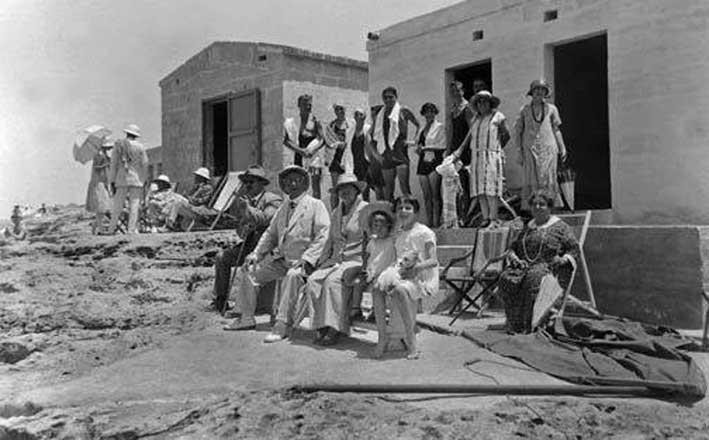
Russian refugees enjoying their stay at the Exiles beach, which took up its name for their frequent presence there
The Naval Attaché, Rome informed the Commander-in-Chief, Malta on 9 May to inform Nina Rodviank, Red Cross nurse that her father and mother were in Rome and whether she and her husband would come to Rome or her parents to Malta.
On 14 May the Governor of Malta informed the High Commissioner, Constantinople that Count Alexander Bobrinsky and his wife were at Hotel Tokatlian in Constantinople and wished to come to Malta to join his mother Countess Bobrinsky who was living at Tigne’, Sliema, Malta and whether arrangements could be made to bring them to Malta. In reply the High Commissioner informed the Governor that the Naval Authorities had been asked to facilitate passage of Count Alexander and his wife to Malta.
By 20 May 1919 the Military Authorities had informed the Secretary of State, Colonies, London that The High Commissioner at Constantinople had been informed that they could take 700 additional refugees at Malta. This was the maximum that could be accommodated in the circumstances. No work could be provided for these refugees, the majority of which were Princess and their families. Some young officers, as noted previously, were desirous of proceeding via England to the Northern Russia front. All expenditure on Russian refugees had by then amounted to approximately £1,000 per week and was being defrayed from Army Funds. An arrangement for British refugees was also being provided for by the Admiralty.
Expenses on Empress Marie had been advanced from Malta Government costing €750. It was noted that many of the high class refugees were absolutely destitute and it was asked whether cash allowance could be made to them. It was undesirable that these refugees would remain in Malta longer than necessary. Hunter Blair who signed the telegram also asked, “how it is intended to deal with them”. The largely increased numbers of Russian refugees were of great concern to the local Military authorities because it was not yet established what would be the maximum number that could be accommodated and whether they were fit for any work and what kind of work.
Welcomed in England
Refugees were also allowed to be hosted in England. The Acting Governor of Malta informed the Secretary of State, Colonies, London whether permission to proceed to England could be given to Princess Vladimir Schakhovsky who had applied for permission to proceed to England with her two daughters. She had previously received an invitation from Sir John Norton Griffiths to go to Wonham Manor, Betchworth. The invitation from England was done through a compatriot, Nina Kolmentseff, who was arranging passport and possibly money for the Princess’ arrival in England.
On a personal note, my mother was seven years old in 1919 and through oral history, she recounted on several occasions, instances where Russian refugees would knock the door of our house in St Julian’s to sell Turkish and other delights, which they had brought along with them.
Gradually, most of the refugees made their way to other countries while some took up home in Malta. Perhaps one reminder of this chapter in history is the name of the “Exiles” beach in Sliema, which took up its name from the Russian refugees who used to enjoy their stay in Malta at this beach. A letter of thanks, dated 24 April 1919, sent by the President of the Russian Committee at Malta exists at Malta’s National Archives wherein gratitude is expressed to the Military and Civilian Authorities as well as the Maltese people; another lasting reminder of the kind treatment the Russian refugees received in Malta.
References
· Wikipedia - https://en.wikipedia.org/wiki/Maria_Feodorovna_(Dagmar_of_Denmark)
· https://commons.wikimedia.org/wiki/File:Russian_exiles_in_Malta,_1919.jpg
· Wikipedia - https://en.wikipedia.org/wiki/North_Russia_intervention
National Archives of Malta (NAM)
· GOV 4114/19 – Russian Refugees – Copy of Telegraphic Correspondence
· GOV 2027/19 – Refugees from Russia (900) Arrangements for Reception of
· GOV 2458/19 – Russian Refugees – Dogs in Quarantine
· GOC 2078/19 – Russian Refugees – Letter of thanks from President of the Russian Committee
· GOV 3756/19 – Measures suggested for the relief of population at Malta