Meeting Robert Maxwell
In his long and interesting career, the author met many eminent people. One personality he writes about is Robert Maxwell, the creator of Pergamon Press whose daughter, Ghislaine, is now making the headlines for the wrong reasons.
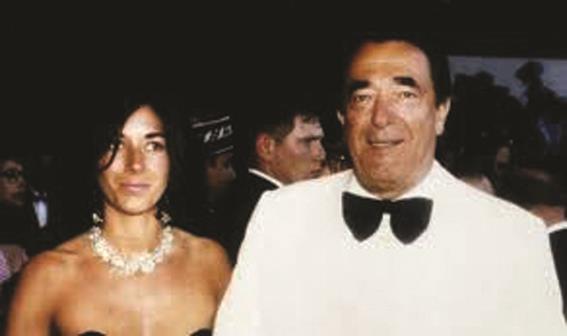
Here is what David writes about Maxwell.
"When I joined George Rainbird (the publisher of big illustrated books) in 1968, one of my tasks was to become involved in preparing production quotations for other publishers both in the UK and abroad, for editions in English as well as in other languages.
At the time Robert Maxwell had been building his own publishing company Pergamon Press.
He had discovered that academics worldwide were anxious to see their learned works appearing in print, regardless of whether any payment would be made, and he was usually able to acquire the publishing rights for a derisory £250 or £300. There seemed to be little or no competition for such works at the time which in any event were most unlikely ever to become best sellers.
At the same time he was aware that there were nearly 1,000 universities and other institutions in the United States alone almost all of which had libraries, and large endowments to enable them to acquire new medical, scientific and technical works.
The Maxwell system was to have the books produced cheaply by letterpress (that is with no colour and only minimal illustrations) and in small quantities, so that he could charge correspondingly large prices. All of this helped to keep the costs down and the profits high.
At the end of the 1960s Maxwell acquired the 'New Caxton Cyclopaedia' which came in many volumes and he found himself immediately with a problem: that he would be in competition with the larger and extremely successful Encyclopaedia Britannica, which used students to sell its enclopaedias from door-to-door.
Britannica was not just successful but also the market leader, while Maxwell was very much the underdog. To enable him to compete he hit on the idea of offering five annually updated year-books free of charge with every set of encyclopaedias sold. It was a very good idea but who was going to produce the volumes for him? The answer was the Thomson Organisation, of which Rainbird was a part and I in turn happened to be a small part of Rainbird, whose duty it was to produce the costings and quotations.
I recall very well my first meeting with Maxwell around in his office, when we enjoyed a very nice afternoon tea on bone china, to discuss some of the information that we required with regard to the costings.
At that time he was Labour MP for Buckingham: tall, dark and quite presentable I thought, as well as being very agreeable. He also possessed a very deep voice. During the meeting I mentioned that I needed up-to-date sales figures, on which to base my costs, so he summoned an accountant to join us and told him "Mr Elyan needs the sales figures up to the end of last month".
"I'll have them for him by the end of the week" said the accountant, whereupon Maxwell exploded and thumped the tea-table so hard that all the cups and saucers jumped about six inches as he bellowed "Mr Elyan wants the figures today, RIGHT NOW". Of course it was not possible for the figures to appear so suddenly and I was perfectly happy to wait until the following Friday, even though I, too, was in fear of my life.
Later I understood that the shouting was intended to achieve two objectives: to terrify the accountant and to impress me.
On another occasions I was around at his office in Poland Street at the HQ of the Maxwell Communications Corporation - MCC for short, and not related to another rather better well-known MCC. When I got there I was told he was late returning from a previous meeting. As I sat by his desk I noticed that his phone had buttons instead of the usual dials and two of them were red and marked 'Kevin' and 'Ian', presumably to enable him to thump the phone instead of dialling their numbers and waiting for his sons to answer.
In November 1986 Phillips and Drew, the stockbrokers, arranged a marketing seminar for their clients, at Whitbread's old 'Porter Tun' room in what had been for many years their brewery in Chiswell Street, where three companies - AGB Research, Reuters and MCC - were to give presentations.
Coffee was served at 10.30 and the meeting was due to get going at 11, but at the appointed hour there was no sign of Captain Bob. The Phillips and Drew partners were seen whispering among themselves and wondering what had happened to him and I understood he was again 'running late', as was his norm.
Shortly afterwards a message came back that he was on his way and he duly arrived at about 11.30. There then took place the ceremony of the introductions and the shaking of hands, followed by a quick cup of coffee.
Suddenly, while the throng stood around mumbling among themselves, Maxwell put down his cup, clapped his hands and shouted out: "OK boys and girls: it's time to get down to business", having kept everyone waiting for nearly an hour.
When I first met Bob, at a guess he would have weighed 12 or 13 stones. Over the next 15 years his weight must have doubled and I understood that on some days he had two lunches or two dinners.
As if in order to accentuate his figure, he took to wearing loosely fitting woollen suits and the ones that I recall were pale blue. Fortunately I don't have any photos to accompany this chapter.
When in the late 80s AGB seemed to be losing its way, Clive Hollick's United News and Media Group decided to bid for us. That awakened Maxwell to the desirability of acquiring one of the world's leading market research companies, and he let it be known, furthermore, that he would not be outbid; notwithstanding the fact that he lacked the resources to complete the purchase - though none of us, of course, knew that at the time.
History tells us that, after he succeeded in the acquisition, some £400 million was "removed" from the AGB Pension Scheme as Maxwell offered the sale of most of its underlying securities to pay for the company's purchase, in breach of all sorts of City and legal regulations.
I had retired from AGB some two years before that event but I had been a trustee of the Pension Scheme for a number of years and can confirm that it was then showing a good surplus. Yet within two years there was a massive deficit and the fund was unable to meet its pension commitments. That led to pensioners marching with banners outside Parliament, which got nationwide publicity, and was itself followed by a number of banks, which had received substantial fees in connection with Maxwell's acquisitions, making contributions to the Pension Fund along with the British government. It didn't quite make up all of the shortfall so that some thousands of pensioners were left with much reduced pensions, while Maxwell was free to cruise about in his yacht, the Lady Ghislaine, or be seen wandering over Holborn in his helicopter.
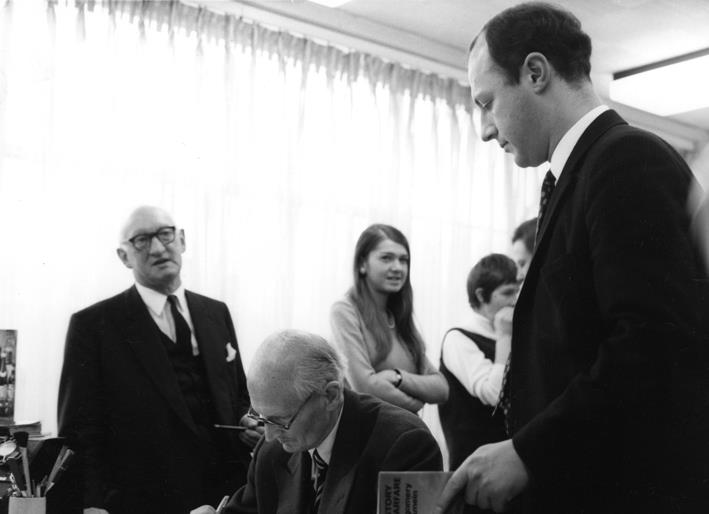
When Maxwell took control of AGB he made no immediate changes to the Board and it continued under the chairmanship of Bernard Audley, who had been one of its founders.
As one board meeting was proceeding, Maxwell entered the room silently and sat at the far end of the board table from Audley: a little disconcerting, I'm sure for any chairman. He never said a word until Audley's secretary entered the room and whispered in Bob's ear that there was a telephone call for him. He asked Audley if he might take it on the boardroom phone, which he did. The following one-sided conversation was heard: "Hello, hello, can you hear me? Hello, Hello, Hello - Is that the King of Jordan?"
Nobody did discover whether this was a put-up job or not. At the time it was thought to be true but Maxwell's subsequent history makes one rather doubtful.
Another story is of a pretty young trainee journalist who happened to meet Maxwell while waiting for the lift in the Mirror building (which incidentally had a helipad on the roof). He invited her to his office-cum-flat where she was seduced, literally with the promise of a journalistic promotion. A day or so later, not having heard anything from anybody, she decided to contact the personnel department to enquire and found herself out of a job (on Maxwell's instructions).
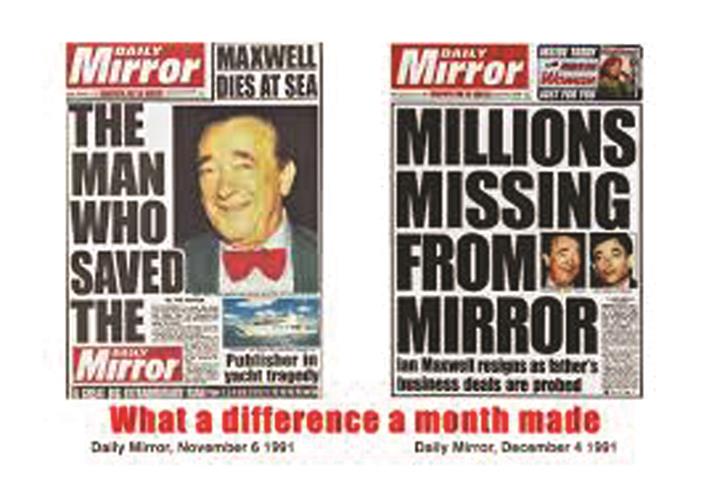
I have frequently been asked if I thought he had drowned or committed suicide, and of course I don't know for certain. His son Kevin said he was sure he had not committed suicide because "it was not in his character". But what was "in his character?"; and Kevin didn't exactly tell the truth in Court even though he was later cleared of fraud (before being declared bankrupt).
A friend of mine in Malta who had worked as a stewardess on the yacht Lady Ghislaine, told me that hers were horrible duties as Maxwell used to defacate in bed, and she and a colleague were required to clear up the mess. He also had a predilection for urinating in the nude over the side of his boat; and when his body was recovered off the Gran Canaria coast in November 1991, it was unclothed, which makes me think that it was unlikely to have been suicide.
With his warped mind, he probably would have been pleased that the mystery rumbles on
some 30 years later."
WC Humour
"....There is a family joke that once when Dad was not feeling well and consulted John Kiely, our family doctor, he was advised to produce a urine sample and take it to the hospital for analysis. Not being able to produce a suitable plastic bottle at home, he washed and used instead an empty whiskey bottle with its label still on which he then delivered to the hospital. Some days later he phoned the doctor to enquire if he had yet received the results of the test. On contacting the hospital to enquire about the delay, Dr Kiely was told that the whiskey bottle had been stolen from the laboratory.
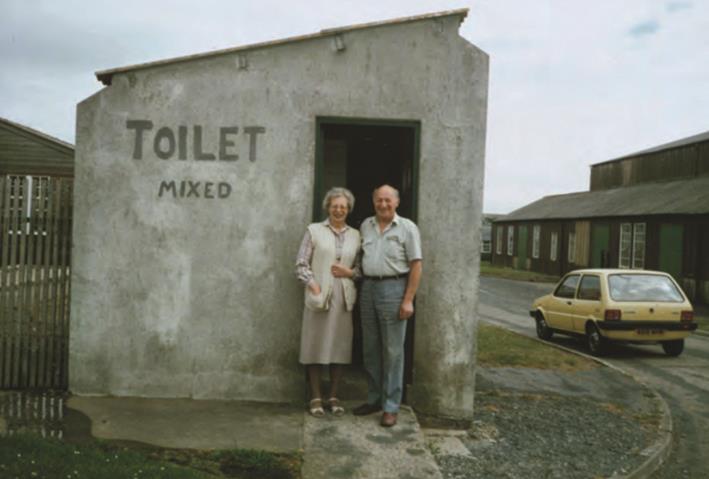
Jon Pertwee, the actor, told a story about when he was beginning his career in repertory theatre in the North of England and appeared in the same bill as Arthur Askey who was then at the end of his career and told him about an amusing incident many years before. When Askey was starting off he once stayed in digs in a Lancashire cotton town and bought a bottle of sherry which he kept in his bedroom wardrobe. Every evening he used to pore himself a glass of the stuff before going downstairs for his supper and onto the theatre. After a few days however, he noticed that the sherry in the bottle was going down at a faster rate than he was drinking it. So he decided to transfer the sherry to another bottle which he kept hidden in his suitcase and peed in the original bottle which he then placed back in the wardrobe. To his surprise he saw that the level of the bottle in the wardrobe went down just the same as before. Eventually his run in the town ended and he prepared to return home. Whilst paying the landlady and saying his goodbyes, she said 'I hope you didn't mind me taking a little bit of your sherry every day, Mr Askey. It wasn't for myself, of course, only to put glass or so in your trifle'.
Serendipitous Tales by David Elyan is produced by Lily Publications Ltd, PO Box 33, Ramsey, Isle of Man IM99 4LP. Telephone 01623 898446. Email [email protected]