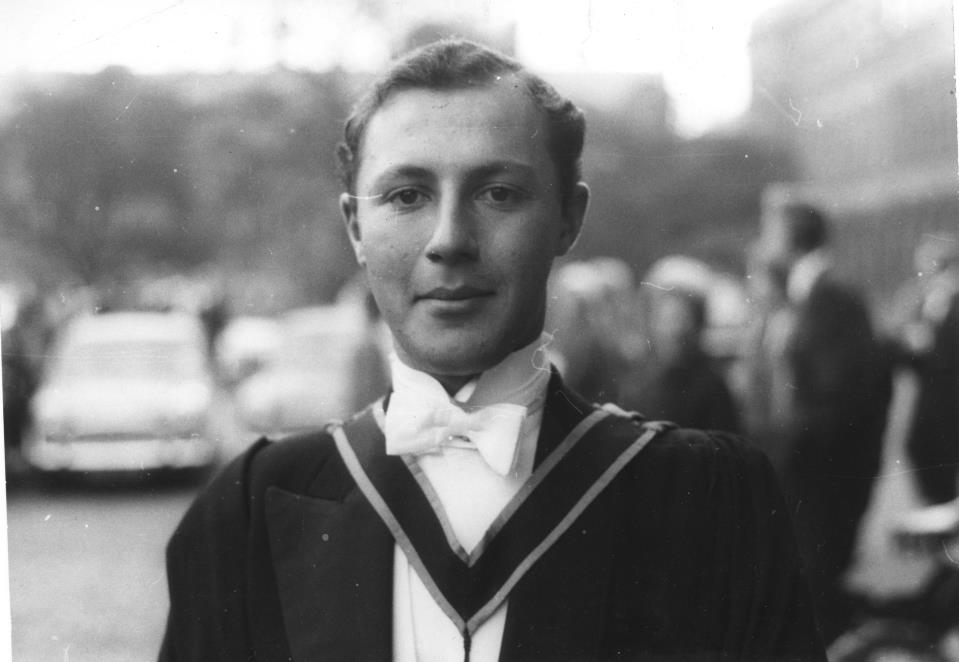
David was born in Cork in 1940 and is a graduate of Trinity College, Dublin. He has worked in publishing and market research and been a director of a number of investment and consultancy companies in Britain and abroad. He is a man of enormous culture, an avid book and art collector and was also a director of the Bankside Gallary in London and Chairman of the Friends of the Royal Academy of Music. He has donated books and works of art to Institutions in England, Ireland the Isle of Man and Malta.
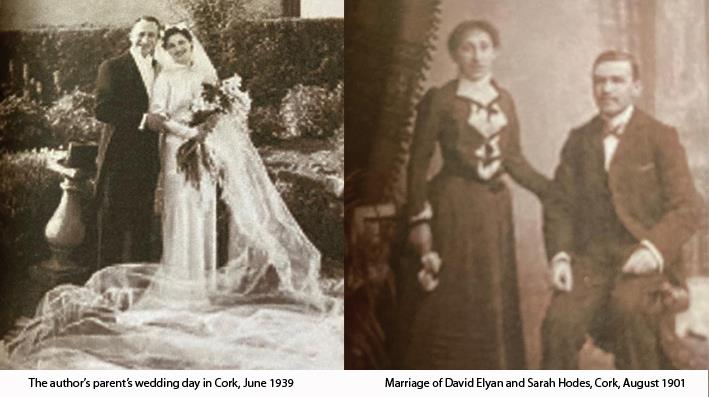
In his book, the author gives us the background of the Elyan side of the family. "According to family research - as far back as we can go - the family lived in Spain contentedly for some hundreds of years under Spanish and then Moorish rule. As the Moors were driven out and the Spanish returned to power, before long the presence of Jews and Moslems remaining in Spain was seen as a threat to the stability of the nation and led to the Spanish Inquisition of 1492. As Jews, life was never easy, particularly living in Ayllón in the province of Segovia, roughly half way between Madrid and Burgos, where I imagine the men would have farmed and studied the Talmud (Jewish law), while the women cooked, mended and helped with other tasks. At a time when very few people could read or write, the Jews were among the better educated in that they spoke two or three languages and could read and write them. Also they had learnt book-keeping or simple accounting from the Moors, so that their services were often in demand and a number of them rose to quite high positions in government. They were the first in Spain to produce wine, olive oil and textiles.
After 1492, however, life suddenly got very much more difficult when Jews were required to convert to Catholicism or, if possible, flee. The family managed somehow to continue living in Ayllón until the 16th century, presumably having changed religion as required - at least on the surface -whilst continuing as Jews in secret. Many did this and were called 'conversos' but God help them if they were found out: death and torture were certain, usually in the crullest possible way....."
David continues: "From Spain the family and others would have gone into France and onto Italy (Livorno) and Greece (Salonika) before ending up at the opposite end of Europe in the Moslem Ottoman Empire, which at the time welcomed Jews. In fact when the Ottomans had conquered Spain and a large part of Europe, Jews had lived relatively peacefully under their rule, and, as mentioned above, were permitted to occupy senior positions in government and in the professions.
Eventually they made their way to the Grand Duchy of Lithuania, which again at first welcomed Jews, although their activities there were very restricted. They were banned from the professions, universities and most occupations which is why so many of them had to engage in menial trade such as shoemaking or tailoring. Some 300 years later there were over 200,000 Jews in Lithuania and exceeding 300,000 in the Baltic countries overall, and by then, under Russian rule, antisemitism again became rife with, at first, occasional pogroms and then more frequent outbursts.
The Lithuanians and the Jews welcomed Napoleon when he led his troops there on their way to Moscow in 1812 and it is said that the Emperor consulted successors to the famed Vilna Gaon, the leading rabbi and sage, about their prospects. As Napoleon continued eastwards, the advice given must have been doubtful.
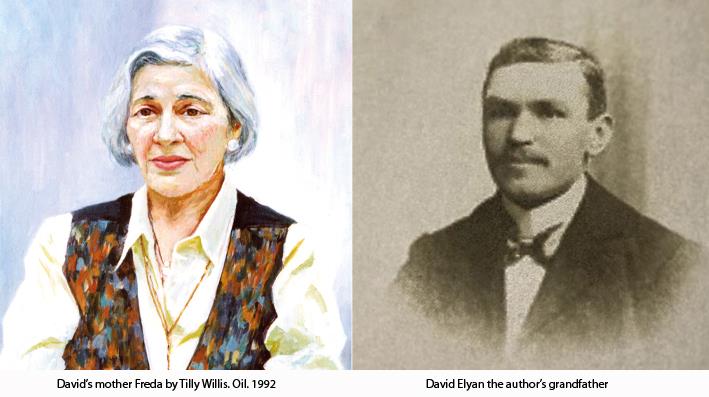
Later in the 19th century there were two major uprisings against the Russian oppressors which were savagely quelled by Czar Nicholas I and his son Alexander II, resulting in the closure of all Lithuanian newspapers and publishing houses in 1864. Towards the end of the 19th century the Jews realised that there was another world outside of the pale or in their case the ghetto, and it was called America. However, there was one problem: how to get there when you have no money. Some managed to pack up and got as far as the British Isles, where, since Cromwell's days Jews (but not Catholics) were almost welcome.
My great-grandfather who was married with some young children, decided to make the move in 1880 from the Lithuanian-Latvian border for New York. Though most others had left Lithuania intending to travel via Germany to USA, Canada or South Africa, they lacked the funds to go all the way and got as far as Britain, finding employment there and hoping eventually to carry on their journey to a new utopia.
The family name, up to this time moved from the Spanish to the Greek and then to the Russian alphabets before reverting back to "English" on reaching the British Isles. And on the way numerous variants appeared: Illion, Aelion, Elion, Eljon and some others, but they are all related, if somewhat distantly, to the Elyans.
Those who arrived in Salonika from 1500 onwards were again made welcome by the Ottoman governors of Macedonia, who were made up of a series of Turkish pashas, and they all prospered for a few hundred years.
While they did so, the original 20,000 who were invited to locate there grew steadily to 80,000, which was 50 percent of the total population; the other 50 percent made up equally of Christians and Moslems. It appears that these Jews never spoke much Greek or Turkish but continued to converse in Spanish and their own dialect of Ladino in their everyday life whether in banking or dockworking.
As my ancestors eventually moved on to the Grand Duchy of Lithuania, we became estranged to those that remained who were to experience great extremes of success and tragedy. Eventually the Greeks retook Macedonia and expelled the Turkish population in 1923/24, while their attitude to their Jewish neighbours was not quite so benign as under the Ottomans. Many left for Egypt, particularly Alexandria, where the family name was changed to Aghion (causing even more confusion to historians) though the family prospered in the cotton trade until the 1950s when Colonel Nassar seized power and overthrew the Egyptian monarchy. Not long before, the majority of the dock-workers in Salonika (by now called Thesaloniki) emigrated to Haifa in the new state of Israel established in 1948, and began to provide the same port-side services as they had done for centuries in Greece.
Those who stayed behind continued in the same occupations as previously - bakers, bankers, shopkeepers etc., though there was a slow but steady stream of emigration to the USA, Canada, Australia, Israel and other parts of Europe. Then in 1942 the Germans invaded Greece and proceeded to round up the 65,ooo remaining Jews. They had been told they were to be "rehoused" in Poland and were to be dispatched there by train at the rate of 2,000 per day so that all of them would be removed within one month. Believing this to be true, a number of the families went out to purchase new, warm clothing because it was going to be so much colder up in Scotland, whilst almost all of them left their house keys with neighbours until such time as they would be allowed to return home.
One relative I met in Thessaloniki in the spring of 2019, 94 year old Moshe ha-Elion, was despatched by train with his family to Poland and, on arrival in Auschwitz, he was then separated from his parents and siblings. He never saw them again and later discovered that they had all been sent to the gas chambers within days of their arrival.
According to the records at the museum in Thessaloniki, some 240 "Elyans", whatever the spelling, were sent northwards, never to return.
The story of Moshe's survival is a most remarkable tale in the face of adversity and is described in a book he has written. He still remains a considerable celebrity in Thessaloniki, and, despite his venerable age, he continues to be active, writing poetry, composing music and lecturing to students about his amazing experiences in the death camps."
A Maltese Goose Chase
At the end of a meeting of the Cartoon Art Trust (now the Cartoon Museum) in London in the Spring of 1988, I was approached by Diana Willis, one of the Founders of the Trust. 'I have heard' she said 'that you have recently acquired a house in Malta'. On confirming that this was in fact correct, she added that her father had died on the next-door island of Gozo in 1970.
Her father was none other than H.M. Bateman, the famous Australian-born cartoonist who drew for Punch, and many other publications, and probably was best known for his "The Man Who Series" which provided an insight into a pre-war British society obsessed with manners and observing conventions. In many of his cartoons he had displayed his distaste for income tax inspectors by making fun of them, so it was not surprising that when Malta introduced the six-pence-in-the-pound scheme after the War, Bateman became one of the early 'sixpenny settlers' as they were called and moved from England to Malta to benefit from the arrangement.
'When he died in 1970' said Diana Willis, 'the Malta-Gozo ferry refused to allow his remains to be transported to Malta on their vessel for burial. However, a very kind Fr Hili offered to convey the coffin on his boat and we were very grateful to him. 'I remember it being a very rough crossing in very bad weather, and only my sister and I, together with the priest, attended the burial.'
'Every year since then I have sent a Christmas card together with a small cheque to the man who looks after the cemetery but I have not heard from him over the years. We haven't been back to Malta ever since and I keep wondering if the grave is being looked after properly.'
'I wonder if you could pay a visit to the cemetery and have a look for us. I will give you the address even though I can't pronounce the name of the place.'
The name Ta'Braxia meant nothing to me even though I had driven past it any number of times on my way to Valletta, and I couldn't pronounce it either.
Having discovered its whereabouts, I drove there one morning only to find the gates firmly closed. I noticed that it wasn't open every day so I decided to call back again on the next 'open' day.
Arriving on the next open day I found the gates were again firmly locked and, on paying greater attention to the notice outside, saw that the cemetery was only open for a few hours on certain mornings.
At the third attempt the gates were wide open and after wandering around inside I eventually located the caretaker. To my consternation he had never heard of H.M. Bateman, and just as bad, had no idea where he might be buried. My heart sank as the cemetery seemed to go on forever (which I am sure was the intention when it was first opened).
He decided however, that if Bateman was an Englishman (much the same as an Australian to him, he must be buried 'over there'. So, over there I went in search of the grave. Walking up and down the rows for ages I eventually came across 'Henry Mayo Bateman 1887-1970'. The grave was so difficult to find because, as I discovered when I found it, the stone was not upright but flat and therefore much harder to spot.
The grave was well tended, so Diana Willis had no cause for concern, and I took some photographs for which she was most grateful on my return to England.
Some years later, Alan Keighley produced for Din l'Art Helwa, Malta's leading heritage society, an excellent and most useful booklet about the cemetery and made reference to the many well-known people buried there, but largely from a Maltese perspective, and he seemed to ignore Bateman.
A short while after the booklet's publication I met Alan at Andy and Jenny Welsh's home in Qrendi and said how sad I was that Bateman's name had been omitted. He expressed surprise. As he had drawn up a detailed plan of the cemetery, he did not believe Bateman's remains resided there - and he should know. Too true, but then didn't I have a photo of his grave?
We agreed to meet up at Ta'Braxia the following week and, when I arrived at the little office there, Alain was waiting to greet me. 'I owe you an apology' he said. 'I hadn't realised that Henry Mayo Bateman on my plan was the same as HM Bateman, the famous cartoonist'.
It is pleasing to be able to report that a new edition of the Visitor's Guide produced in 2010 made amends with a suitable entry for Bateman.
While the Guide contains a number of worthies well-known in Sweden (Gollcher) or in Russia (Princess Nathalie Poutiatine Tabone), it is my belief that the 'unknown' H.M. Bateman who was renowned internationally, is probably the most famous person there. And to think that I wouldn't have known had Diana Willis not asked me to do her a favour.
Diana died in the summer of 2010 and I wrote to her husband Dick to express my sympathy on the loss of a good friend and a founder and benefactor of the Cartoon Museum. Enclosed with my letter was the above unpublished piece about my "discovery" of HMB's grave.
Later, Diana's elder daughter Lucy, a well-known watercolourist, acknowledged my letter and said that the following May (2011) she hoped to pay her first visit to Malta while leading a group of amateur artists on a painting holiday and wondered if I would be there then.
Well, I was there and we did meet up. Lucy hoped during her trip to be able to visit some of the places that her grandfather had frequented and painted, and to obtain some local assistance in identifying the locations painted during his retirement years in Gozo.
Fortunately I was able to introduce Lucy to Marie Benoit who interviewed her in The Malta Independent on Sunday and was able to give her the names of some of the painted locations. Her brother, Joe Said, then Chairman of Malta Heritage, was able to supply the locations of the remainder.
In September 2013 Heritage Malta organised a splendid exhibition of Bateman's Gozo and Malta pictures, accompanied by an excellent catalogue. Simultaneously, the Cartoon Museum in London, displayed Bateman's famous cartoons, most of which came from their permanent collection, and the Curwen Gallary put on a show of Lucy's watercolours, resulting from her visit to Gozo. Not to be outdone, Malta Post produced a set of five stamps depicting three of Bateman's Gozo scenes and two of Edward Lear's from the Maltese national collections.
At last Bateman had received the credit he was long overdue."
Serendipitous Tales by David Elyan is produced by Lily Publications Ltd, PO Box 33, Ramsey, Isle of Man IM99 4LP. Telephone 01623 898446. Email
[email protected]