I cannot remember when I last went to a book launch. When Gordon Pisani of Kite publishers, sent me an invitation to attend the launch of their latest publication: Among others: The Maltese in Egypt: Life, Crime and Death - 1860s - 1923 by Michael Refalo I was happy to see that I was free on that day last month.
I have been to Egypt three times and loved it. My mother spoke of her sojourn there arriving on the P & O in those days and instilled in me the dream to visit ever since I was young. It sounded so exotic. The mother-in-law of one of my daughters is a Copt, born in Egypt, a lovely lady. One of my brothers-in-law worked with the U.N. there for many years. The ties are there, so I went to the book launch with pleasure.
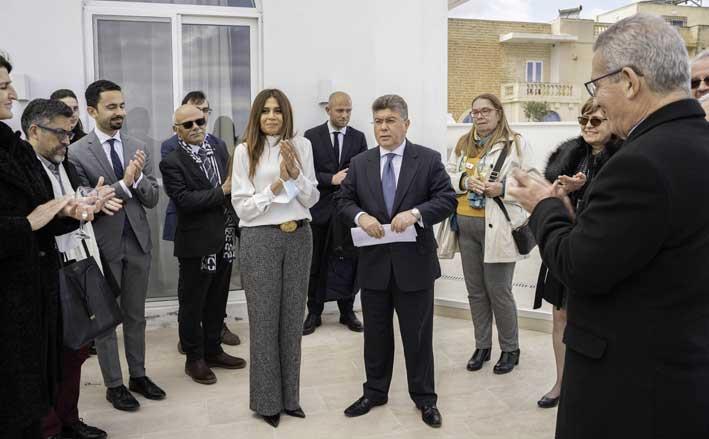
H.E. the Egyptian ambassador delivers his speech to guests
It was a small gathering, in the open air, by the swimming pool of the residence in Kappara. His Excellency the ambassador of Egypt to Malta Mr Khaded Anis and Madam Elashiry were hosting the event. H.E. said that this was the first function since he was appointed to Malta.
But who was the author, Michael Refalo? I knew it could not be the genial former minister of tourism as he had unfortunately passed away. Had he perhaps left a manuscript to be published posthumously? I was eventually introduced to the author who is a lawyer who practices as a notary. After reading law he returned to the University of Malta to read History and Philosophy obtaining a Ph.D in 2009. Moreover he had published a number of papers and books and in 2015, The Maltese Nineteenth Century Notary and his Archives won the National Book Prize. In short he is a scholar.
H.E.Yassine El Oued, ambassador of Tunisia to Malta and Madame El Oued were present as well as The Libyan ambassador H.E.Dr Saadun Suayeh and Mrs Suayeh. The then minister of Foreign Affairs, The Hon. Evarist Bartolo came a little later and said a few words mainly that he had met Maltese everywhere he had been, even in the most unlikely places.
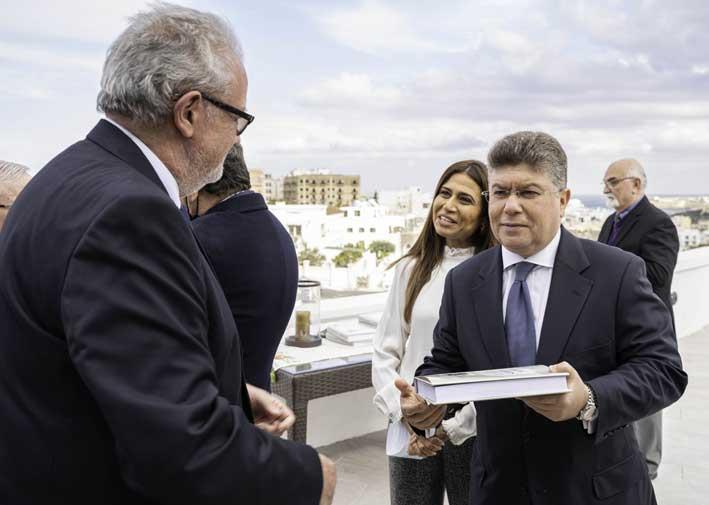
Dr Refalo presenting the Egyptian ambassador with a copy of his book. Madame Elashiry is on his right
The Egyptian ambassador was the first to deliver a speech and spoke about the relations between Malta and Egypt in the past, present and future.
The Egyptian Embassy in Malta was set up in 1972 but diplomatic relations had been set up earlier, in November 1965."Even before Dom Mintoff warned President Nasser about the Tripartite Aggression on Egypt in 1956; a step that was reciprocated by Nasser allowing Dom Mintoff to release short radio waves supporting the independence of Malta in 1962."
H.E. then recalled the exile of the Egyptian Leader Saad Zaghloul to Malta in 1919, "an event that led to the Revolution of 1919 against the British Occupation; the same year that witnessed Sette Giugno in Malta, and a year before the imprisonment of Manwel Dimech in Alexandria." He emphasized that Egypt is keen on bolstering its bilateral relations with Malta on all levels and in all sectors.
He recalled the cooperation a couple of years ago, through a Maltese expert, when he visited Egypt "to help in the preparation of a file on the Wadi El Natroun Monasteries to be registered as UNESCO World Heritage Sites, and he followed up on that by writing a remarkable article named Where Christ Walked which was published in Maltese newspapers."
I was to find out later that the expert was Ray Bondin and the interesting article appeared in The Times of Malta of 8 March 2020. It is about the fortress-like monasteries which have been cared for by Egypt's Coptic monks for centuries. When the Holy Family fled persecution and went to Egypt as the angel had told them to do, it is here halfway between Cairo and Alexandra, Wadi al Natroun, that they came.
Ten per cent of Egypt's population is Coptic. Unlike other countries where Christians and those of other religious denominations are often persecuted the current president of Egypt is doing his best to protect them and make sure they live an integrated, normal life.
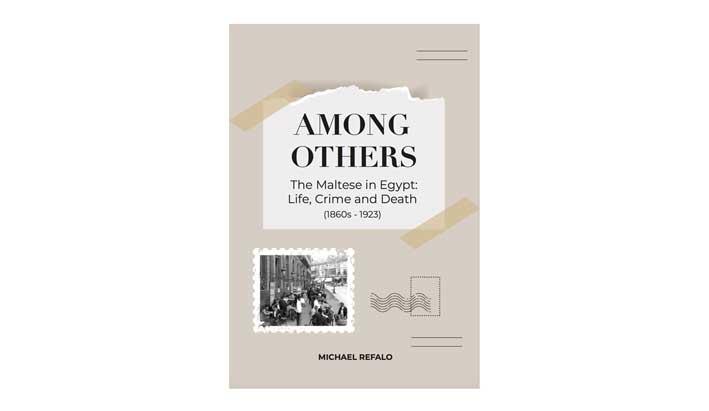
Dr Refalo then spoke about his research and his book about the Maltese in Cairo. This is a handsome and well documented tome with a bibliography, index and black and white illustrations. He focused attention on only one word: 'cosmopolitanism.' "The Oxford English Dictionary defines it as 'free from national limitations or prejudices.' However, within the nineteenth century Mediterranean context that word has acquired a more focussed meaning. It is frequently used in connection with cities such as Alexandria, Beirut, Izmir but is also used with reference to individuals. Alexandria, for example, during the period from the 1860s to the first decades of the 20th century has been celebrated as a cosmopolitan city. A cosmopolitan individual was usually resident in one of those cities (but not necessarily). It defined an individual who transcends the strictures of his birth - language, religion, customs - and merges effortlessly with other cosmopolitans. It is in this latter sense, I suspect, that the term is particularly useful. One example of such an individual was the British Consul in Cairo, Raphael (or Ralph, as commonly known) Borg. He had a Maltese surname and acknowledged Maltese law as his personal law in his last will. At the same time, he was a British subject (as all Maltese were), a Protestant, a member of a Masonic lodge, a philanthropist, multi-lingual, and enjoying friendships and acquaintances beyond the restricted circle of British-Maltese subjects: practically a non-Maltese Maltese! And yet, this is not all the cosmopolitanism which my book deals with.
Here, it should be premised that the majority of Maltese resident in Egypt were low level labourers, artisans, and petty traders. In the Egyptian environment, these Maltese mixed freely and, more or less pacifically, with local subjects, Greeks, Italians, Austrians, Syrians, Armenians, and others..."
He then commented on Egypt itself. "For most of the period covered by the book Egypt was under Britain's 'veiled protectorate,' as Lord Cromer called it. Nominally, however, the country formed part of the Turkish Empire and, one thing we tend to forget is that Empire afforded sanctuary to a multitude of Europeans - Maltese included - whether in search of work and opportunities, but also to escape persecution."
It was a happy time for those seeking work outside often dire economic conditions in their home country as viceroy Mohammed Ali and his successors, had set out to embellish Cairo and Alexandria. The construction of the Suez Canal in 1869, provided more opportunities. Merchants and traders often became rich in the cotton boom of the 1860s in particular. Then once the Suez Canal was built, after 1869, there was the transit of steamships which created more wealth.
Dr Refalo then went on to give two examples of successful Maltese in Egypt. "One, Roberto Stabile, a Maltese-British subject, has been described by historians as the richest British subject in Egypt during that period. On his death in 1914, his estate was valued at £130,000 (over £12m. in today's worth), this apart from land and houses in Alexandria. The second is the renowned merchant/explorer Gio Andrea Debono (d. 1870) who had extensive business interests in Egypt and the Sudan and freely engaged in commerce with Egyptians, Italians, Russians, and others ... another cosmopolitan."
Dr Refalo went on to tell us that not all were successful. Indeed, "Some entered Egypt poor and died poorer. However, an analysis of the wealth of the Maltese shows that, on average, they were relatively successful if not necessarily affluent... My book seeks to tell the story of these and others like them; those who were successful but also the others who scraped through, if that. It also tells the story of those others whose tendencies to violence, to crime, brought them to the attention of the judicial authorities; and through these last, to us.
As to further details about Egypt and about the deeds and misdeeds of the Maltese, I would invite you to read the book." Indeed, I am enjoying it but it's a slow read for it is far too heavy to read in bed.
I am constantly in awe of scholars who have the stamina to spend hours researching in archives near and far, to bring us books of this calibre.
[email protected]