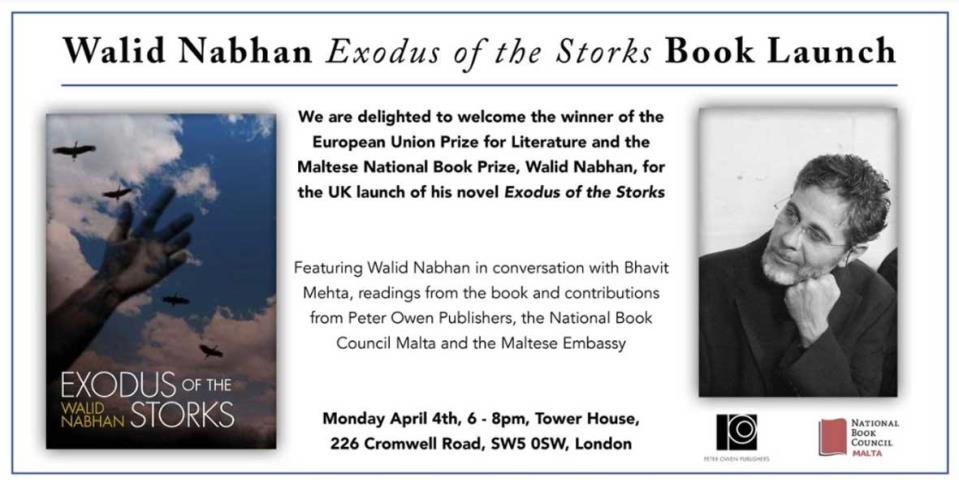
Every time I am asked to write something about myself, I immediately come face to face with the other half of my life which I lived in Jordan, where I was born and spent my influential years. Many of the places and people I remember don't exist any longer. This certainly triggers a sensation of sadness and loss which I never expected when I arrived in Malta in 1990.
I was born in 1966 to Palestinian parents from Hebron who ended up refugees in Jordan after the Arab defeat in 1948 which resulted in the establishment of Israel on the ruins of Palestinian towns and villages. This dreadful loss which had been named later 'The Catastrophe' left a hefty and gloomy effect on our entire life.
The first time I left Jordan was for former Yugoslavia. I was barely 18. After two years of civil engineering, I realized that this was not what I wanted. I quitted and went back to Amman only to smash my father's wish to see me an engineer. Perhaps I did it on purpose as retaliation because he deprived me from studying journalism at the University of Jordan. By that time, my mother was long gone. I was seven when she left, in complete silence.
As counter retaliation my father sent me to join the army for two years. This military service was obligatory unless you were studying. I was sent in the middle of the desert, but those two years proved later to be the most important phase of my life. It's there that I learnt everything about life.
After the military service I came to Malta and enrolled in Medical Laboratory Technology and kept learning until I gained a Master's degree in biomedical sciences.
Then there was the big encounter with the Maltese language. Stranger for me as an author to be, was the sense I experienced while trying to translate memories that had not only happened in a remote part of the world, but also in a different language.
It took me a while to realize that everyone lives life in a given language. I can't claim that the first split in my life was between Arabic, my native language, and English, because I was poorly exposed to English in my childhood. Building on that little was a truly complicated and very difficult task. The real dichotomy was between Arabic and Maltese, though they are cousins and perhaps much more.
Similarity between languages sometimes makes things more confusing and vexing. For instance, 'Ħafna' in Maltese means a lot whilst in Arabic the word means very little; also, it is very hard to explain in Maltese the actual wording that Arabic uses to differentiate between maternal and paternal uncles; I had to render that in one way or another. In later years, during the translation process, I had to contact the author to inquire about this matter.
After all those years I have come to question which language is mine beyond any doubt whether it is Arabic or Maltese. What I do know, however, is that the two have featured together in my life, one echoing the other, sometimes ironically, sometimes nostalgically, and most often to correct each other.
Along with language, geography, especially in the form of farewells, departures, homesickness, and nostalgia together form the core of my memories. Each place I lived in, Jordan, former Yugoslavia, England, Malta, Sweden, had a complicated and intense influence on my growing up, achieving an identity, and forming a perception of myself and of others. Therefore, there was an imperious need to bridge the distance of time and space between my new life and my life then. I am mentioning this as a matter of fact, not to indulge or go deep into it, but just to say that it resulted in a certain detachment and irony of attitude every time I try to reconstruct the distant time and experiences.
Since I arrived in Malta, I have retained some sense of unsettled multiple identities, mostly in conflict with each other. Also, the travail of bearing an Arab name is an equally bewildering quandary when it comes to identity and culture. Every time I mention my name to someone who doesn't know me his first reaction would be 'What?' Perhaps because I look perfectly Maltese, and this has helped a great deal for me to integrate in my new home among my new people.
Sometimes I feel myself as an agglomeration of flowing tides. I prefer this rather than to have a rigid self, the identity to which so many bind a lot of significance. These tides, like the themes of one's life, flow along during the stirring hours, and they require no reconciliation, no harmonizing, and no apologies.