I have known Darren Tanti for quite some years now and I remember the first works being created for this massive project - tackling the (unfortunately) current topic of war - around four years ago.

The opportunity for the perfect location came along, that of the incredible space at Spazju Kreattiv, to be exact, all of Space C. But it did not end there. In fact, this might be the first time ever that a solo exhibition takes place over two venues at the same time, as the exhibition continues (or starts) at il-Kamra ta' Fuq in Mqabba. I still remember my jaw dropping when Darren asked me to curate this exhibition for him, not only at my little nest in Mqabba but also at the overwhelming space of Spazju Kreattiv.


It was no small venture. A substantial part of the artworks was ready, but such a project requires funds. Sleepless nights working on the application for the Project Support Grant for Arts Council Malta were fruitful as well as the great opportunity to collaborate with Spazju Kreattiv.
This project is meant to shed light on the mediatic processes utilised to spread information about war and its effects on the viewer as most of us are experiencing war almost every day, not first-hand but from the comfort of our homes.
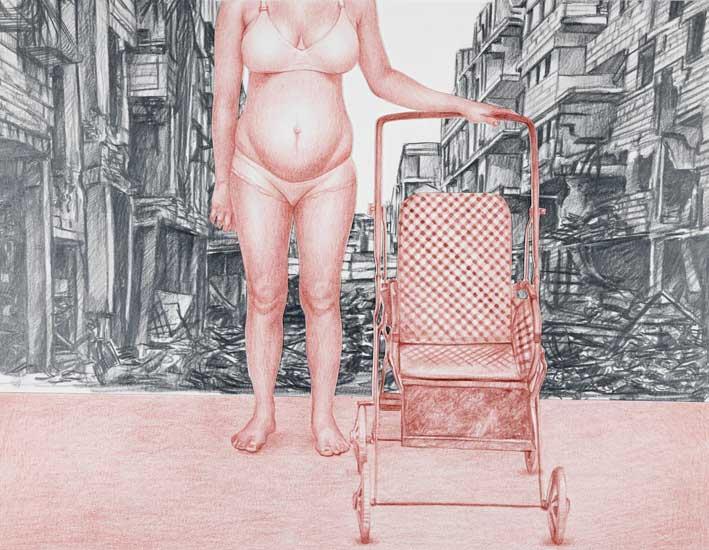
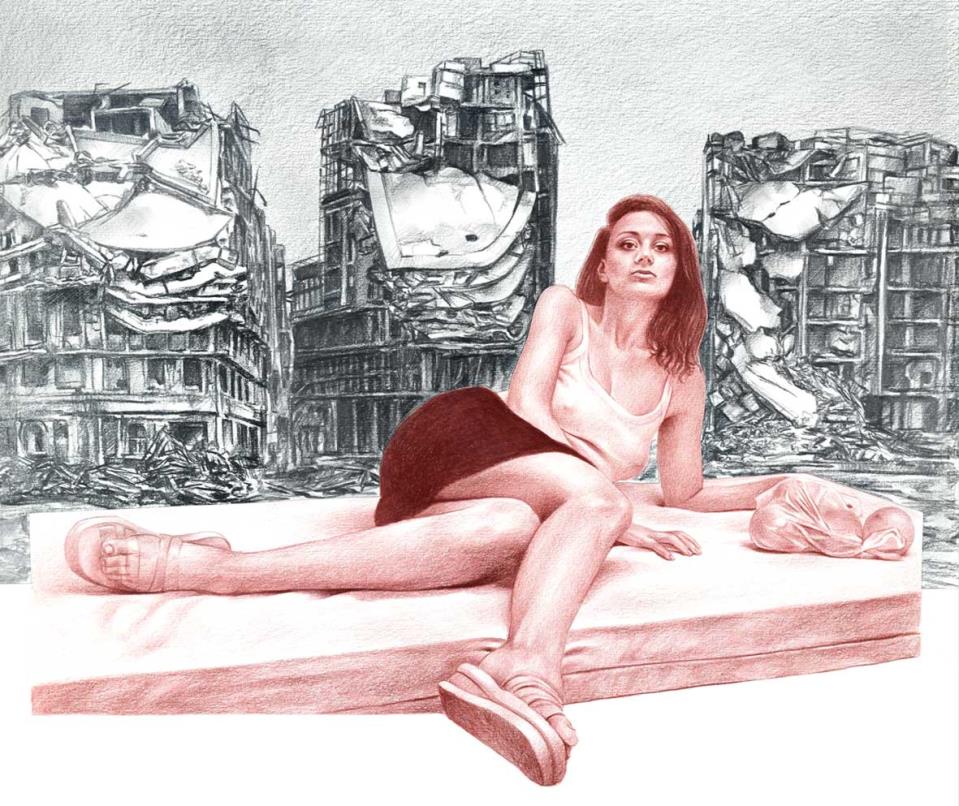
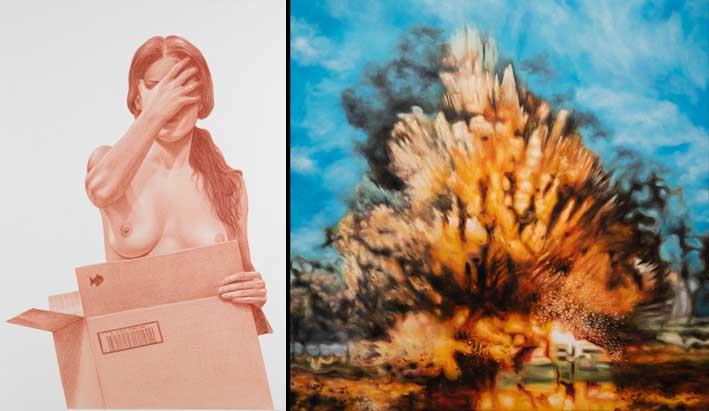
The work in an array of media - paintings, drawing, sculpture, installation, interactive works, textile and video - is a reflection of the artist's preoccupation with fabrication, editing and twisting of information that people outside the conflict zone might be subjected to. The dangers arising from this are very serious as they might severely impact public opinion on matters of humanitarian aid and military intervention based on falsities or half-truths. The artist has no solution, but the project is meant to provoke viewers by a number of analytical, ironic, and at times, cynical works based on factual, fictional images and theoretical work.

The curation for this project was not an easy feat, but I feel we managed to achieve what we had in mind. At Spazju Kreattiv we decided to make use of the separate rooms and try to replicate the comfort of home in most of the rooms, to imitate even more the daily life and how we are inundated with information. On the other hand, at il-Kamra ta' Fuq we wanted to remove the homely feel and instead have a room with an almost clinical feel.
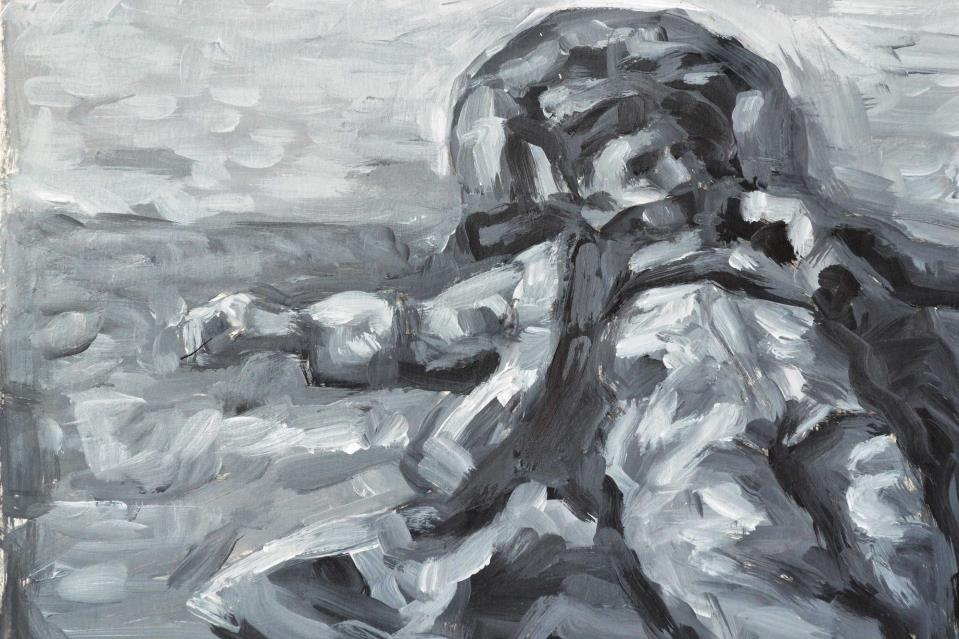
The first room at Spazju Kreattiv is showing an inviting living room where the spectacularity of war is the highlight. The room is dedicated to the fragility of the human body and the devastating power of war technology. The artworks displayed in this room are ironic and cynical with the aim of exposing in a hyper-realistic style the absurdity of humanity's attempt to control insane power.
The emphasis on the spectacularity is meant to be a provocation. It plays on the popular use of the word "spectacular" as something beautiful and amusing. The term is used in the Debordian understanding of the spectacle. Here, a mixture of cinematic explosions, video game graphics, music video snippets and real-world video footage were integrated. And yes, we are urging visitors to sit down, relax and take selfies.

We then move to the "study-room". This room introduces hybrid artworks - digital projections, paintings and drawings. This area is aimed at emphasising the manipulation of data, where the visitors are urged to interact and manipulate two of Tanti's artworks by projecting images onto these artworks via a custom-made editing software developed by Justin Azzopardi. The chosen setup is that of a study room, to make the visitor feel more at ease and at home while sitting at a desk and using a laptop. The manipulated images can also be printed on-site. This technology was already used by Tanti in the Ostrale Biennale in Dresden but was never exhibited in Malta before.
The editing, fabrication and manipulation of data is being emphasised in what we are calling the Sewing Room, which is mimicking both the editing room of major news agencies and a room at home dedicated to sewing.
A body is wrapped in fabric - a piece of textile fabric coming out of a sewing machine. The textile is portraying an obsessive repetition of worldwide logos of the major news agencies, a design created by Tanti. The corpse is representing the passive viewer engulfed in all the news feeds. The main hyperrealist painting in this room is portraying me, the curator, as in theory (and practice) I am an editor - the editor of this project.
The sculptures in this section tackle the absurdities of violence, war and unethical and excessive bombardment of media, which is mirrored in the series of sculptures, the "empty shells" - empty shells from guns. In the video artworks, one may find satirical and cynical reflections inspired by the artists' realization that mass media and manipulated news are as dangerous as the conflict itself.
In the last two rooms, the narrative takes a twist to what can be perceived as nightmares and a more realistic truth concerned with emotions. The artworks in this room question the hyperreal "clarity" of the previous rooms and allow for more expressive and abstract art.
The abstractions are artworks that encapsulate the dark anxieties felt by the artist. The dread associated with powerlessness and doom that news of war leaves in his psyche. These works break away from the realist figurative style that the artist is usually associated with and delve into abstract forms that are more concerned with the actual emotion rather than its representation.
Most of these works were executed in tandem with the large hyper-realist works, which reflect the state of mind and preoccupation of the artist while working on and reproducing "absurdities" and at the same time being affected by war news and real war footage.
The last room continues on the theme of the first bedroom but focuses on children and the innocent. The bedroom is in a state of how one may perceive a children's room in a warzone and in a state of fleeing and abandonment.
The reality of the situation is emphasised again by the hyper-realism of the main artwork, but the surreality of it all (for us not experiencing the actual situation) is then triggered by the fact that the artwork presented is in fact a digital reproduction print of the actual collaged drawing which highlights the frequent sad preference for the "unreal" over the "real" experiences.
To top it up, at Spazju Kreattiv there will be a series of discussions along with exhibition tours. Different experts from journalism, film, art, education and the military fields will also contribute to the project in a number of talks, workshops and catalogue essays.

And what to expect at il-Kamra ta' Fuq?
The editing has been taken to another level at il-Kamra ta' Fuq, where a room has been fabricated into the actual exhibition room thus creating a bubble or cocoon of an avalanche of real and unreal data - displayed as sculptures, real paintings, digital paintings and video clips, all blurring the line from what is real and what is not.
The artworks are surrounding video pieces which simulate real experiences of when one is constantly being bombarded by advertisements and mundane frivolities which when seen in the context of watching war-related news, becomes an absurdity.
Most of the artworks are the first thoughts, studies and visual responses made by the artist vis-à-vis the project. These studies are meant to show the initial creative processes that eventually developed in the larger artworks which are on show at Spazju Kreattiv, but not only.
This creates a link between the two spaces and the experience of viewing one space alone isn't enough to understand the whole project.
The exhibition catalogue will be launched on 23 November at 7pm at Spazju Kreattiv.
The project is in collaboration with Spazju Kreattiv and is supported by Arts Council Malta through the Project Support Scheme.
Follow on FB: Inaction is a weapon of mass destruction; Instagram: @i.w.m.d.2022