I have attended two or three of these ceremonies at San Anton over the years. The speeches are generally touching and inevitably make one reflect.
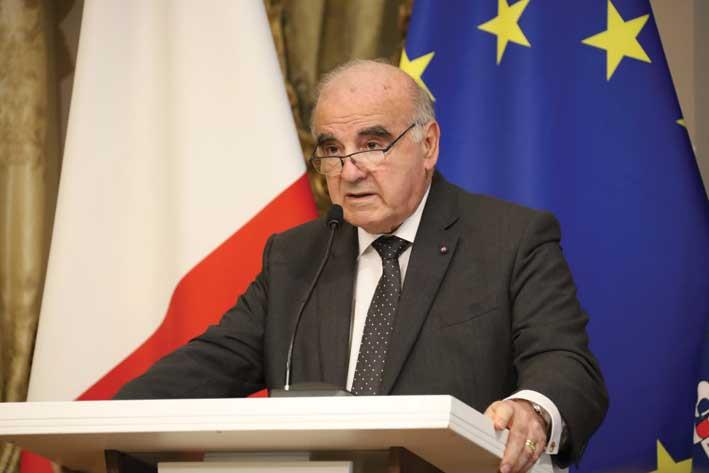
On 26th January, our President, Dr George Vella in his speech gave us several points to ponder. Year in and year out, he told us, we gather "with sad souls and deep emotions" to commemorate the world's worse ever recorded deliberate mass killing of civilians. It was part of a bigger plan of world domination by a regime that had ideas of superiority and had become obsessed with power." His Excellency showed empathy and compassion towards the innocent millions that were needlessly killed and stressed that we must go on celebrating Remembrance Day. However the main thrust of his speech was that mankind has not learnt its lesson. Man's inhumanity to man persists. "Repeatedly on every Remembrance Day, we solemnly proclaim that we will do everything to keep these memories alive, and do all in our power to see that such barbaric and horrendous atrocities will never happen again. My question to you here is: Is that enough?"He invited the audience to reflect on what has been achieved and on whether humanity has learnt any lessons from the holocaust. He expressed his doubts.
"As I look around me, 80 years after the Shoah, I still see a mentality of death and subjugation; I see traits of policies that came together at that moment in time to bring about the extermination of so many millions of innocent people, still being practiced and implemented around the globe with little or no shame or remorse, justified through domestic legislation and diplomatic allegiances.
The biggest and most deplorable fact during the Holocaust was how humans were treated as numbers, deprived of all respect, identity, and basic human rights.
Today unfortunately, some human beings continue to face these atrocities, albeit not in such large numbers together.
The ideology that certain people are superior to others still exists. Whether we admit it or not, this is at the basis of racism, xenophobia, discrimination, and apartheid.
With hand on heart, can we honestly see any iota of respect to human dignity in white slavery? In human trafficking? Or in drug trafficking where vulnerable human beings are literally disparagingly dehumanized and referred to as animals by being called 'mules'?
Millions of unborn babies are killed before they ever have the chance to see the light of day."
Others, he continued, also in their millions, are living in the most abject of conditions... The irony of all this is that, in many cases, such deprivation is experienced by people who are living in countries rich in resources, which unfortunately are exploited by multinational business interests, and the politics of greed, leaving the local inhabitants in poverty and desperation." He referred to refugees and their plight, the millions displaced by regional strife and conflicts "where displacement of whole populations follows wars encouraged by the procurements of arms, armaments and ammunition, supplied by an arms producing industry, on which whole national economies depend.
This is the industry that gobbles down billions and billions of dollars worldwide... dollars that could well be used to relieve poverty, provide better health and education, and help achieve in a shorter period of time the objectives of the UN Sustainable Development Goals 2030... dollars that if diverted towards development, could help us prove that we have really learnt the lesson to respect human dignity and treat all human being as equals.
However, we should also, as from now, reflect and raise our voices on the ongoing suffering of the unfortunate millions who become victims of the politics of division and the machine of war, and who fall within the categories of the disenfranchised, the poor and the forgotten I referred to in my reflection today.
If we do not do it now, who will be organizing a Remembrance Day for these people in the future?
Segregation through political and legal means, and the use of dehumanizing language and policies erecting mental and physical demarcations between 'us' and 'them', continue to be at the root of human suffering and injustice.
Despite the repeated commitments and all the agreements signed in multilateral political fora, such as the United Nations, inequality and atrocities continue to be the order of the day...We should denounce the politics of division, and instead promote the politics of peace, dialogue, and inclusion."
It is difficult to do justice to our President's speech in such a restricted space but it was thought provoking. It was moving.
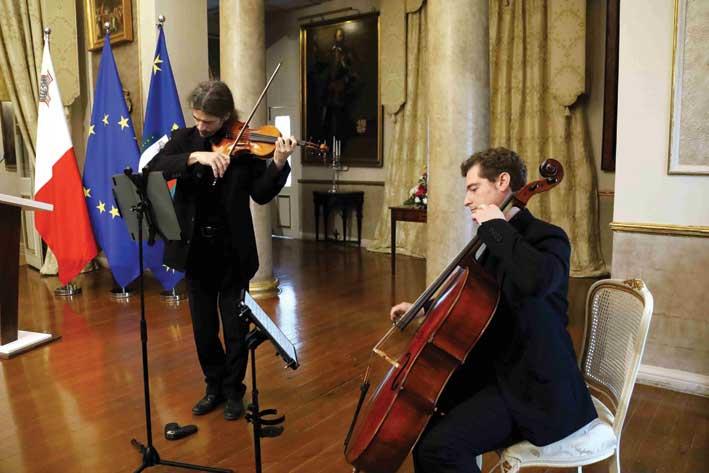
The choice of music too was appropriate. Jacob Portelli on the violincello and violinist David Lang, a member of Jacob's Cordia String Quartet played Remembrances and Theme from Schindler's List composed by John Williams.
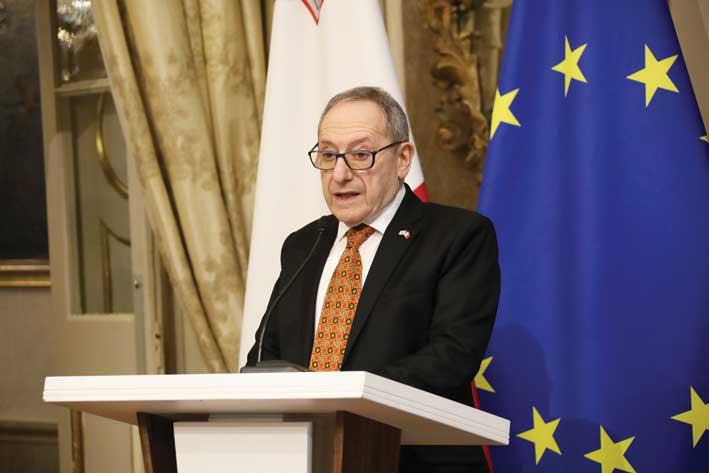
Ambassador of the Federal Republic of Germany Walter Haßmann stood on the podium to speak and made two important points: "We must take a stand against antisemitism and all other forms of hate and racism through education and prevention, but also through swift and efficient prosecution whenever necessary," His Excellency said. He emphasised that younger generations "have to cope with the knowledge that it was their grandfathers and other relatives who were responsible for all this or at least did not stop it from happening. Remembrance should not perpetuate a guilt complex. However, we, including the younger generations, will continue to shoulder our responsibility to ensure "Never again!"
Julius Nehorai Chairman, Tayar Foundation for Jewish Heritage in Malta mentioned the exhibition organised in collaboration with Yad Vashem in Israel now making its rounds on the island. He explained that Yad Vashem means 'a memorial' in Hebrew. This organisation conducts research with the aim of preventing such an atrocity from ever occurring again to any people. Yad Vashem's vision is to convey the history of this singular Jewish and human tragedy worldwide.
Mr Nehorai then went on to tell us something about Yad Vashem and the work it is doing. He reminded us that "one of Yad Vashem's core goals is to recognise non-Jews who, at the risk of their and their families' lives, without a financial or evangelistic motive, chose to save Jews from the atrocities of the holocaust. Those recognized are honoured in a section of Yad Vashem known as the Garden of the Righteous Among the Nations. I'm sure many will remember the movie Schindler's List. Schindler was recognised for saving some 1,200 Jews from the Nazis. Approximately 28,000 people from 51 countries have been recognised as Righteous among the Nations. Yad Vashem is the second-most-visited Israeli tourist site." Mr Nehorai then went on to relate the touching story of Sandra Saliba who was in the audience with her son.
"Sandra married a Maltese gentleman and came to live here from her native Poland. Her grandmother, who was brought up as a Catholic knew that in the war as a baby, she had been left on the doorstep of people who took her in and eventually adopted her. Many years later Sandra encouraged her 80 year-old grandmother to take a DNA test which showed that she was over 99% Jewish. The test revealed she had a sister who lived only 200 miles away. She had also been left on a doorstep and had been adopted. They are now happily reunited. They look alike, they dress alike and they have the same interests. It is more than likely they are twins but there is no official record of their birth to prove it. The sisters were found at the time the Jews in the Ghettos were being exterminated. The likelihood is their parents' heroic but tragically desperate act, in abandoning their children forever, saved their lives."
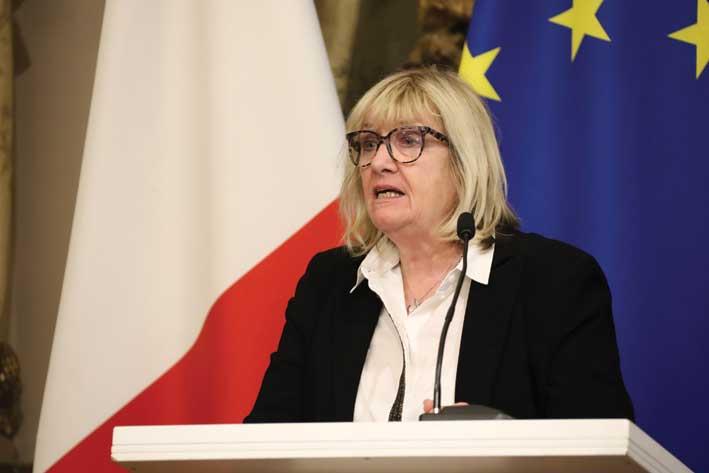
Dr Juliane Wetzel, holocaust and anti semitism expert from Germany and Professor of Jewish Studies, spoke of the importance of educating children about the holocaust.
The Minister of Foreign Affairs, Ian Borg too spoke about the holocaust.
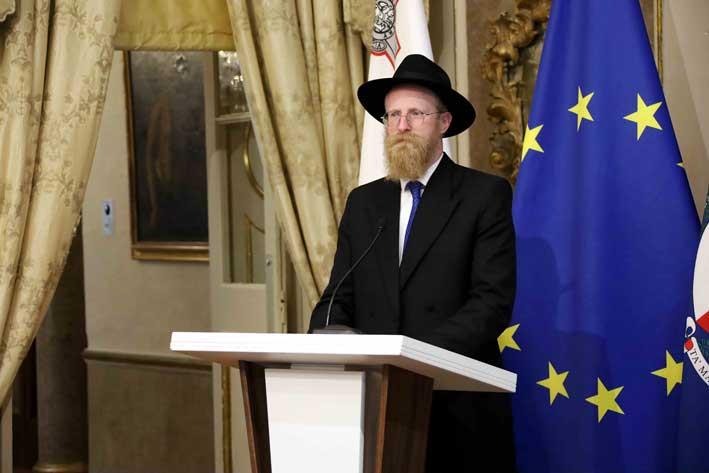
Rabbi Chaim Segal said a special prayer, the Kel Maleh rahamim, a prayer for the soul of the departed, in this case for the souls that perished during the holocaust.
As I caught a glimpse of the Ambassador to Italy a favourite book later turned into a film came to mind: Il Giardino dei Finzi-Contini by Giorgio Bassani, the film by De Sica. It is on You Tube. The sadness of it all. Never again? Just look around you. What are we going to do about stopping all this misery and man's inhumanity to man?