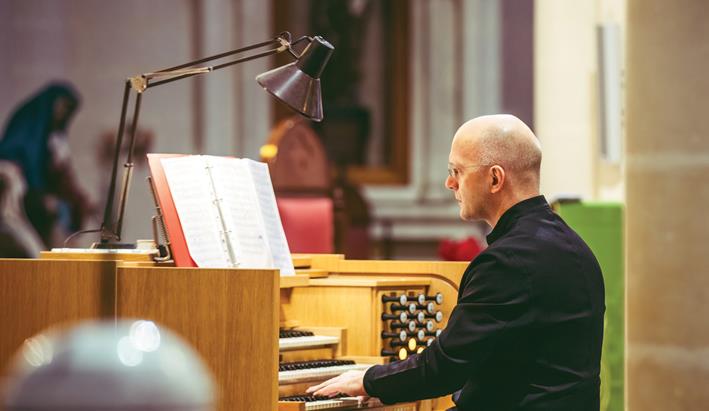
Let me say a few words about the last concert of the Baroque Festival that I attended. Hansgjörg Albrecht the organist was the star that evening at the Karmnu church in St Julian's where the audience was offered blankets to keep them warm on that cold and windy day.
The applause that evening was most definitely for Albrecht's performance and not so much the music.
I was in the front row and I had never before been so close to an organ and organist. It was a revelation to watch this extraordinary musician and the leg and body work involved to produce such beautiful sounds. Kenneth Zammit Tabona described it as follows: "It is like flying a jumbo jet singlehanded. Attempting the Handel Royal Firework Music and Vivaldi's Four Seasons was brave simply because they are both works an audience would know backwards however the transcriptions showed Albrecht to be a true virtuoso. As is customary for organists the encore was an improvisation on a Maltese cantilena theme which was given to him a few minutes before the concert."
I have to say I have little time for transcriptions and reinventing this and that. On the whole I would rather listen to the original pieces but I would listen again to this gifted musician no matter what he played.
Last month the Mediterranean Conference Centre was filled to capacity for the Romanic Tales concert held a few days before the commercially inspired Valentine's Day. On these popular occasions many of us go by taxi. It is easier on the nerves and we arrive in a good mood and not worn out trying to find a parking place.
The concert started with Suite on Estonian Dances by Eduard Tubin (1905-82). I had never come across Tubin or his music but there is much of interest in it to reward the listener. It was enjoyable music.
The main attraction that evening was Rahmaninoff's Rhapsody on a theme by Paganini, one of the best loved of Rahmaninoff's works. It is essentially a set of 24 variations on the theme of the famous A minor Caprice No 24 for solo violin by Niccolò Paganini. Intertwined with his recognisable melody is a fragment from the Dies Irae from the plainchant Mass for the dead which first appears in Variation No 7.
Although remembered chiefly as a composer during his lifetime Rahmaninoff was renowned as a virtuoso pianist, famous for the precision, clarity, drive and smoothness of his playing. He was also a conductor notably in opera for two seasons of the Bolshoi Theatre. He was born into hard-up nobility and experienced complex feelings towards his motherland: he went into permanent exile after the revolution and died in Beverly Hills. Just as Puccini is the successor of Verdi, Rachmnaninoff is the successor of Tchaikovsky. A lesser figure but one of unique value.
The Rhapsody is one of those works whose familiarity is never wearisome.
"Some pianists say they are the slaves of their instrument," Rachmaninoff told a reporter in 1933. If I am its slave, all I can say is - I have a very kind master." Two hours a day is all the practice he needed to stay in top form. Composing however was a different matter - Rachmaninoff could never seem to find as much uninterrupted time as he needed. As he wrote to a friend in 1907: "Today I worked only from 9am to 12.30 and then lunch. And now I write to you instead of working. I have one free hour and then an hour's walk, then two hours practice and then I retire with the chickens. Thus I have only four hours a day for composition. Too little!"
If you're a fan of great Russian romantic music then you will love this piece and are probably already well acquainted with it. Russia is not only Putin. It is Pushkin, Pasternak, Prokofiev, Popov and so many more musicians, artists, writers. I am an admirer of this great nation which has fallen victim to a heartless politician. But then who am I to judge?
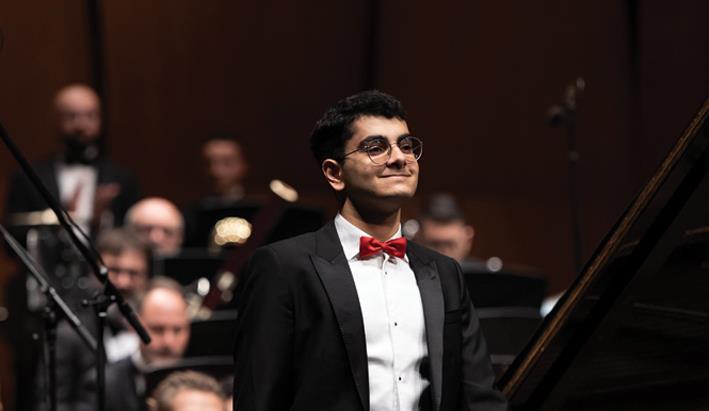
At the piano was the young Dmitry Ishkanov who has fleet fingers. I remember going to a concert at San Anton Palace when he was about 11-years-old. This, when Marie Louise Coleiro Preca was president and regularly held musical evenings there.
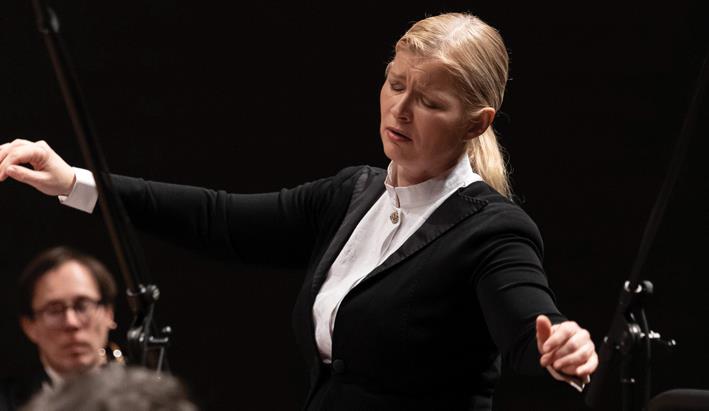
Dmitry made an excellent foil to the playing of the Malta Philharmonic Orchestra, equally lyrical and controlled, this was a passionately Slavic interpretation. The orchestra which has made such enormous progress since I first heard it some thirty-three years ago, was conducted by Anu Tali who doesn't lack adrenalin and has plenty of flair. One felt she loved every bar of the score, was in full control and although of small stature, easily identifiable by her blonde hair and her very active baton.
There was beautiful music throughout but especially the lyrical Variation 18, the thematic foundation, the heart of the matter of this Rhapsody.
The young musician rewarded the audience which pressed a button for an encore, with a Chopin piece, I forget which. Sheer carelessness on my part but then it did happen almost a month ago.
As far as I am concerned Chopin is always beautiful and the pianist deserved every single one of those flowers with which he was presented.
After the interval we were entertained with Antonin Dvořák's Symphony No 8. Dvořák was the first Bohemian composer to achieve worldwide recognition. He turned folk material into the language of 19th century Romantic music. One of 14 children, he himself had six. What immediately comes to mind at the mention of this composer is the film Driving Miss Daisy in which Dvořák's Song to the Moon from his opera Rusalka was used. I love most of his Slovenic dances, too. I still have the scores for piano which my father had asked someone in Czeckoslovakia to send him, hoping I suppose, that one of us would one day play them on the piano. I hope he is not too disappointed.
At the risk of being lynched I wish to say that I much prefer Symphony No 8 to the more famous No 9, New World Symphony. No 8 is full of the joys of spring. It is a glorious work that puts a smile on our faces. The orchestra and conductor brought out the energy, immense vitality and expressive lyricism of the four movements. It sounded wonderful throughout and almost made me cry. I came away from the MCC in a very good mood.
At home that weekend, I played the whole programme all over again... and again. My neighbours must be bored to tears.