Esprit Barthet: A life of colour is currently being held at Il-Ħaġar Museum in Victoria, until 28 May. This exhibition offers Gozo residents and visitors a rare opportunity to see a large collection of this esteemed artist's work and gives an interesting cross-section of his subjects and styles over five decades, the second half of the 20th century. It was a period of great change in the Maltese art scene and one in which Barthet was pivotal: alongside his contemporaries Antoine Camilleri and Emvin Cremona, he broke with tradition thus influencing Maltese contemporary art both with his wide-ranging work and as a teacher. The exhibition is an exploration of his legacy and a fascinating insight into the evolution of and diversity within his artistic practice which drew on the art of artists worldwide and in Europe in particular.

Chosen and curated by Nicoline Sagona, the exhibition includes 58 paintings including portraits, still life paintings, figurative and abstracted works. Only one piece is painted by another artist: a small portrait of Barthet as a young man by Frank Borg. It's this picture which opens the show and it's a lovely touch to begin a tour by "meeting" the man who the exhibition celebrates. It's the first of several pictures of Barthet, the others painted as self-portraits and the last of which shows a much older man in a more contemporary style. The "journey" travelled between the two is reflected throughout the exhibition.
The exhibition includes a selection of Barthet's portraits including both those in the more formal style of the earlier half of the 19th century and that of Mari tal-Bajd (1975) which he considered to be his best. It shows the woman who sold eggs and vegetables to his family at their summer residence rendered with expression and texture, for which he used a palette knife. This focus on a local character, showing her careworn hands and the value of honest work, was unusual and gives an insight into Barthet himself: Barthet made a good income from portraiture which needed to conform to convention, but because this was not a commissioned piece, he had the freedom to present her as he saw fit. Her tired dignity and direct stare against a brilliant turquoise-blue are depicted in a style influenced by those of Vincent Van Gogh and Paul Cezanne in particular whose colourist approach resonated strongly with Barthet.
It wasn't until the late 1950s - and particularly the period 1959-1960 when he spent time in England - that Barthet embraced modern styles of painting. The exhibition at Il-Haġar, is largely divided so that various categories of subject hang together. It's easy, therefore, to compare older and newer pieces and Barthet's versatility.
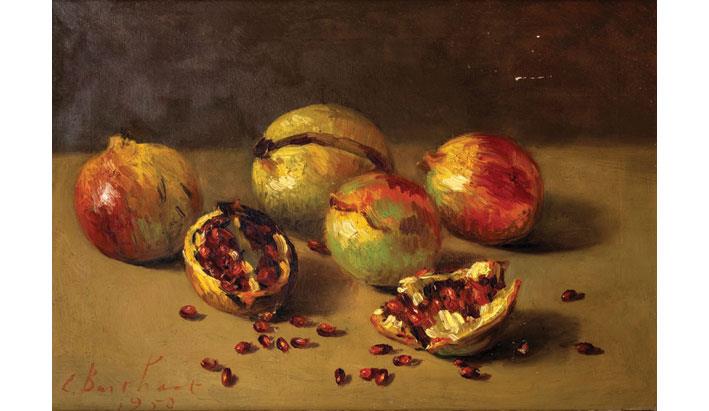
Barthet saw still life as basis of all art, regarding each painting as a construction and used them to teach perspective and proportion. Despite this, the difference between Still Life with Poinsettias and Copper Pots (1953) and Leaves and Branches (1959), which hang alongside one another is stark, and the neighbouring piece Abstracted Collage (1960) gives a hint of later Barthet's constructivism pieces which hang on the floor above. There's an equally broad range of styles in evidence there on a wall of nudes, bathers and dancers where the realism of Sitting Female Nude (1981) with her sensuous glowing skin, although painted at a later date, is a striking contrast to the Abstracted Nude (1959), which evokes the work of Picasso's. The exhibition also shows in several works depicting dynamic female figures which Barthet superimposed against a background that evokes rooftops.
It is of course his rooftops for which Barthet is best known. Influenced by cubism, he simplified scenes of Valletta rooftops into richly-textured compositions of cubes and, later, flat colourful squares painted in brisk energetic strokes, reminiscent of the work of Paul Klee. In this exhibition, the stunning Rooftops (1969) in brilliant blues, pinks, soft-ivory and gold, which has been borrowed from a private collection, is a highlight, serving as a perfect example of the way Barthet saw and used cubes and other geometric shapes as the building blocks of nature and life.
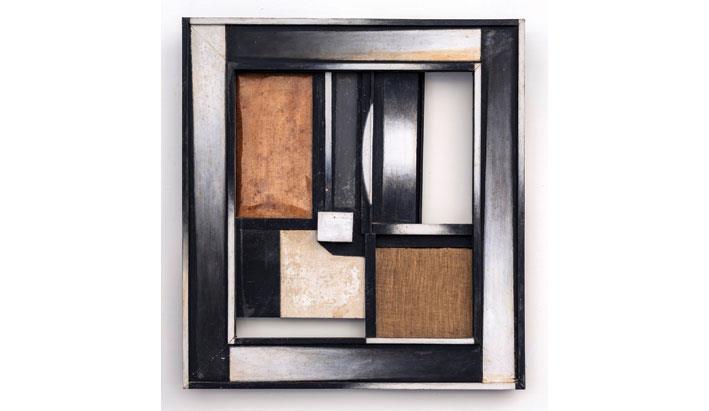
The other rooftop pieces here are darker in tone: organic browns, blacks and reds seem to pave the way for the final chapter in Barthet's artistic practice: towards the end of his life Barthet began to integrate painting with materials including wood, reflective Perspex and mirrored glass to create optical illusions and static-kinetic art in which one can perceive movement. Look back across the gallery and you'll see movement in the Rhythm with Nudes and Bathers too which predate these by a decade giving an insight, perhaps, into the roots of Barthet's final chapter which was rather a surprise to his followers.
And then, I recommend you head back into one of the early rooms in the show (the one directly behind the museum reception) to have another look at the extraordinarily compelling Traffic Accident (1966). Unexpected, intriguing and rich with uneasy emotion it's a far cry from Barthet's earlier work, Farmers at Work (1944), on an adjacent wall. Despite the unusual subject matter, because it's big, bold, brave and modern, with bright flashes of colour, strong underlying geometry and an apparent movement beneath your gaze, it seems to sum up many of the characteristics of Barthet's art. While the famed Mari tal-Bajd and Rooftops will rightly draw the crowds, despite its dark nature, this very different and lesser-known painting, while dark in mood, was also a pleasure to discover.
Esprit Barthet: A Life of Colour runs until 28 May. It is accompanied by the latest book in the popular Il-Ħaġar Gems series, available at €15.
Il-Ħaġar - Heart of Gozo Museum, St George's Square, Victoria, Gozo is open Monday-Sunday from 9am-5pm. Entrance is free.