First things first - what is pyrography?
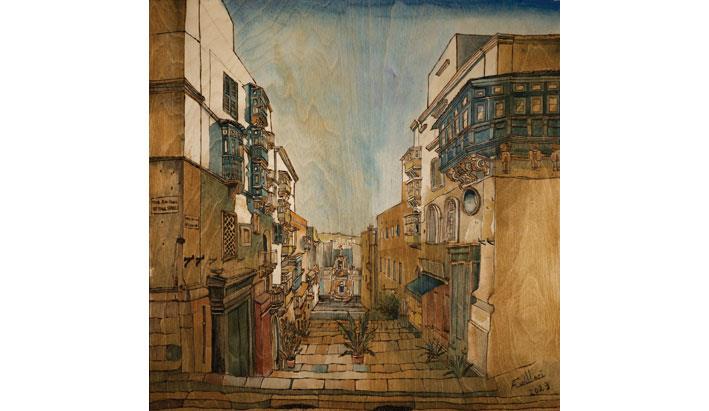
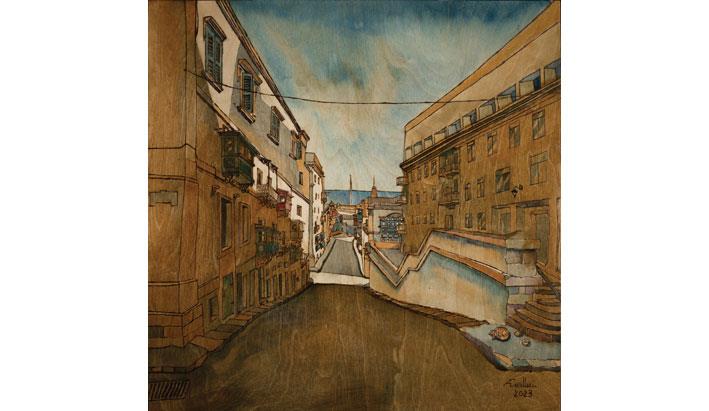
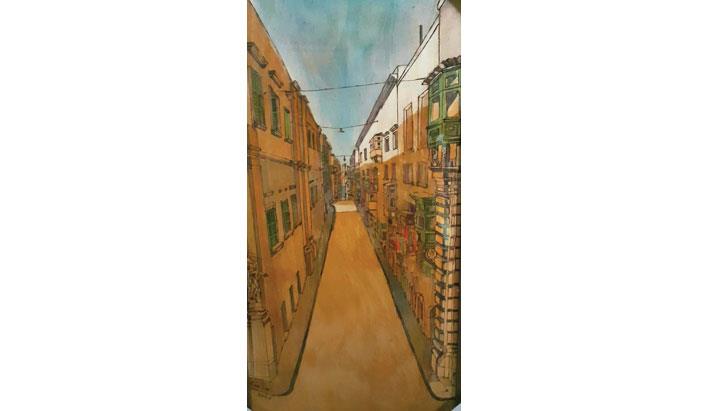
Literally translated from Greek pur means fire and graphos writing, Writing with Fire, which has been wittily used for the exhibition title Drawing with Fire. Quoting from the exhibition synopsis, "Pyrography, also known as wood-burning, is a free-hand art form that involves decorating wood or other materials with burn marks produced by a controlled needle". Pyrography or pokerwork can be executed using various tools and in fact we can also see a difference in Antoine Paul's works when one compares the first work from this series, which is Lija Church where he used a soldering iron to burn his design and the later works where he used a heated nib. The process involves finding a suitable wood which in this case is replacing the canvas and creating the drawing, which is then "redrawn" using a heated nib, which is not lenient at all to mistakes. Camilleri opted for beautiful beech wood, which has less grain, is very durable and it is light in colour. The choice of wood is important as Camilleri wanted to make use of the texture and natural patterns found in this wood. In fact, in various areas of these works, the layer of paint is just a coloured transparent glaze and one can appreciate how the wood pattern is incorporated in the compositions, especially for the sky, and at times the wood is left in its natural colour to manage to capture the pristine honeycomb colour of the Maltese Globigerina Limestone.
One cannot look at these artworks and not immediately link them with his father Antoine Camilleri's iconic Pictures in Clay. My first question to Antoine Paul was why did he opt to experiment in this technique. The reason and inspiration do come from a relative, but this time from his aunt Mary, who was very talented in this craft of pokerwork. In fact, what aroused the curiosity into this technique was a beautifully decorated piece of furniture by Mary, which illustrates a composition made up of birds captured in mid-flight, twigs and flowers.
He explains that the link to his father's clay resin artworks came later and in a natural way, following a long process of experimentation with the medium, the burning of the wood, the application of colour and varnishes and keeping them to a minimum to exploit the natural colour of the wood. The main similarity, is of course, that in both series, one observes an engraved outline of the design, one of drawing in clay with a needle and the other of burning the lines into the wood, using a heated needle tip.
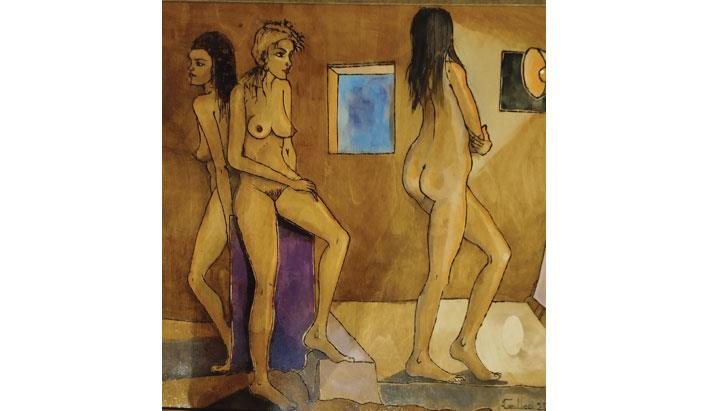
The first batch of works I saw from the exhibited works were all Valletta scenes, which, of course, made me wonder, why specifically Valletta? But upon seeing the rest of the works, I got my answer. The other scenes are from various places in Malta which were of a special significance throughout Antoine Paul's life - Lija church, St Paul's Bay, Floriana and of course a "collage" of snippets from his studio showing three nudes in different poses title Life Class, which brings to mind Antoine Camilleri's Self-portrait with model in the studio (1993). Antoine Paul explains how "during one's life, the environment around us influences us, and the experiences, the place itself and the people leave a mark on us".
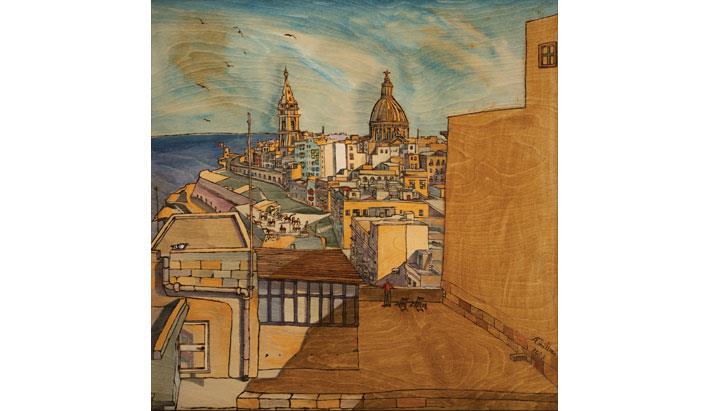
He spent seven years living in Valletta with his family, and let's face it, Valletta is Valletta. Impossible to count how many artists were inspired by the grid-like streets and the contrasting architecture of palaces and more humble abodes. However, he opted to search for streets which are less commonly depicted or to take a different approach to the scene. In fact, these almost "postcard" scenes are brimming with a feel of nostalgia. The streets are not cluttered with the obstruent cafeteria tables, nor filled with cars, nor tourists and there is absolutely no hint of any scaffolding. It is an idyllic interpretation of Valletta, quiet, glowing in that beautiful Spring sun, not scorching, just the perfect balance between the prominent sun sometimes portrayed in these works in an obsession of concentrating circles and the beautiful honey stone colour. Speaking of the sun, here we have a completely different approach from his father Antoine's works, where the sun was so typically depicted as a circle in a rectangle.
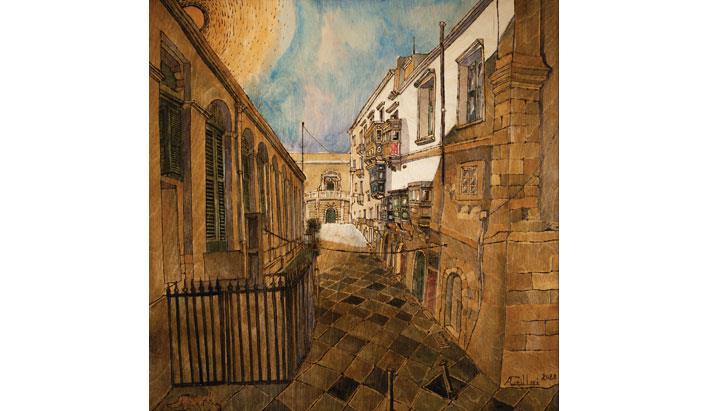
Andrew Zarb did a great job in taking the photos of these works that accompany this article, but as often happens, these works really need to be experienced, to admire the engraved lines, the wood grain timidly surfacing under the transparent layer of paint, and all the detail. In some works the detail is incredible, considering the technique used. In the small work Valletta XXVI, apart from the bravura in achieving the perfect and complex street perspective, if you poke your nose in the artwork, you might catch a glimpse of Sliema!
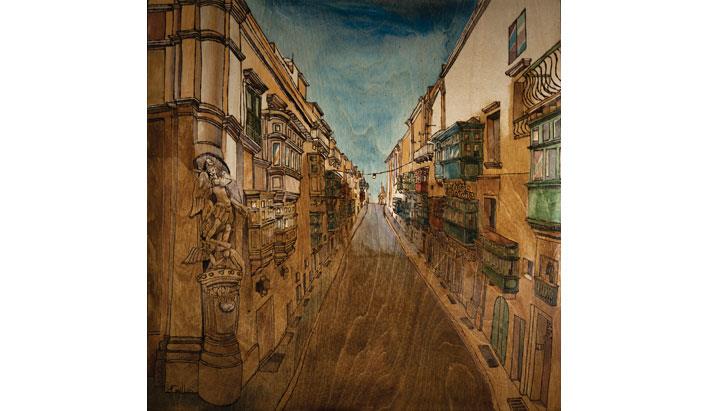
Some artists are most concerned when it comes to signing their works, as they feel it interferes so much with the artwork. Well in these works, for Antoine Paul, the signing of the works becomes a game with the viewer, where one has to search for the signatures which he hid or camouflaged in his compositions in the most astute of ways. I found myself searching, zooming and laughing while preparing the online catalogue of works. Oh and keep an eye out for the intruding cats in some of the artworks.
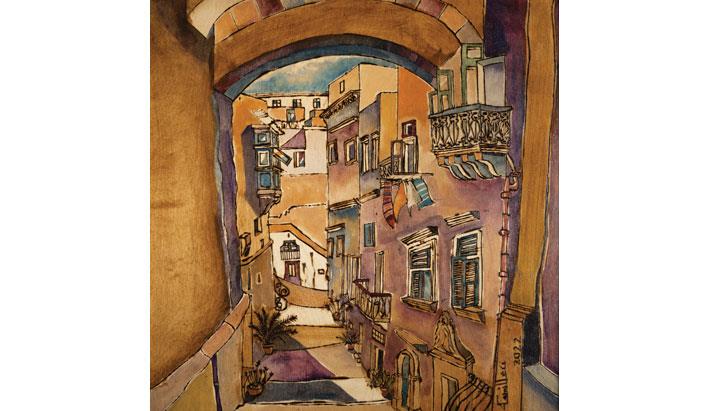
While setting up the exhibition, I had a chance to observe very closely the work of Lija Church, and I commented at how different it looks from the rest. Antoine Paul explained it was the first of the series where apart from using a different tool for burning, we see almost an outline of unpainted wood around the structures - the Lija church, Villa Gourgion and a large statue. Another difference is that the layers of paint are thicker as he had not decided yet to leave the wood grain showing in certain places like the sky. So make sure to have a close look and compare how the works evolved from the more fresh almost alla prima approach to the more elaborate detailed ones like Valletta XXV.
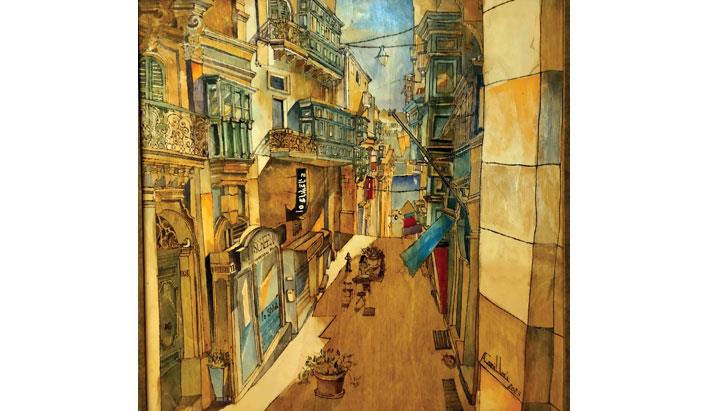
And to conclude, it is important to mention Antoine Paul's favourite medium, which is pen drawing. He quotes Paul Klee: "A drawing is simply a line going for a walk" and continues to emphasise on the huge difference between pencil drawing and pen drawing, where the latter is more difficult but is more rewarding and fresh. It all starts with a dot and then emotions and creativity take over. He warns us that when he is deeply immersed in pen drawing, no matter who and what tries to distract him, it's a lost battle, as he is absorbed in his own world chasing his line.
The exhibition is being held at the Malta Postal Museum, Archbishop Street, Valletta until 29 April