Let's start with an easy one - what do you think every family table in the world has in common?
BK: It's the focal point where people come together.
AF: Food!
MJL: I think on a base level all family tables in the world are alike. Sometimes it is not a table but the floor, a room, a ritual or something else. But there always is some place or construct that shapes your feeling of "this is my family" and works as a foundation for conflict, closeness, happiness, social interaction and struggle for any family.
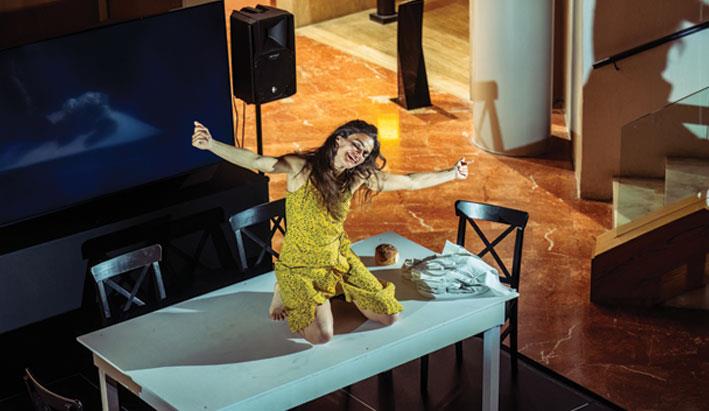
Mats, what inspired you to set the focus of your short film/performance?
MJL: In 2020 my father died of cancer after my mother suffered the same in 2018. So, my video was an opportunity for me to work on that trauma and find a way, through performance art, to tell some of the stories and work through a lot of it. To be able to do that in such trying times as there were because of the pandemic is a privilege I am very thankful for.
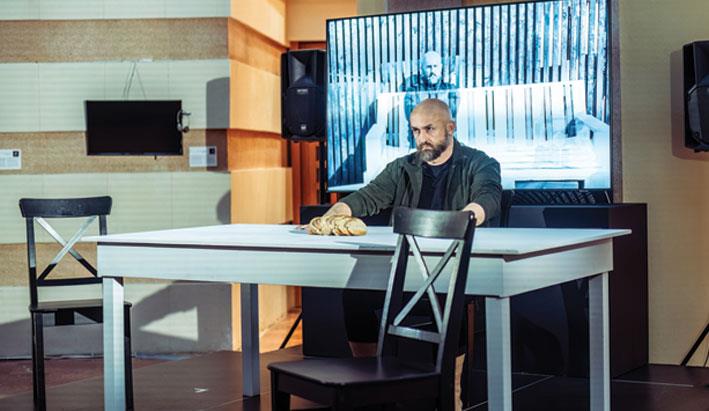
And, what would you have liked to do differently in your own work after seeing the films of the other artists?
MJL: I don't really think I would have liked to make something differently. I always view performance art as something that reflects you and your situation at the time it is produced. Today, I am a different person. We have all changed a lot through the pandemic and I especially am at a different place concerning the trauma of my parent's death. But, that does not make me want to change my film in any way. And as my work is fundamentally shaped by who I am, seeing who the others are in their work does not make me rethink my approach.
Since my parents had passed away, they never saw it. But my brother, my cousin who is as close as a second brother to me, and a lot of my extended family as well as friends saw it. A lot of really close people knew about those situations and were touched rather strongly by seeing it so condensed. People that were less connected to our core family were really surprised, as we most of the time seemed to be a tightly knit close model family to the outside.
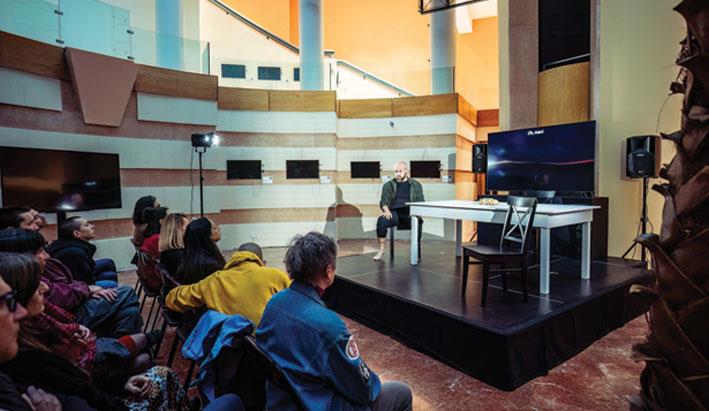
Which brings us to our next question - was it difficult to make art about your own family? Why? Or why not?
MJL: For me, it wasn't that difficult because as an artist I tend to be very open about my life, my emotions and my traumas. We, as a family, always shared a lot about ourselves (with a lot of self-pride in the case of my parents) and I have been working artistically with my brother since we were kids, so we share a lot of our views towards art and openness in our artistic work.
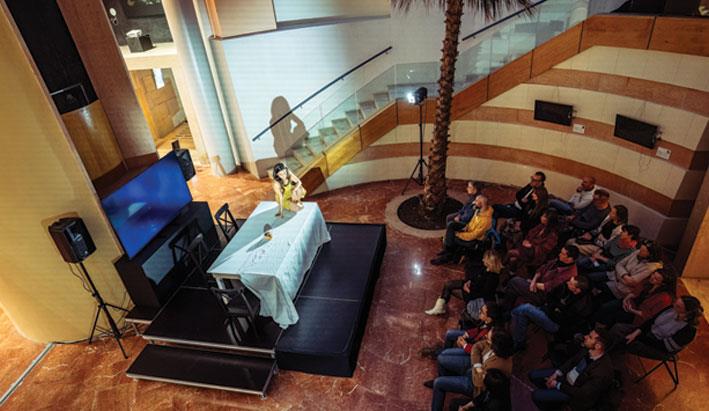
And for you Amy, was it difficult for you too?
AF: It is not difficult in the basic sense. My family is very open and supportive. I think the difficulty for me is sometimes not knowing where the line is between what is too personal and what's still okay to talk about. My family saw my film and they were very moved. I think what moved me the most was seeing my grandmother shed some tears while watching my film... I wasn't sure she would understand my videos since it was sometimes a bit abstract, but she did.
Which of the short films (excl. yours) is your favourite and why?
AF: Phaedra's film. Her family is in the sea in the video and being close to the sea also feels like home. In our family, there is also a lot of distance. My parents, my sister and I live on three different continents, so we also have a lot of goodbye meals. Her mother also says that since Phaedra left, they have been waiting for her to come back. There is a lot of waiting to see each other happening in my family as well. And there is just something special about hearing Phaedra's parents speak in Greek. I grew up going to a Greek church and listening to a lot of byzantine chant, and just hearing the language again brings me back to my childhood and makes Phaedra's film somehow even more relatable.
BK: I'm particularly touched by the fact that really each film has its own unique aesthetic and theme.
MJL: I couldn't pick a favourite if I tried. I love a lot of them very much, as I see a lot of the artists shine through their work, which is always a beautiful thing to see and feel. Phaedra's and Amy's films are especially close to my heart, but maybe that's because they are, too.
Bianca, what was the inspiration for this project and what future do you see for it?
BK: National Theatre Weimar, which was mainly about different political attitudes within a family. At the table is a logical development for us, which we want to make internationally accessible through the medium of film. It was designed to be sustainable. This means that the video exhibition will be expanded in the long-term to include more and more perspectives. We would like to see two more artists each year working through their view of the topic on film and the video exhibition travelling internationally.
'At the table' is open until Sunday, 28 May at Spazju Kreattiv, Castille Place, Valletta. More information on www.kreattivita.org
Photos: Elisa von Brockdorff