This feature investigates the Malta Civil Service Association as the oldest staff organisation in Malta, having seen the light of day in 1919. This write-up also focuses on the early 1950s; a time when the civil service was part of the overall process of stimulating economic growth and the development of trade and industry in Malta.
The civil service was always a major, if not, the main employer in Malta's labour force and each party in government saw it as the largest constituency. This meant that any changes, re-organisations and reforms to this employment sector had to be introduced gradually and prudently, not to irk civil service employees and their families, which could lead to a massive loss of votes for the party in government.
The Birth of the Malta Civil Service Association
On 15 April 1954, the Malta Civil Service Association celebrated the 35th anniversary of its formation. It was created during the turbulent days following the end of the First World War. The war had created conditions resulting in a heavy rise in the cost of living. This brought financial distress to civil servants. The effect of the Great War was an ever-increasing working-class militancy, especially in the dockyard and the harbour area. The public service was another sector of employment which saw the need to establish a union (association).
During harsh times, it is natural that human beings bond together in order to present a united and strong front in making requests for increases in salaries and improvements in conditions of work. It was in April 1919, that a Provisional Committee, consisting of members of the clerical establishment, convened a general meeting for the purpose of forming a regular staff organisation.
Thus was the Malta Civil Service Association born. The Association was a good example of Trade Unionism in that it took an active part in matters affecting government workers. Its officials served on various staff committees and joint councils and took a lead in contributing in no small way towards the advancement in the standard of living and conditions of service and work of Malta's workers.
'The Civil Servant' journal
The Association was also responsible for the publication of The Civil Servant magazine which was the official organ of the Association. This journal made its re-appearance in 1954 with its spring edition as a New Series, Volume 1, Number 1. The journal was very well received by all, be they members of the Malta Civil Service Association or not. The press too had pleasant comments on the journal. The price of the journal was 3d. The spring issue of 1954 deals with several matters affecting the civil service in Malta such as the re-organisation of the service scheme, foremen's claims, personability, overtime, electrical engineers claims and the clerk typists group.
Classes or groups of the civil service in the 1950s
Section I - Administrative, Executive & Clerical
1. Account keepers
2. Higher Division Clerical Establishment
3. Lower Division Clerical Establishment
4. Postal clerks
5. Temporary female clerks
6. Temporary male clerks
7. General
Section II - Minor and Manipulative
8. Court Marshals & Officer Minor employees
9. Customs and Excise Minor employees
10. Post Office Minor employees
11. General
Section III - Outdoor and other Officers
12. Customs and Excise officers
13. Labour officers and inspectors
14. Landing & Warehousing officers & assts.
15. Meter readers
16. Store officers
17. Telephone Traffic Branch
18. General
Section IV - Professional, Scientific & Technical
19. Agricultural experts and technicians
20. Apothecaries and assistants
21. Appraisers and Keepers of Pledges (Monte di Pieta')
22. Civil engineers and architects
23. Draughtsmen
24. Electrical engineers
25. Foremen
26. Legal officers
27. Medical officers
28. Professors and lecturers of the University
29. Registered nurses
30. Sanitary inspectors
31. Teachers of the Lyceum & High Schools
32. General
Interestingly, extracts were published in the magazine from the Manifestos of the Nationalist Party and of the Malta Workers' Party - the two parties that had combined to form the Coalition Government that was in power at the time. These promises were vague and convey very little of the actual intentions of those who made them.
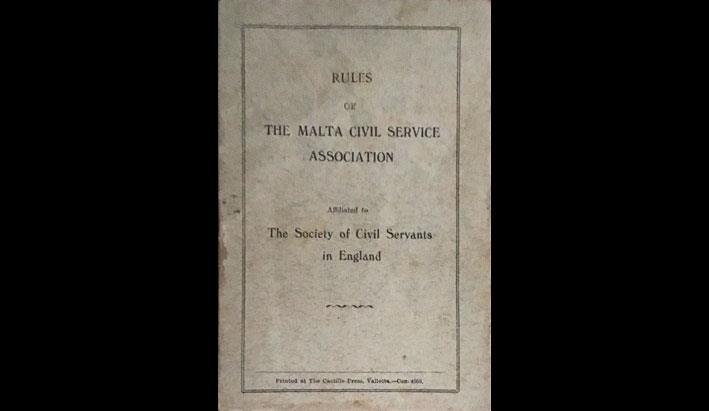
Rules of the Malta Civil Service Association
The Malta Civil Service Association was affiliated to The Society of Civil Servants in England and in the rules of the Association one finds the objects of the Association, which read:
(a) To safeguard and further the interests of its members by providing the relevant machinery for obtaining proper conditions of service and for dealing with grievances involving a general principle.
(b) To promote harmony of aim and unity of action among all officers of the civil service.
(c) To secure the greatest measure of co-operation between the government and the general body of civil servants, with a view to increased efficiency with the well-being of those employed.
Presidents of the Malta Civil Service Association from 1919 up to 1954
Presidents
Mr J. Mercieca 1919/23
Mr J. Rutter, M.B.E 1923/28
Mr O. Sammut, C.B.E. 1928/37
Mr A. C. Crockford 1937/41
Mr S. Dandria, M.B.E. 1941/42
Mr V. Dillon, M.B.E. 1942/44
Capt. J. L. Pace 1944/45
Mr S. Mizzi 1945/48
Capt. J. L. Pace 1948/-
General Secretaries
Mr O. Sammut, C.B.E. 1919/23
Mr H. Pace Bonello 1923/42
Mr S. Mizzi 1942/45
Mr P. F. Gatt 1945/47
Major F. Amato Gauci, M.B.E., B.Sc. 1947
Mr W. H. Tabone 1947/51
Mr Jos. Torpiano 1951/52
Mr A. J. Tabone 1952/-
During the 1950s and 1960s, Malta started to diversity its economic base from one almost entirely based on revenue emanating from it being utilised as a base for British military services to one based on trade, manufacturing, industry and tourism. It was in 1955 that Dr Thomas Balogh and Dudley Seers were commissioned by the government to visit Malta and report on the economic state and problems of Malta.
As a gradual withdrawal of British forces from the island was taking place, a series of development plans were put in motion after 1959 based on the Balogh and Seers report. The government also enacted legislation such as the Aids to Industries Ordinance, 1959 to support private enterprise and stimulate investment both local and foreign.
The Malta Civil Service Association from its date of inception in 1919 to the early 1950s is a fine example of Malta's early efforts in setting up trade unions in its finest sense. Apart from taking an active role on staff committees and joint councils, the Association took an active part in matters affecting government workers and sought and managed to improve the standard of living and conditions of service of Malta's civil service. The overall impact of the Malta Civil Service Association and the civil service is to be appreciated against its ever-increasing role in Malta's development process from a servile colony to a sovereign nation state.