What role did music play in your early years? Do you come from a musical or artistic family?
I started learning piano when I was six years old and then joined a specialised music school when I was seven years old where I studied for the next 12 years before doing my Master's in Piano Performance at the Music Academy. Therefore, music was always the most important thing in my life since the very early age. My parents are not musicians themselves; both are historians. My mum is an art historian; therefore, art and literature played a big role in my life. My great-grandmother was a piano teacher, and this is why my grandmother decided very early on that I will play piano. She bought the piano for me when I was a small child, so I didn't have much choice in the matter.
Later, being in a music school surrounded by musicians, it was hard to imagine a different path for myself. My teachers encouraged me along the way even though they were sometimes harsh.
How did you finish up in Malta from Poland?
I used to live in Dublin, Ireland for a while after my studies and then, due to personal circumstances, I decided to move to Malta 12 years ago.
Is this your real name or is it your stage name?
Julia Miller is my real name. My great-grandfather on my father's side was of Austrian origin and his name, before making it more Polish-friendly, was Müller.
You are also a piano teacher. Could you tell us something about this profession?
I have been teaching piano for the last 15 years. Firstly, in Poland and then later in Ireland. I have been teaching in Malta for the last 12 years, mainly in the Malta School of Music where I am a piano teacher, piano accompanist and ensemble tutor.
Who are your main inspirations as a pianist?
I get my inspirations in all the encounters with great musicians that I am privileged to have - be it being at their masterclass or concert or having regular lessons. During my studies at the Music Academy in Lodz, Poland, I studied with many great musicians who made a big impact on my life. Currently, I am working under the supervision of Prof. Michael Laus with whom I am studying for my D Mus. in Piano Performance at the University of Malta, and I am being motivated following each meeting.
I also have few favourite pianists that I love to listen to. One of them is the legendary Martha Argerich, and last February I finally had the chance to hear her perform live in Vienna, making a dream come true.
Do you have a favourite composer(s)?
I am inclined to say that the Romantic era is my preferred one, especially the second half of the 19th century. I think I could say that some of my favourite composers are Schubert, Brahms, Rachmaninoff and, of course, Chopin. I am also discovering more the music of the composers of the beginning of the 20th century like Szymanowski, Shostakovich, and others.
Is there a favourite piece you like performing?
I really like Brahms' 6 Klavierstücke, Op.118. It is a piece I played for my final exam at the Academy of Music, and I love to return to it. I also enjoy performing Chopin's Ballad no.1 in G minor op.23. It is one of the pieces I have been playing since I was 19 years old and it is amazing how it grows and changes with me.
Have you given other concerts in Malta or is this your first?
I have been living in Malta since 2012 and I have been giving regular concerts here. In the beginning primarily as a piano collaborator with singers. Since 2019 I have started performing solo as well as inviting other musicians, mostly from Poland, to perform alongside me in Malta. In 2022, I was the brains behind the project Valletta-Varsavja-Vjenna, where I was playing Mozart's D Minor Piano Concerto together with the Polish-based Apertus Quartet as well as the piano part in the specially commissioned piano quintet by Karl Fiorini. The project was supported by Arts Council Malta and The Embassy of Poland in Valletta. In April, I performed alongside the Polish pianist Aleksandra Halat a four-hand recital with compositions by Polish, Maltese and French composers which was performed in Malta as well as in Gozo as part of Gaulitana 2024. The forthcoming violin and piano recital (Echoes of Poland) will be presented in Malta, as well as in Gozo as part of the Victoria International Arts Festival 2024.
Do you have a message to give to those who hope to pursue piano as a career
I think you need to really believe in yourself, be systematic and motivated, learn from the best teachers and immerse yourself in the music world. I think it is very useful to study in a musical institution, be it a conservatory or academy, to fully engage with music. On the other hand, one needs to realise that being a musician can be a difficult path and you need to learn to develop a "thick" skin as many times there will be obstacles in your way or disappointments.
Please tell us something about the composers whose music you are going to play and which are not so well known?
This recital presents Polish composers from the 19th century and the beginning of the 20th century. Henryk Wieniawski (1835-1880) was a romantic composer who was a violin virtuoso and is recognised as one of the greatest violinists in history. The pieces chosen for this concert showcase his creativity into transforming folk Polish music into small musical masterpieces as well as very demanding virtuoso pieces like Polonaise or Scherzo-Tarantelle.
Karol Szymanowski (1882-1937), according to words of Aleksander Laskowski (Exploring the music of Karol Szymanowski, the greatest Polish composer since Chopin), developed a unique music language, blending Straussian and Wagnerian styles with romantic Oriental influences, culminating in a national period influenced by his Tatra Mountains stay. We will perform his Sonata for violin and piano in D minor op. 9 as well as a transcription of Roxana's aria from the opera King Roger. Staying in the theme of transactions, I could not forget about other great Polish composers like Frederic Chopin and Ignacy Jan Paderewski. They were both pianists and therefore, composed mostly for piano. This time we will present transcriptions of their piano pieces for violin and piano.
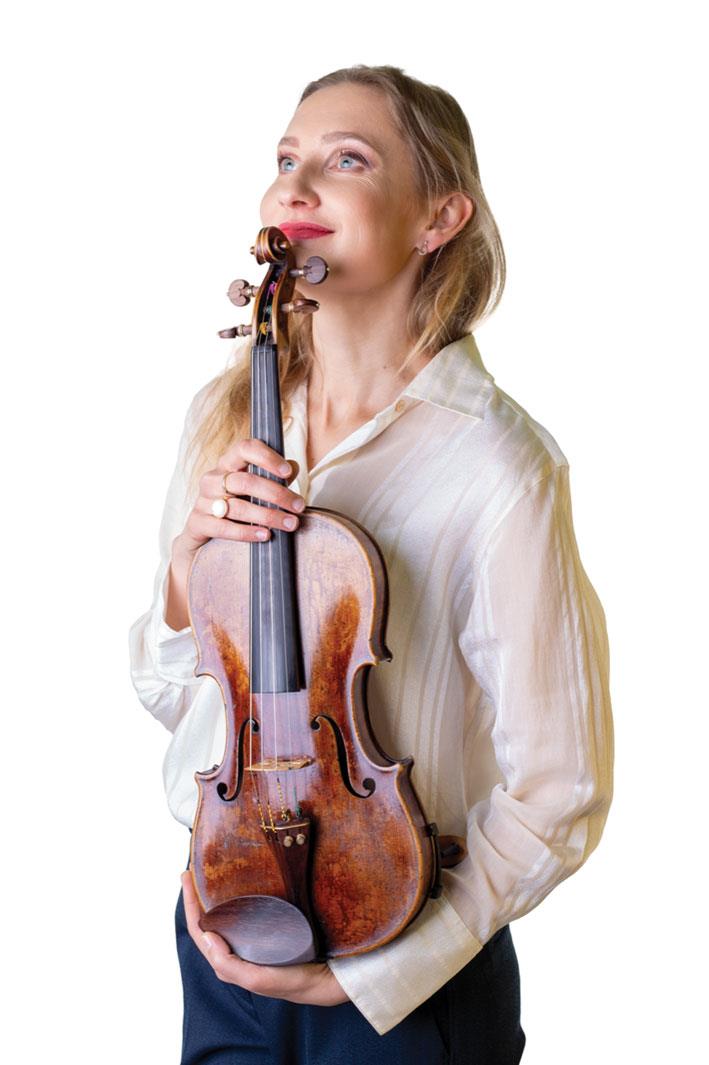
Justyna Zanko is a Polish-born violinist who obtained her MA degree from the Academy of Music in Warsaw studying with Tadeusz Gadzina and Roman Lasocki. In 2014 she gained a prestigious Advanced Postgraduate Diploma in Professional Performance from Birmingham Conservatoire in the United Kingdom where she studied with the last student and protégé of the legendary David Oistrakh, Dr Rimma Sushanskaya.
As a winner of many international competitions in Europe, United Kingdom and the United States Justyna has been undertaking a number of concert engagements at many distinguished festivals in Europe and the United Kingdom, such as The Old Town Harmonies Festival, The International Festival of the Wieniawski Brothers Virtuoso Violin Festival, Virtu Classic Festival and many others. Conductors she has performed with include Piotr Wijatkowski, Michael Seal, Rimma Sushanskaya and Cheung Chau.
Pianist Julia Miller
Polish-born pianist Julia Miller graduated from the Music Academy of Lodz in piano performance and chamber music under the tutelage of Prof. Anna Wesolowska-Firlej, Prof. Boguslaw Pikala and Prof. Cezary Sanecki, just to name a few. She was a finalist in several competitions and had her own trio that performed in the most prestigious locations in Poland. Since then, she has carved for herself an international career both as a soloist and as a musical collaborator.
After a stint in Dublin, Ireland, Julia moved to Malta in 2012 and built herself a reputation as both an accompanist to vocalists as well as an accomplished pianist in her own right. She collaborated with the Malta Philharmonic Orchestra, Kor Malta, the Manoel Theatre Youth Opera and been present in several festivals, including the Malta Baroque Festival, the Malta International Spring Festival, the Gaulitana Festival and the Victoria International Arts Festival.
Currently, she is reading for her DMus at the University of Malta under the supervision of Prof. Michael Laus and Dr Max Erwin where she is focusing on female composers from the end of 19th century from the USA and Sweden.