"It's a simple story really," said the woman in the seat in front of me. At first, I was mortified. To think The Merchant of Venice is a "simple" story was inconceivable. Looking at the premise alone: a man takes a loan on behalf of his beau ami, through a contract with his nemesis that threatens his life, all to allow said "friend" to tempt his fate with a woman cursed to be a prize by inheritance. Factor in serious themes, such as race, materialism, vengeance and the story is anything but simple.
Nevertheless, the play was directed simply, with a relaxed approach to Shakespearean tradition and a faster pace. This is worthy of note following the craze of The Merchant of Venice, 1936, which brought the story into the fascist 20th century with its already-heavy themes amplified. But to lay the moral dilemmas bare, as originally instructed, and to leave the decisions entirely up to the audience takes its own courage.
Despite the play's classical style, featuring rich damasks and folds, the characters' behaviour was far from 16th century in manner. Director Stephen Oliver assigned the characters to actors based on age which contributed much to his interpretation. The generally young cast, contrasting with classical BBC interpretations, in itself made the play lighter.
The interactions between the younger male actors had a contemporary "bro" feel. There was no ceremonious back-slapping in the "Come let us taste some wine" fashion while the banter flowed naturally and easily, for example Bassanio's (Gianluca Mifsud) tongue in cheek, "If you can find a wife".
One of the debates of The Merchant of Venice is the relationship between Antonio (Edward Caruana Galizia) and Bassanio. Why would someone risk their life for an "ordinary" friend? While some have taken this character's dynamic and run with it to scenes of overt homosexuality, this was not the case. W. H. Auden critiqued Antonio as "a man whose emotional life... is concentrated upon a member of his own sex". With this in mind, and side-stepping sensationalism, subtlety was the rule of the day for the director. There was inconclusive cradling of Bassanio's face and a bashful Bassanio guilt-tripped Antonio into "trying his credit" but blink and you'd have missed it. It all fell into a quiet and bittersweet place when Antonio visited Belmont, following Bassanio's marriage and the rejection of the contract. Antonio hung behind the happy, victorious couples as a thoroughly awkward figure. He didn't belong. As Bassanio exited the stage with his newly-wed before him, a look of silent understanding was exchanged: the confirmation. Antonio was the means to this end, he knew his emotions were being toyed with for Bassanio's gain all along and he allowed it.
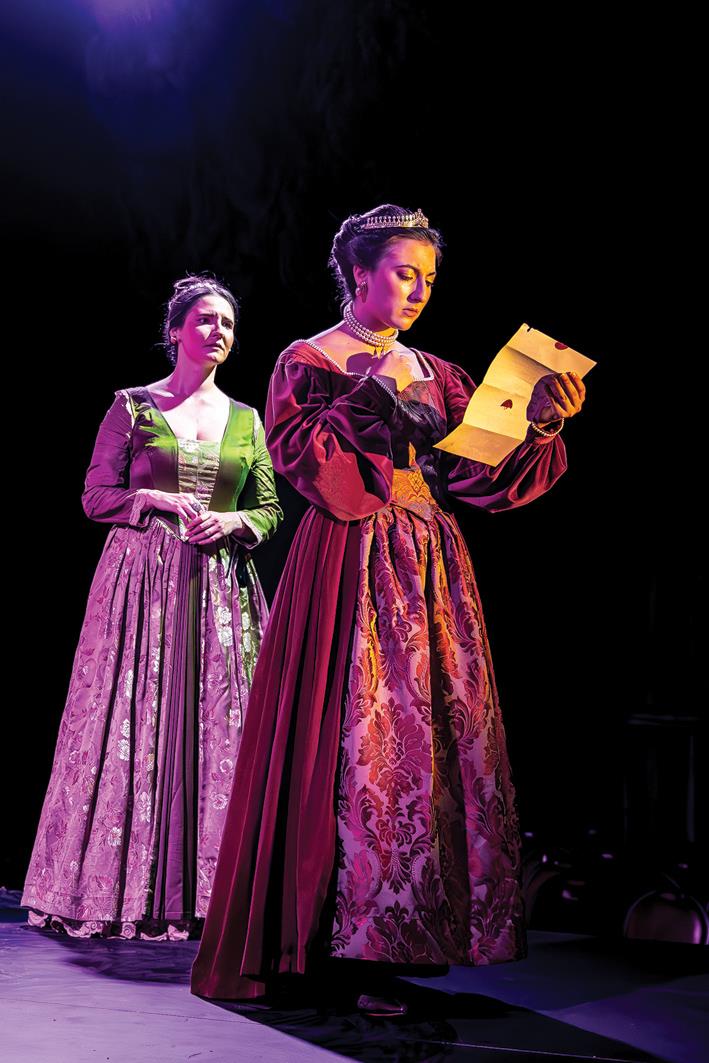
Portia (Julia Camilleri) and Nerissa (Cassandra Spiteri) were a duo to be reckoned with - partners in crime, through the ordeals of the caskets to their legal tricks and final marital games. Though some interpret Nerissa as being akin to Portia's nanny and the voice of reason to her father's inheritance dictum, this was not it. Here, Nerissa offered realistic comfort to a thoroughly fed-up Portia, she was her friend and confidante. Their skilful dynamic had added realism from secret and snide glances they exchanged throughout the play when bitching about suitors or making fun of their husbands.
Thus far, I have sketched the play as a smooth yet clever piece of fabric, a design conducive to highlight instances of intense emotion and planetary gravity. While many debate whether this is a moral play or a problem play, this particular interpretation was, with good reason, a contemporary dark comedy.
The play begins with ominous, dark female vocals and one would be justified to have foreseen Antonio's mortal crisis. But the game is revealed prior to the trial with merry Elizabethan pipes over execution drums: it was rigged. It was Shylock's foreshadowing at the start, he was set for failure from Act I. While Shylock, also played by Stephen Oliver, is usually perceived as a cunning schemer, so much so that Marlowe's The Jew of Malta has a prologue by Machiavelli, this interpretation was different.
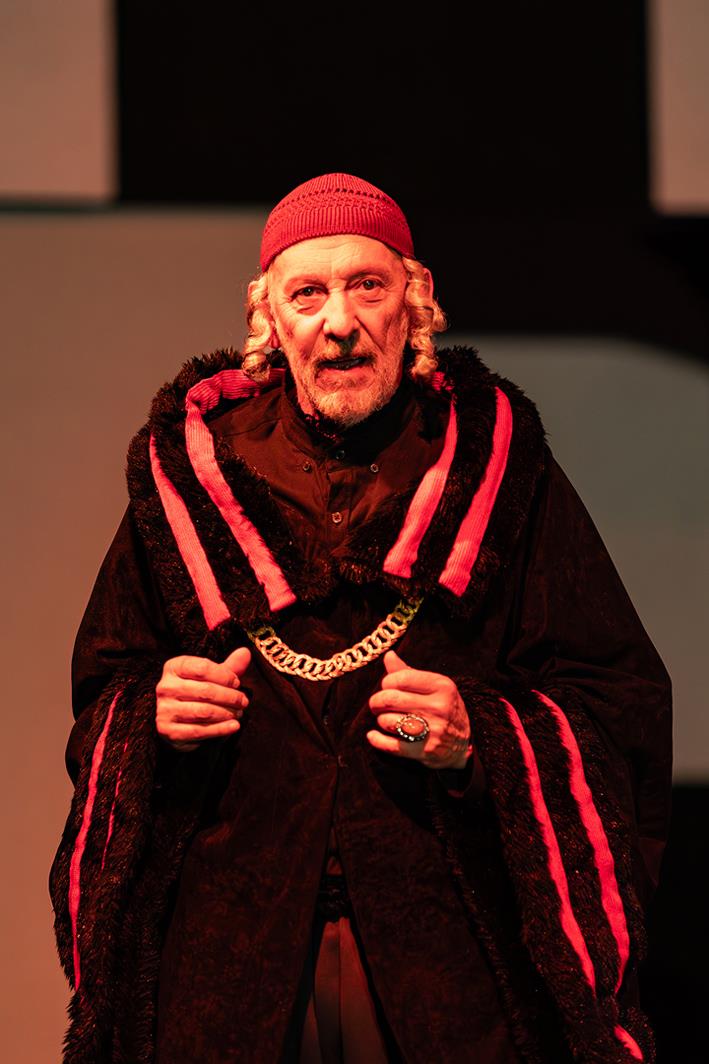
From the start, a sharp divide is made between the clustered Christians and lone Shylock that cannot be bridged by any mercy. Ever a solitary figure, save for occasional Tubal, in his Jewish Gabardine he looked like the perfect pantomime villain. This was no cunning Shylock, a stark contrast to Manuel Cauchi's sharply-dressed and sharkish interpretation in 2014, rather, a figure to be picked on. He lived with the never-ending taunts of the Christians, reminiscent of playground bullying, and literally plodded on through life onstage. The lethal contract was depicted as an opportunity that struck Shylock by chance. It was not pre-conceived. Life gets heavier for Shylock, however, with the eloping of Jessica and over the play he was progressively ground down. Oliver portrayed this physically through swaying and unsteady step as well as vocally becoming more guttural and harsh as Shylock approached his demise.
The first scene is an alternative to that in the original script with the Christians calling Shylock (morally) dead for his usury yet still alive. By the end they get their wish and more. Not only do they crush the character but also send him to hell with forced conversion to Christianity. After all what is hell but the absence of God? And in the infernal red-lit finale the ambiguous "shutting-out" of now-Christian Shylock could be argued to be from the synagogue, whose Torah Ark contains the presence of God.
While many get stuck on the racist themes of The Merchant of Venice, which were present in this interpretation, with Portia not even touching Morrocco to give him a key, it would appear that Oliver ultimately asks the audience, "What if your human punching bag shows feelings?" Replace "Jew" in Shylock's great speech with any minority in our society and one easily sees that the play and Shylock, as a symbol, are universal. But in answer to Oliver's question, I report that while most of the audience stared at the final annihilated Shylock in horror, some laughed.