Though whittled down to three hours from Bergman's four-hour interpretation, to keep an audience attentive for even 30 minutes in the age of 30-second dopamine pulses is a long shot. What's more, the original script of Peer Gynt builds an immensely complex narrative steeped in philosophical themes. One would naturally expect a modern reinterpretation of Ibsen's Peer Gynt to be shorter, abridged and altogether easier to digest. But Brad Birch thought otherwise. He doubled-down and added a commentary on pressing international issues with an Absurdist spin.
Some would call it madness to heap new, heavy themes onto an already oversaturated work but I disagree. When an "unstageable" play is staged, it would be ridiculous to expect a sanitised production. Birch understood this and used it to his favour.
Chaos doesn't come in of itself but is planned, therefore why not give it meaning? Birch harnessed the chaos of Peer Gynt and added to the chaos to reflect the chaotic world outside in a pyromaniac streak of realism. Birch's reasoning may be seen in his switching Ibsen's surrealism with something more trivial yet equally illogical: a proposal to traffic humans instead of a bastard "thought-baby". Ultimately, Birch embraced an imperfect story to reflect an imperfect world, resulting in perfect realism.
Ibsen's proclivity to socio-political commentary was particularly honoured with the depiction of a traditional cruel, local community. Though portrayed as doe-eyed with its attempts to reconcile its "I'm alright, F-U Jack" mentality through piddling fundraisers, it suddenly waxed Orwellian. Their insistence on being "grateful" smacked of brain-washing. Though clear to the audience, one wonders if the production gave a polite invitation to question how different the drama was from reality. Another Orwellian theme cropped up later with the audience looking from troll to man, and man to troll but unable to tell the difference in monster.
Commentary on current issues started strong with Chakib Zidi's choreography having performers presenting passports to a life jacket. While metaphorical, the sequence was grounded with poignant realism: crowded refugees, envious of sardines, falling dead passport in hand. Zidi's symbolism and eye for detail tied-in well with the narrative, when Peer returned home as a refugee. This synergy raised the question, "Did we not all come from the same symbolic home? Even if those who remained no longer recognise us, is it not still home?" Zidi's diverse understanding of movement was exhibited throughout the play, even including a tango, showing a firm grasp of the art.
The performance was emotionally enhanced by SonGaia Group's live performance. Prudishly modest in the gallery and unseen, they gave a musical world-tour with an impressive vocalist who even pulled-off an infamously difficult Arabic melisma at one point.
The sloped shipwreck was a feat of stagecraft by Romualdo Moretti. Though inducting actors as endurance athletes, it was a metaphor, a multi-use prop and a director's tool. As a prop, frosted spatters were sea salt and perhaps the obsessive Ase's imaginary dirt. Director Chris Gatt used the stage to the full with the slope's gradient boosting inter-personal power dynamics for example, when Peer faced-off Aslak and using its uneven gravity to amplify movements. Most impressive however, was the use of the slope for spatial depth during Ase's death to make the actors appear smaller and the characters more fragile.
For the sake of review it is necessary to divide Peer Gynt into a character and a symbol, though both were intimately connected.
Symbolically, Peer Gynt is everyone and no one. Peer is a "being" since even in dialogue. Peer was sometimes addressed as a thing and not a person. Throughout the narrative, he experiences everything a human can experience and may experience, in part but never in total, in one lifetime. In this aspect, every human condition, internal and external, is condensed into one being. For example, though lacking of will at one moment, Peer traversed a desert "on will alone" in the next.
Further complexity was added to Peer the "being" with the paraphrased declaration that Peer Gynt is change. Heraclitus then comes to mind, especially with the character's travels and paradoxical values, who maintained that man is always becoming and never reaches completion.
In this production, Peer's fantasies weren't portrayed as clear-cut, malicious lies, instead as buffers to miserable reality. As Dr Blum, viciously played by Stephen Oliver and reminiscent of Burrough's Dr Benway, who also created a dystopia, lives with himself through drugs, Peer lives with himself through stories. Though Peer is repeatedly called a brute for this, Samuel Johnson comes to mind saying, "he who makes a beast of himself gets rid of the pain of being a man".
With such a "universal human", one cannot blame observant X, calmly played by Mikhail Basmadjian, with steepled hands in Freudian fashion, from psycho-analysing Peer despite being his ultimate judge.
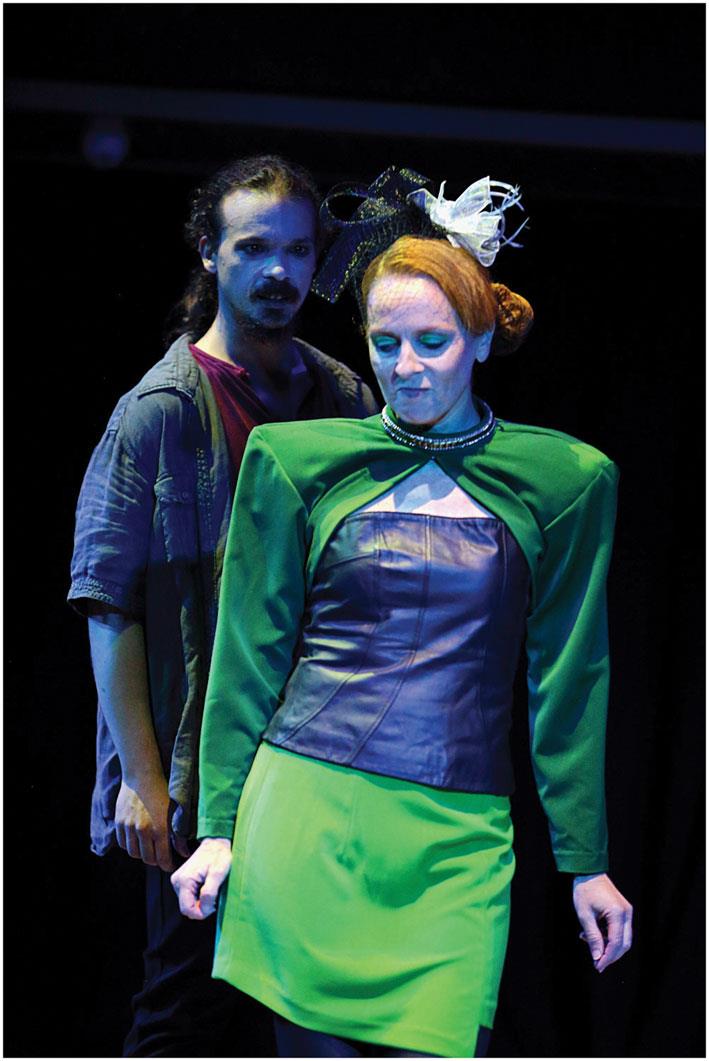
This abstract "being" was personified by Joseph Zammit, an artist of all seasons, with a cathartic performance whose, often sexual, love-hate relationships personified Bukowski's poem, You. His nuclear-level energy was carefully tempered, going from hand-wringing like some deprived addict to a chilled "dude" in couch-surfer garb. This created excellent contrasts which served as exposition, such as in Peer's early exchange with his mother Ase, soulfully played by Pia Zammit. The stage could have been in blackout but the difference in characters would have been just as evident by voice alone.
The play's heavy Absurdist influence, with an act titled, The Outsider, Peer being invited to suicide, and heavy Sisyphean imagery, though lofty and philosophical was grounded in bitter, irrational realism such as the humanitarian centre-turned slave camp. The ultimate product of all this, along with the, undoubtedly lacking, previous observations was an experience not a play.
As Ibsen has been observed to have outstripped the advent of film with visuals in Peer Gynt, this reinterpretation surpasses the touchscreen. Beyond sensory elements like the burning incense that a screen cannot replicate, Peer Gynt left the audience stumbling out of the theatre with a profound sense of catastrophic despair and, as all great plays do, with a lingering question: "We built a civilisation, but for what?"
Those who brought Peer Gynt to the stage appears to have taken a dramatic leaf out of The Grapes of Wrath in which Steinbeck strived "to rip a reader's nerves to rags". The omission of Grieg's furious incidental music was a mercy, lest the production team wished to drive the audience into a screaming existential frenzy.
Photos: Christine Muscat Azzopardi
