Russia’s Foreign Minister had little time for criticism during the OSCE Ministerial Council taking place on Malta over these two days, as he used his plenary speech to lambast the “pseudo-liberal” West and warn that a new Cold War created in Ukraine may well turn hot.
Lavrov is in Malta for the 31st Ministerial Council meeting of the OSCE, which is taking place at the Mediterranean Fairs & Conventions Centre in Ta’ Qali, and he was the third country to address the meeting’s plenary on Thursday morning.
"The Helsinki principles are just empty words to NATO and EU... They expect others to abide by them but only as long as it is in line with their aims. The West wants to drive neo-colonial hegemony at any cost,” Lavrov said.
It is the first time that Lavrov has set foot inside the European Union since Russia launched an invasion of Ukraine in February 2022, and his presence was not welcomed by all of the other 56 nation states at the council meeting.
Foreign Ministers from Poland and Baltic States of Lithuania and Latvia all told the media as they entered the venue that they would walk out of the meeting when Lavrov spoke.
Malta’s Deputy Prime Minister and Foreign Minister Ian Borg, who is currently chairing the OSCE, also had strong words for Russia’s invasion of Ukraine: “We call on the Russian Federation to withdraw from the internationally recognised territory of Ukraine and end this war. The recent escalation of attacks must stop immediately to pave the way for a diplomatic process - one that leads to a comprehensive, just, and lasting peace,” he said.
But Lavrov was unphased: he said that the West’s weapons and barbed wire in Ukraine was a “reincarnation of the Cold War, only now with a much greater risk of a transition to a hot one."
He described the West has being “over-flowing with pseudo-liberal values” and as never respecting the principle of consensus – adding that mutually respectful dialogue within the 57-nation OSCE had been killed.
An example of this, he said, was the revocation of a travel visa for Lavrov’s ministerial spokesperson Maria Zakharova on Wednesday. She is subject to an EU travel ban, and three countries within the bloc refused to allow her permission to be exempted in order to come to Malta.
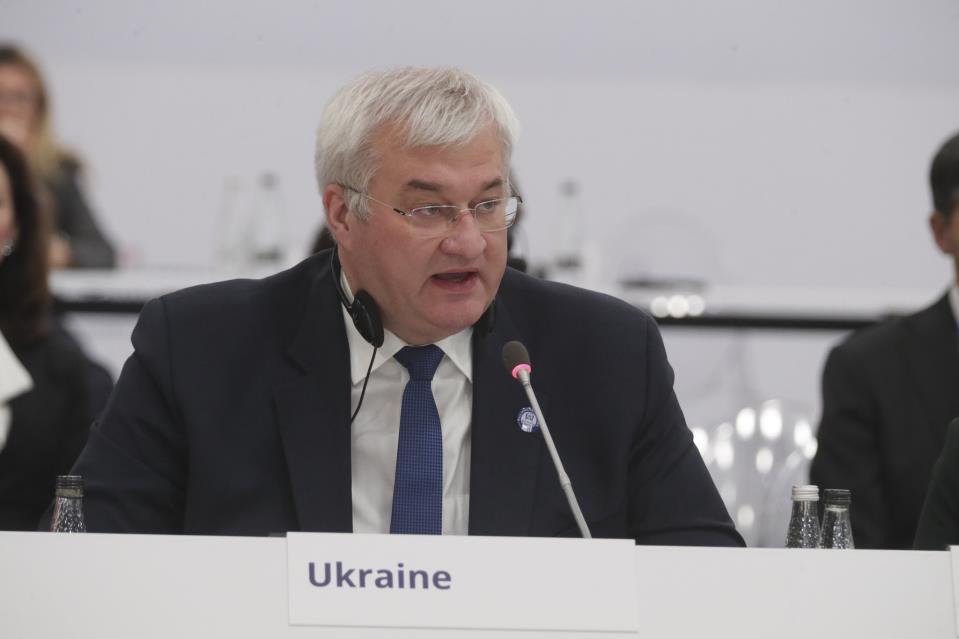
Ukrainian Foreign Minister Andrii Sybiga meanwhile presented an altogether different analysis of the situation.
Sybiga was the first to address the meeting, saying that Russia is “the biggest threat to our common security.”
“Russia itself is the biggest security concern for the world. When they say they want peace, they lie. Look at their actions not words,” Sybiga told his ministerial colleagues.
He also described Lavrov himself as a war criminal.
US Secretary of State Anthony Blinken meanwhile, similarly, had little time or consideration for anything that Lavrov – who had departed the room by the time Blinken spoke – had to say.
“Let’s talk about escalation – let’s talk about the introduction of North Korean forces into Europe. Let’s talk about the use of intercontinental ballistic missiles,” Blinken said in a marked note towards Russia’s war in Ukraine.
“Let’s talk about the ongoing assault on Ukrainian’s energy infrastructure, including its nuclear transmission grid, which poses a great threat to every single country in this room. That is escalation,” he added.
“Our Russian colleague is very adept at drowning listeners in a tsunami of misinformation,” he said of Lavrov.
"But let's not fool ourselves and let's not allow him or anyone else to fool us. This is not about and has never been about Russia's security. This is about Mr. Putin's imperial project to erase Ukraine from the map," Blinken said.
Lavrov had already left the plenary meeting by the time Blinken – who was the 7th to speak – addressed it. He later gave a press statement which was only open to Russian and Belorussian media.