The exhibition Silence Within Abundant Birdsong, curated by Andrew Borg Wirth and Sera Galea is open at Palazzo de la Salle, in Republic street. It will close on April 17th and not 24th as formerly announced. Many turned up for the launch. The exhibition is celebrating 50 years of the Manikata church, Richard England's first of many sacred spaces he has built since. He was then just 23 years old.
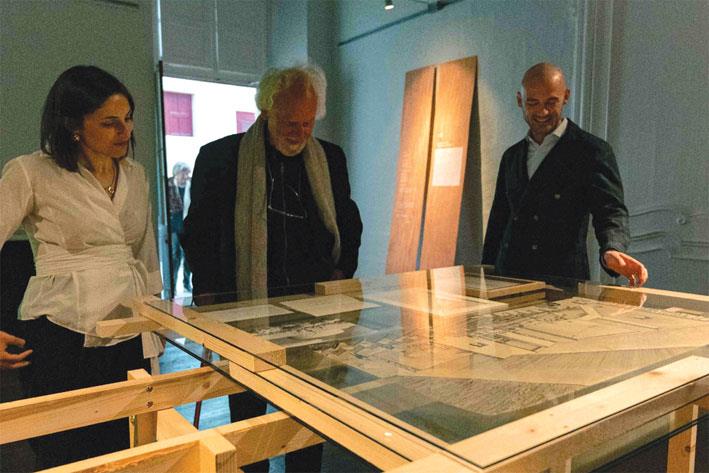
This title of my diary honours the church's innovative design and enduring significance, reflecting its evolution from a groundbreaking architectural feat to a cherished spiritual landmark.
The exhibition beautifully captures the essence of Richard England's church as a living symbol of innovation and continuity. Through the unique perspectives of the four artists, visitors are invited to explore the interplay between architecture, nature, and faith. The choice of materials, sounds, and imagery resonates with the church's spirit of "continuity within change," as described by England himself. In his Chambers of Memory (Kite 2018) Richard England wrote: "The church of St Joseph in the hamlet of Manikata was my first major commission, given to me by my father as a kind of rite-of-passage gift after my return from my student-architect work phase in the Milan studio of Gio Ponti. The design of the church broke away from the conventional traditional Baroque-haunted church typology of the island, in a concept on a space-time solution conforming to then current philosophies and novel liturgical reforms.This was a project both of its time and its place. Its embracing walls and the internal womb-like intimacy recall the forms of Malta's prehistoric temples and also echo the traditional dry-stone rural, corbelled stone girna tool sheds. These forms are, however, abstracted and synthesized into a rational modern structure rooted to the local context to manifest my philosophy of 'continuity within change' and 'a new leaf not a new tree'. Termed a church of today designed on the foundations of yesterday, Manikata twelve years in the making was fashioned and built by the loving hands of the farming community of the hamlet as a manifestation of their commitment and belief. To this day the church still resonates as a forceful expression of a hamlet people's faith."
There is no space to publish the anecdote, in the same book, which Richard relates about the reaction of the then Archbishop, Mons. Michael Gonzi to such a modern church.
Richard England has written and said: "Many roads lead to God. I chose architecture." Perhaps architecture chose him.
I asked a couple of those who attended for a comment.
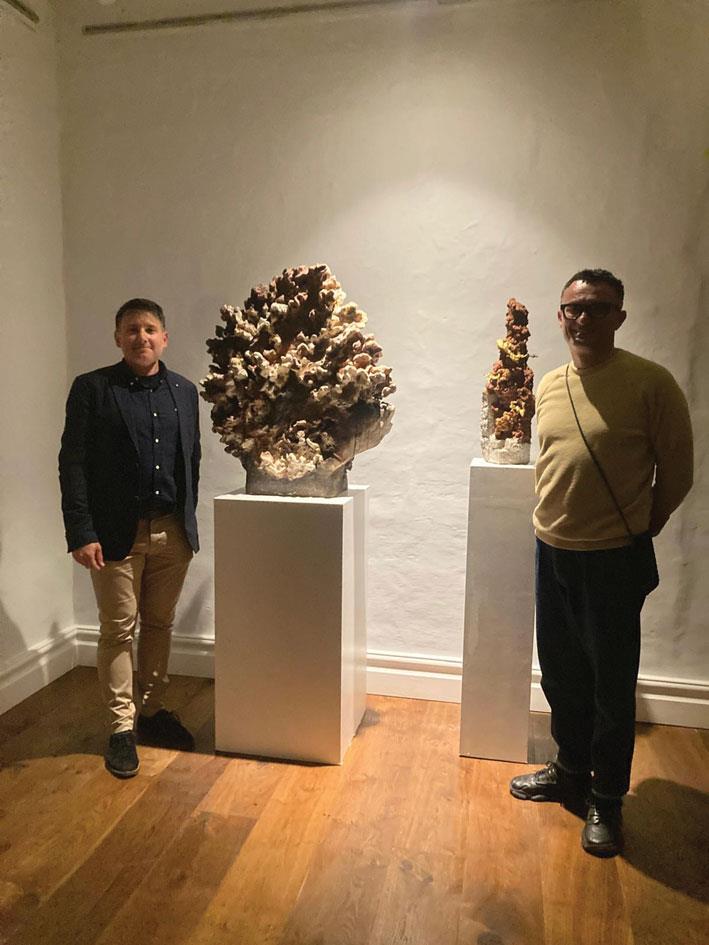
Here is what Christian Attard, who lectures in the art department at the University of Malta said:
"A small, colonized island on the cusp of independence; a young architect, fresh from his studies in Milan; a Church searching for ways to reinvent itself in the wake of a Vatican Council; a once-quiet hamlet now growing beyond expectation. Like stars aligning, these elements converge in a perfect confluence to find their voice, perhaps subdued only by the bespoke birdsong, in Richard England's iconic, if not iconoclastic, Manikata Church. Half a century after its inauguration as a parish church, the curators of this exhibition bring together four artists who engage in creative dialogues with the church and its ever-evolving surroundings. If I were to draw a common thread running through all the works presented, it would be a shared quest to search for the genius loci - to find the absolute in the ephemeral, the spirit in the form.
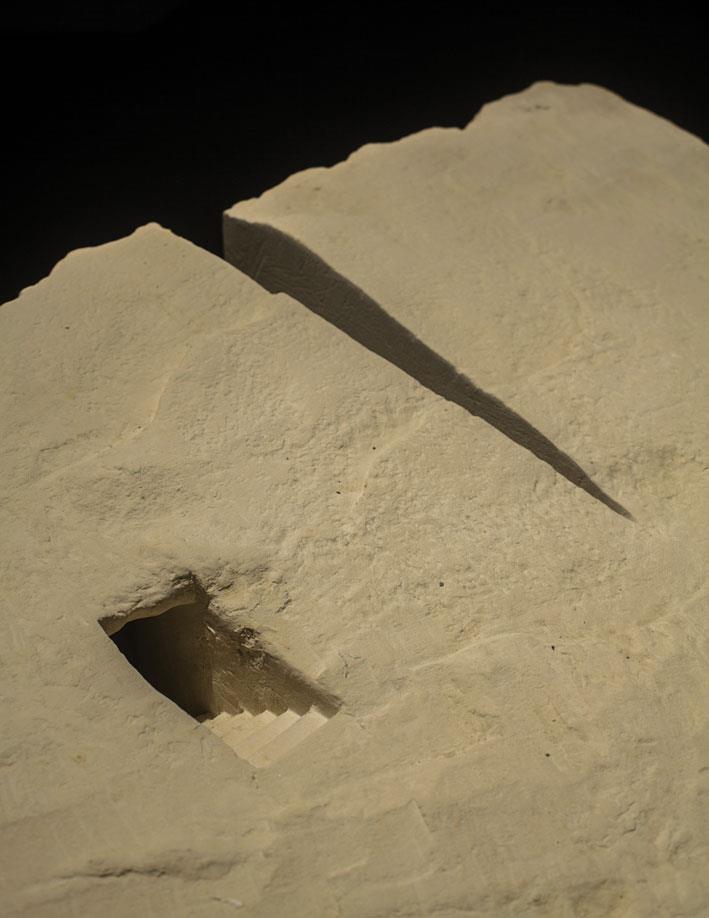
Victor Agius, raised in the shadow of Xagħra's Ġgantija temple, finds in Manikata a church that is both ancient and modernist, a home away from home. In his works, material becomes materiality; the soil of Manikata transmutes into gold, and earth becomes sky. Austin Camilleri's Lumen forges a stairway into a boulder, leading into an inner chamber. We are compelled, even if impossible, to descend those stairs, much like prehistoric communities seeking solace in Ħal Saflieni's Hypogeum, to reach the tomb/womb within. The Church as a haven of eternal repose or rebirth. Julian Vassallo's series of monochromatic photographs displayed on the floor on travertine slabs, like puddle-reflections after a downpour, reveal elements of the church's textures, detailing, and furnishings. Harpist Laetitia Troisi de Menville along with composer Carl Borg create a sound installation where the notes of the harp mingle with field recordings from the site, including the sound of birds, wind and bells. We are invited to sit on a wooden pew and immerse ourselves in the soundscape through a set of headphones.
While the church's subtle, gentle undulating forms rise and fall in harmony with their environment, the heavy-handed development encroaching like canker sores upon its proximity is, alas, their exact opposite.
Francesca Balzan, artist and more, whose exhibition The Queue is showing in the reading room of the Casino Maltese commented:
"The exhibition hits all the right chords. It takes as its central focus a (groundbreaking) piece of architecture, miles away from the busy streets of Valletta. And yet, in the quiet halls of Palazzo de la Salle, the spirit of place is magically evoked, or recounted, through the language of each artist, as the exhibition unfolds. It starts with a sense of history and place and then each room is taken over by one of just four hand-picked artists. Through each of their contemporary art pieces they address, frame, react to the iconic Manikata church, the earliest masterpiece of Richard England.
I went to this exhibition questioning how one could make an exhibition that addressed and revered an absent art piece...absent because it was miles off to the North, in rural Manikata, and it is a building not even an object after all. Andrew Borg Wirth, who keeps producing one exciting exhibition after another, curates this exhibition with sensitivity and a minimal approach, paring back to the essential in a beautiful parallel with the building that is being celebrated itself.
The choice of artists is key. Victor Agius responds to the Manikata site in the most tangible manner, working Manikata soil into his art pieces. A suspended disc of his tactile clay terrarossa is visually stunning and - I would hazard a guess - a technical marvel in its own right. Austin Camilleri's block of rough limestone reveals, on close inspection, a crevice and a doorway and staircase hewn into it seemingly penetrating to another doorway. There is hidden architecture here, and it is easy to draw parallels with the troglodytic caves near Manikata. Once again a relic of the landscape is brought from rural Malta into these Valletta halls. Less tactile but no less effective are the beautiful photographs of the church, by Julian Vassallo placed on slabs of stone, and the soundscape created by Laetitia Troisi de Menville that draw on the sounds she knew growing up in Manikata. This is a landscape (like the rest of Malta) under threat and the church itself deserves every protection possible, not only in its fabric, but to retain the integrity of the natural site that it is rooted in.
The exhibition serves as both an homage to Richard England's philosophy and a call to protect the delicate harmony between the church and its natural surroundings. It's a poetic celebration that balances reverence for tradition with the boldness of modern creativity, encouraging attendees to reflect on the fragility and beauty of the spaces we hold sacred."
I am sorry I simply didn't manage to hear the birdsong. On a personal note, it is the 50th birthday for my eldest. She has the same birthday as the Manikata church. I am so surprised I am here to celebrate both.
[email protected]