I particularly enjoy attending exhibitions at Gallery 23 in Balzan. It is a cheerful kind of place. Perhaps it's the ambiance - how the space feels. Some galleries have an innate energy. Maybe it offers a comforting balance between intimacy and expansiveness that lets you connect with the art on display in a more personal way.
Or, perhaps it's the people - curators, Rachel Said and Alexia Gingell Littlejohn; the artists, many of whom I am now on friendly terms with and recognise their work immediately or even the visitors and collectors who create a communal sense of shared experience.
Then there's the emotional connection. I like the two gallerists, both busy young wives and mothers who put their heart and soul into these exhibitions.
I am a Diarist and neither a music nor art critic. I like supporting artists of all kinds and writers who do so much work often for little gain. I like helping them by giving publicity to their work, this is why I keep my Sunday Diary going.
Last week I went to Gallery 23's fourth edition of Collectively Solo which brought together a diverse group of nine artists many exhibiting at Gallery 23 for the first time. When I arrived guests were spilling out of the main door and onto the small terrace, vino tinto in hand. I walked through to the garden to survey the scene and say hello to my hosts and came across several unfamiliar faces. Were they new artists, collectors, guests like myself? I knew that some were foreign artists exhibiting in Malta for the first time.
Collective art exhibitions, where multiple artists showcase their works together, are fascinating and dynamic. They come with both advantages and challenges.
They bring together varied styles, themes, and perspectives, offering audiences a richer artistic experience. It's a melting pot of creativity.
In this kind of ambience artists can connect with each other, share ideas, and form collaborative relationships. It's also a chance to meet collectors.
By joining forces, artists share expenses and responsibilities.
Less established artists can benefit from the presence of well-known names in the same show, attracting a wider audience.
Collectives draw in people with varied tastes who may discover new favourite artists.
The disadvantage is that individual artists get less space or attention compared to a solo exhibition. It can be challenging for their work to stand out.
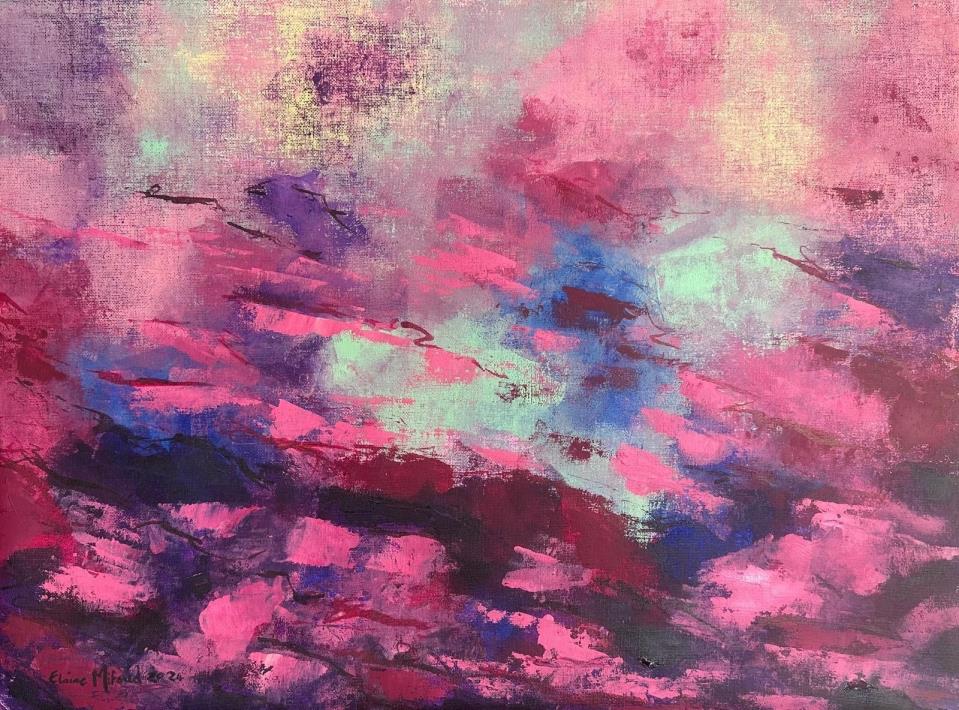
I picked out two new artists at random and asked them about their art. One was a teacher Elaine Mifsud who told me that she had shifted to abstract painting and that is what she was exhibiting here: "The shift towards abstraction came as an exploratory move when last year I set off working on my solo exhibition which will happen next September. Since my academic training at the Malta School of Art I have always worked on realistic compositions executed from direct observation such as still life. Therefore, at first it wasn't that easy to tackle abstracts. I used to think that creating abstract art is easy but I soon realised that it is far more complex than it seems. My passion and obsession with colour helped me explore unlimited ways to express myself using various mediums such as soft pastels, acrylics, acrylic inks and oils, drawing inspiration from my own emotions and philosophical thoughts on life. When I am at work on my pieces I enter into a meditative state and shut off all that is going on around me, and it's just me, and my inner world of colours."
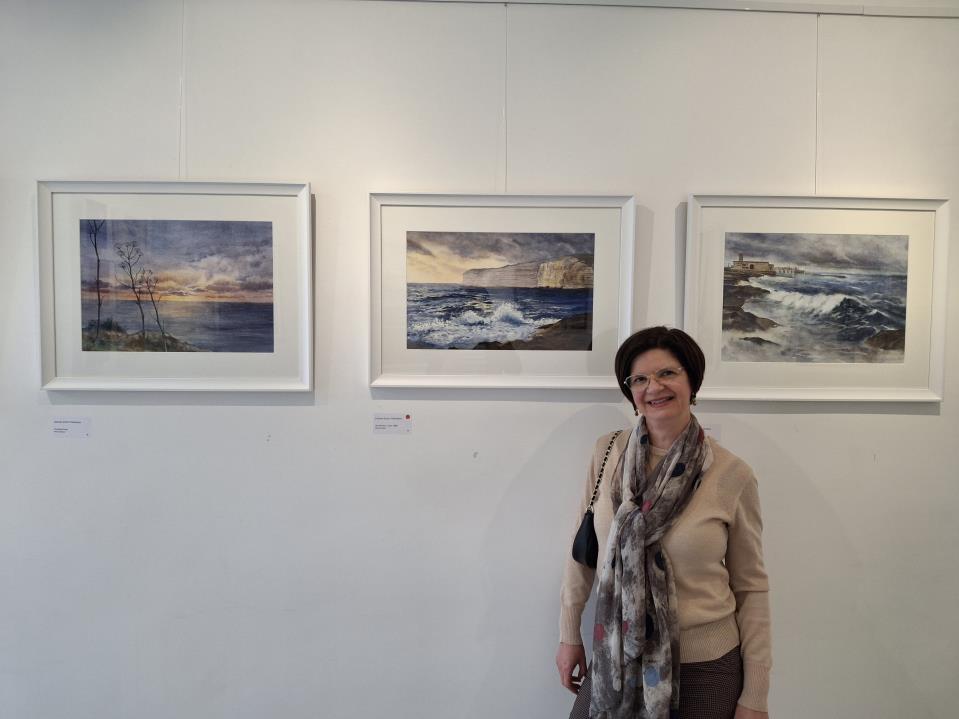
Joanne Scerri Valentino was another new name to me. Here is how she expressed herself: "All my works are rendered in watercolour, a medium I love for its fluidity and transparency.
My main paintings are the three seascapes that reflect fleeting moments in life, each with a different mood. From the symphony of colours that light up the sky in Evening Song to the wind ruffling up waves in Sea Breeze, to a more dramatic clash of sea and sky in Storm over Tower Road.
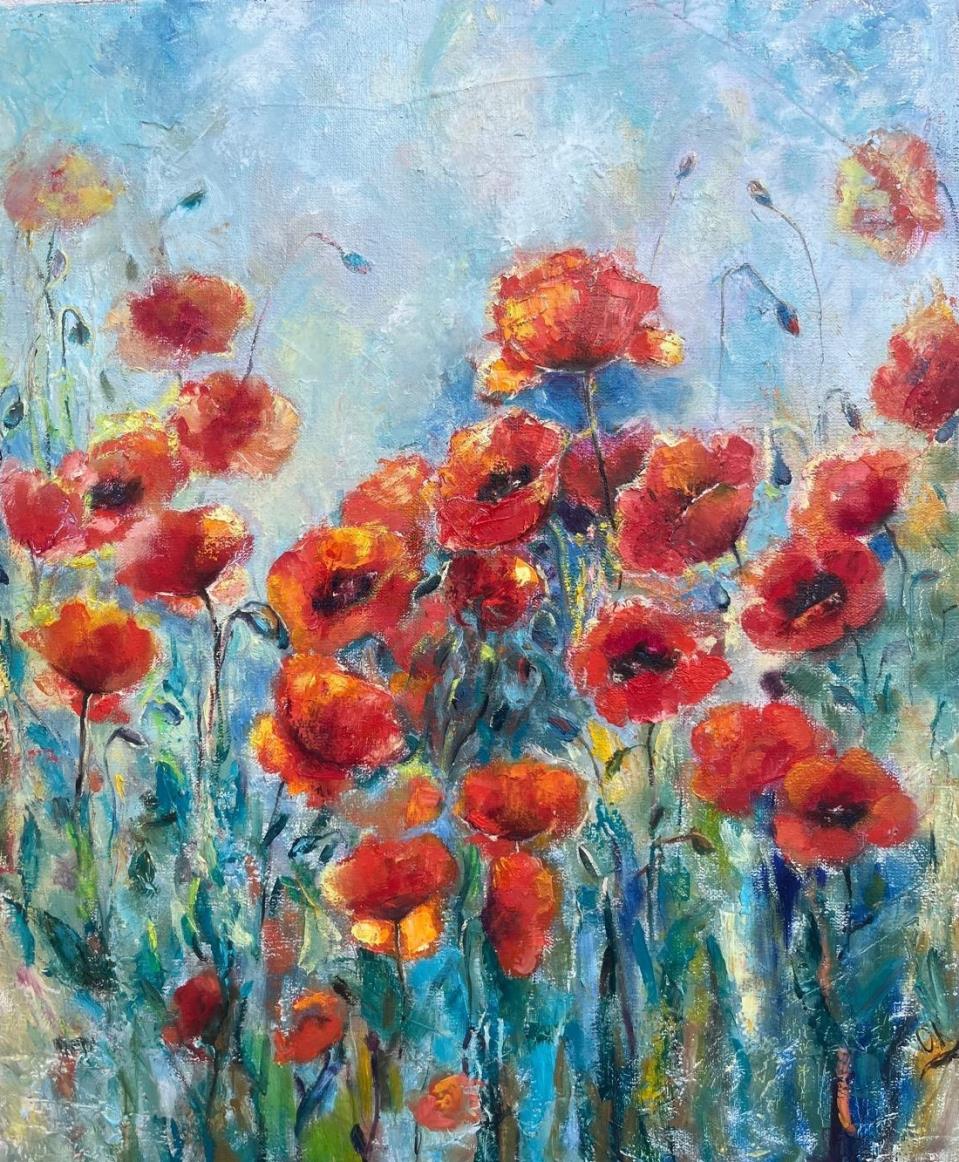
My floral paintings celebrate wildflowers that grow on the wayside, often overlooked, giving them the status and dignity they deserve as painting subjects."
From being an unknown the time came when artists started to be appreciated. In one of his influential treatises Della Pittura, during the Renaissance, Leon Battista Alberti saw the artist as "the most favoured among men" because "he competes with God in the act of creation." Alberti held artists in high esteem, believing them to be among the most favoured and gifted of all individuals. In his treatises, particularly Della pittura, Alberti celebrated the artist as not merely a craftsman but as a creator capable of elevating the human spirit and contributing to the betterment of society. He emphasized the intellectual and imaginative aspects of art, suggesting that artists possessed divine-like abilities to shape and create beauty. His perspective helped elevate the status of artists in the Renaissance from manual labourers to intellectuals and innovators.
As we know, artists depend on collectors and patrons such as churches, as they always have: the Medici family, for an obvious example, who commissioned works by Leonardo da Vinci, Botticelli, Michaelangelo; the Gonzaga family known for their patronage of painters like Andrea Mantagna; the Papal Court. How would Raphael and Michelangelo have survived without the patronage of Pope Julius II and Leo X?
It is largely thanks to galleries that local artists manage to survive, make their work known and sell it.
Do go and see this collective. There is a great variety of art and it is uplifting.
Please note that Collectively Solo closes on 11 April.
The participating artists are: Glendine Chisholm Elaine Mifsud, Godwin Muscat Azzopardi, Henry Borg Barthet, Henry Falzon, Joanne Scerri Valentino, Julia Borg, Maris Zammit and Olha Kovalchuk.
Gallery 23 is located at 23 Idmejda Street, Balzan. Opening hours: Wednesdays from 6.30 to 8pm and Sundays from 10.30am to 12.30pm.
Visits can also be made by appointment on 9942 8272 or by emailing [email protected]