Luigi Piovano was truly remarkable at the Manoel Theatre last week - his ability to seamlessly transition between conducting and performing as a soloist is a testament to his artistry and was much appreciated by the large audience. As the Principal Cellist of the Orchestra of the National Academy of Santa Cecilia, he has built an impressive career, collaborating with renowned musicians and leading performances with elegance and precision. His dual role as conductor and cellist added a unique dimension to last week's concert at the Manoel Theatre, creating an intimate connection between the orchestra and the audience.
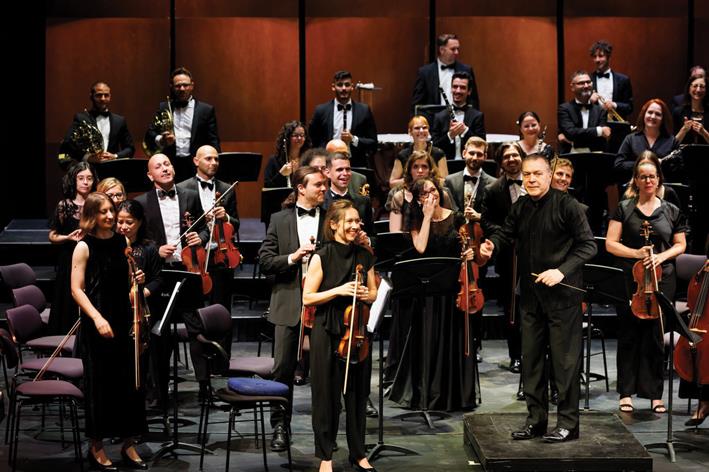
The evening consisted of a rich selection of pieces, spanning different styles and eras.
Saint-Saëns' Cello Concerto No. 1 in A minor, Op. 33 is often praised for its seamless structure, breaking away from the traditional three-movement format. It was composed in 1872 for Auguste Tolbecque, a distinguished French cellist. Unlike many concertos where the orchestra introduces the theme, Saint-Saëns immediately gives the cello a commanding presence. That evening, indeed, the cellist had as commanding a presence as did his cello.
Camille Saint-Saëns was a fascinating composer who blended Romantic expressiveness with Classical precision. His music often reflects a balance between technical brilliance and lyrical beauty.
He was intrigued by non-Western music, incorporating elements from North Africa and the Middle East, particularly in works like his Piano Concerto No. 5 ("Egyptian").
He was sometimes criticized for being too conservative compared to composers like Debussy, but his works remain beloved for their elegance and craftsmanship. His influence extended beyond France, inspiring composers worldwide with his technical mastery and orchestral innovations.
Saint-Saëns (1835-1921) was in fact a child prodigy. To most of us now, he is but a composer. In his day, however, he was so much more. Indeed so much more that even his contemporaries found him hard to categorise. Liszt, for example, once called him 'the greatest organist in the world'. Whatever the subject it seemed that Saint-Saëns was an expert at it. He was a proudly nationalist composer. Together with Gabriel Fauré he established the Societé National de Musique, which existed solely to promote French music. The young SS could read, write and play tunes on the piano at the age of just two. By the time he was seven years old he was something of an expert on lepidoptera (butterflies to us mere mortals).
When the great Tchaikovsky received his honorary degree from Cambridge University on 13 June 1893 (the feast of St Anthony of Padua, by the way) he was in the company of Saint-Saëns, Bruch and Puccini's librettist, Arrigo Boito.
The Cello concert, that evening at the Manoel, was very well received. Everyone on stage seemed to sparkle and be in a good mood. I suspect the conductor/cellist had a great deal to do with it. The audience was most enthusiastic. There were quite a few Italians in the boxes overhead. In the theatre our neighbours are much more extrovert than we are which, I am sure, is very much appreciated by those on stage.
After the cello concerto we were rewarded with an unannounced encore. Instantly recognisable, it was Le Cygne from the composer's Le Carnaval des Animaux. And so we were enjoying one of the most famous cello solos ever written, not as an encore but unexpectedly, at the beginning of the concert. Le Cygne stands out for its serene, flowing melody, evoking the graceful movement of a swan gliding across water. In my mind's eye I was imagining Margot Fontyn gliding on a London stage, just as I had watched her, many mango seasons ago on some stage in London.
The piece was one of the few movements Saint-Saëns allowed to be published during his lifetime, as he feared the rest of the suite would damage his reputation as a serious composer. The audience loved it. There is some music most of us are prepared to listen to all day and every day and this piece is one of them.
Then followed Rossini's Overture to L'Italiana in Algeri. Rossini composed this opera at just 21 years old, reportedly in less than a month. The overture is a brilliant mix of playful energy and dramatic flair, setting the stage for the comedic opera that follows. The opening pizzicato passage is particularly striking, leading into a whirlwind of orchestral brilliance.
2025 marks the 46th edition of the Rossini Opera Festival in Pesaro, Italy. While there isn't a major milestone anniversary for Rossini himself this year, the festival continues to celebrate his legacy with new productions and revivals of his operas. We enjoyed quite a few Rossini concerts here this year including his popular opera, Il Barbiere di Seviglia.
The concert closed with Beethovan's Symphony No 8 in F Major. I have to say I did not enjoy this symphony particularly. Compared to his great symphonies like the Pastoral; Eroica; No 5, instantly recognisable by its dramatic "fate knocking at the door"motif; No 7 known for its energetic rhythms and the deeply moving second movement; No. 9 ("Choral"); Famous for its Ode to Joy, a monumental piece that introduced choral elements into symphonic music.
As the final notes of Beethoven's Symphony No. 8 faded into the night, the audience left with a sense of musical fulfillment. From Piovano's masterful cello to the lively charm of Rossini and the unexpected encore of Le Cygne, the evening was a testament to the beauty and power of classical music. Another memorable night at the Manoel Theatre, and one that will linger in the minds of those who were fortunate enough to experience it.
[email protected]