From his early training at the Government School of Art to a lifetime of exhibitions, he reflects on the discipline of painting, the pull of memory, and the enduring mystery of light that continues to shape his work.
What first drew you to painting, and how has your relationship with the medium evolved over time?
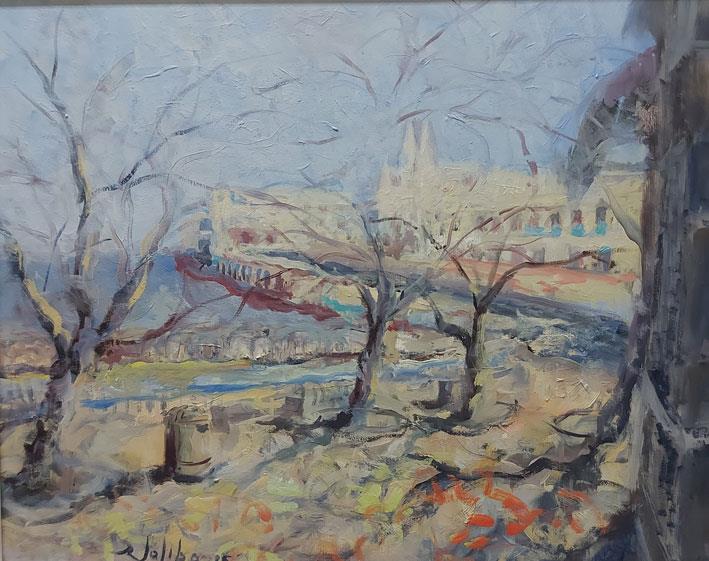
My first encounter with painting dates back to 1960, when I enrolled at the Government School of Art. Under the tutelage of Vincent Apap, Esprit Barthet, and George Borg, I began by learning the fundamentals of drawing, initially through still life and later through studies of the human figure from classical cast statues. In my later years at art school, I was introduced to the full process of oil painting: preparing the canvas, primers, pigments, oils, solvents, and varnishes. These may seem self-evident to the casual observer, but few fully appreciate the technical knowledge and material discipline required to bring a painting to completion. Mastering these processes is part of forming a deep, almost intimate relationship with the medium itself.
Can you describe a moment when you felt your artistic voice truly emerged?
My first significant artistic milestone was my debut exhibition in 1975, held at the newly inaugurated National Museum of Fine Arts in Valletta. It was a defining moment in my artistic journey. From that point onwards, my work continued to evolve, not only in style and technique but also in my understanding of what constitutes meaningful artistic expression.
How do you choose your subjects - do they call to you emotionally, visually, or through memory?
Facing an empty canvas is always a moment of hesitation, but also a possibility. It may have been waiting in the studio for some time, silently demanding an idea worthy of surpassing what came before. An artist inevitably reflects on past work: on weaknesses, repetitions, and strengths. The challenge lies in learning from these elements and striving to refine them.
Your landscapes often evoke a sense of solitude and reverie. What role does emotion play in your depiction of place?
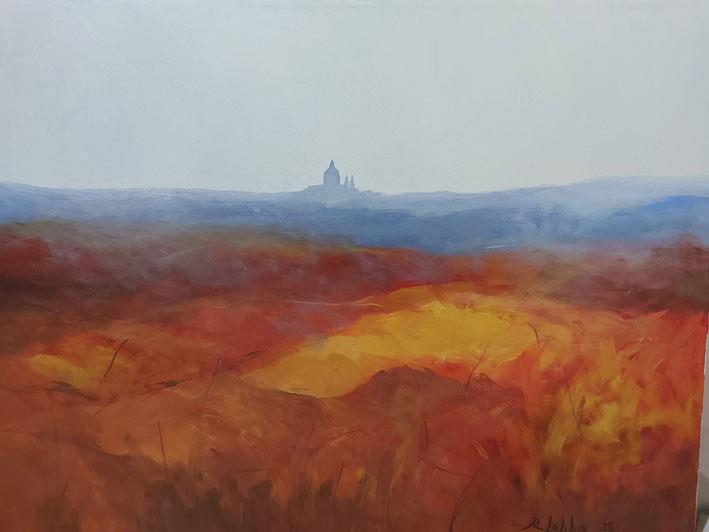
My landscapes, like all the work that inspires me, are closely tied to my character. They may appear nostalgic or romantic, but this is simply how I perceive the world. I paint in a style that has developed organically over the years, without consciously striving to produce a "great" work of art. A consistent visual timbre runs through my paintings; it reflects who I am. I paint primarily for myself, and if others respond to the work, that is an added satisfaction.
How do Maltese light, terrain, and architecture influence your palette and composition?
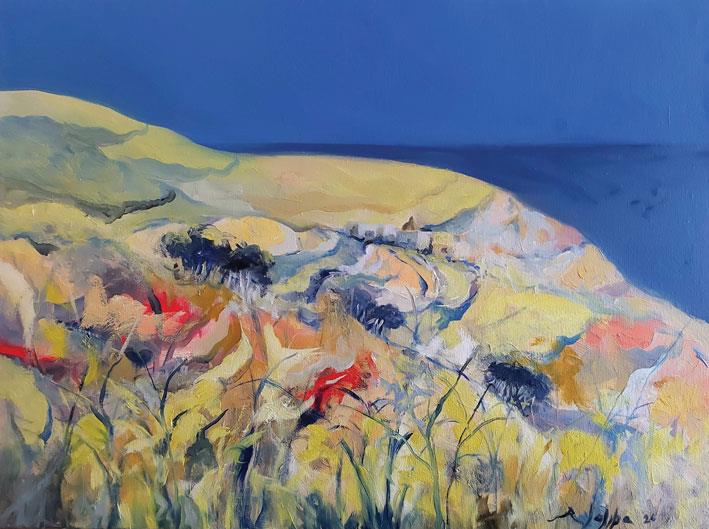
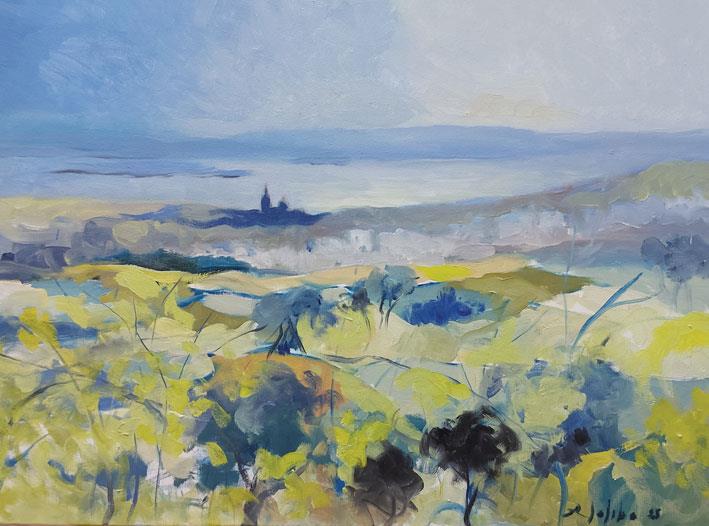
For visitors from northern Europe, accustomed to long stretches of grey, mist, and cloud, Mediterranean light can be a revelation. For us locals, it is something we often take for granted, yet it inevitably permeates our work. Landscape has long been my primary source of inspiration, and I have always been curious about what defines the Maltese landscape. It is unmistakably Mediterranean, comparable to Sicily, yet distinctly its own. The arid, sun-drenched terrain has a unique identity that invites close observation and study. My landscapes are an attempt to engage with and convey this complexity.
Do you paint en plein air, from sketches, or from memory? How does each method shape the final work?
In the past, I painted extensively en plein air. Today, due to my age (83), this has become more challenging, although I recently had the opportunity to do so under favourable conditions and was very satisfied with the results. I also work in my studio from memory, my own early paintings, or from photographic material that suggests particular features or compositional possibilities.
Could you walk us through your process, from first inspiration to final brushstroke?
Inspiration usually comes from scenes encountered while visiting the countryside, especially in Gozo, whose hills are particularly evocative. The light itself often suggests the colours and tonalities I wish to explore. Indeed, nearly half of the works in this exhibition depict Gozo. I do not spend much time on preliminary drawing; instead, I begin painting directly with the brush, blocking in the areas I consider most prominent. This approach comes with experience and confidence. From there, the painting develops organically, through constant adjustment and refinement.
What materials or techniques do you return to again and again, and why?
There is no single medium or technique that defines an artist. One's artistic identity is present regardless of whether one works in oil, acrylic, or any other material. Even our distant ancestors, the cave painters, used whatever materials were available to leave a mark. What matters is not the medium itself, but the imprint of the artist.
Do you know when a painting is finished?
Sometimes I feel that a painting is complete, only to return to it later and decide that changes are needed, whether minor adjustments or, occasionally, more substantial revisions. As long as a work remains in my studio, it is open to reconsideration. Often, the final brushstrokes are added the following day. One of the most difficult lessons for any artist is learning when to stop and resisting the temptation to overwork a painting.
What does painting offer you that words or other forms of expression do not?
Painting, like all forms of artistic or literary expression, lays the artist bare. It reveals one's true, unguarded self and allows others to glimpse who and what you are.
Do you see your work as part of a larger tradition or movement, or do you prefer to remain outside such definitions?
I do not feel the need to belong to any particular movement. I draw inspiration from many sources and traditions, each offering elements I can relate to. There are, of course, artists who have had a strong influence on me, such as David Hockney, whose exhibition at the Fondation Louis Vuitton in Paris I visited this past summer.
How do you hope viewers feel when they encounter your work?
I have been exhibiting my work for over fifty years, and during that time, my approach has developed into a recognisable personal language. Viewers familiar with my work may know what to expect, though certain pieces will inevitably stand out for their more experimental qualities. While my paintings retain a consistent timbre, I have continued to evolve. Many will recall my earlier hard-edge landscapes; this latest body of work moves towards a more expressive approach, with freer, more spontaneous brushwork, particularly in the foreground.
Are there artists, past or present, who have shaped your vision or inspired your practice?
The Impressionists were among the first to capture my attention. Over time, I discovered other artists whose work I have long admired, including Paul Gauguin, Renato Guttuso, Felice Casorati, and David Hockney.
What role do exhibitions and public engagement play in your creative life?
Each exhibition provides a measure of progress, allowing me to reflect on how my work has developed from one presentation to the next. Viewed over the long term, exhibitions reveal the gradual improvements made through years of sustained practice.
If you could pass one message to future generations of artists, what would it be?
Enjoy what you do, learn from others, remain humble, and work hard. In time, the results will follow. Painting gives purpose: a reason to live, to dream, and to continually strive for improvement.
Please leave space here
Across more than fifty years of artistic practice, Richard Saliba has remained committed to the slow, attentive act of looking - at land, at light, and at the shifting terrain of his own inner life. His paintings trace a journey of refinement rather than reinvention, revealing an artist who continues to evolve while remaining true to the sensibility that first drew him to the canvas. In his words and in his work, one finds the same qualities: humility, curiosity, and a deep, sustaining love for the craft that has given his life purpose and direction. For Saliba, painting is not merely a vocation but a way of being in the world - a quiet, persistent search for meaning through colour, form, and the landscapes that have shaped him.
Richard Saliba'solo exhibition of paintings Reflections of Tranquility is open at The Palm Court Lounge, Phoenicia. It is curated by Charlene Vella and closes on 1 March