A striking sense of visual clarity greets visitors stepping into Palazzo Ferreria in Valletta, where the veteran Maltese artist Joseph Pulo is currently showcasing a major personal exhibition. Running until 30 July, the exhibition serves as a comprehensive mid-summer highlight for the capital's cultural calendar, drawing art enthusiasts, collectors, and curious passersby alike into Pulo's highly disciplined, yet deeply poetic world of form, structure, and colour.
Pulo's signature hard-edge style is a method defined by sharp transitions between colour areas, crisp lines, and intentionally simplified forms, immediately reminds local art lovers of another veteran Maltese master, the late Harry Alden (1929-2019). Like Alden, Pulo possesses an innate ability to strip away the chaotic visual noise of reality, leaving behind a clean, balanced, and harmonious framework. Yet, as this curated collection demonstrates, Pulo carries this rigid aesthetic into a deeply personal, distinctly Mediterranean realm that remains entirely his own.
A consistent and unified vision
The exhibition brings together a remarkably diverse selection of works that vary widely across multiple genres. Visitors will find themselves moving seamlessly between urban landscapes, figurative works, portraits, geometric abstracts, and intimate studies of flowers and leaves. What makes the collection so compelling is how Pulo maintains a completely unified visual language across these distinct and seemingly contrasting subjects. Rather than offering literal descriptions of the world around him, his paintings function as analytical reconstructions, transforming raw human observation into tight pictorial structure, and everyday experience into vibrant colour.
In an era where contemporary art often leans into the chaotic or the conceptual, Pulo's paintings immediately assert a distinctive visual clarity that is both deliberate and quietly compelling. His work is deeply rooted in a hard-edge aesthetic that privileges precision, balance, and the eloquence of simplified form. Yet, what emerges from this highly disciplined approach is not a cold emotional detachment, but rather a deeply felt, authentic engagement with the visual and cultural environment of Malta.
Reorganising the Maltese landscape
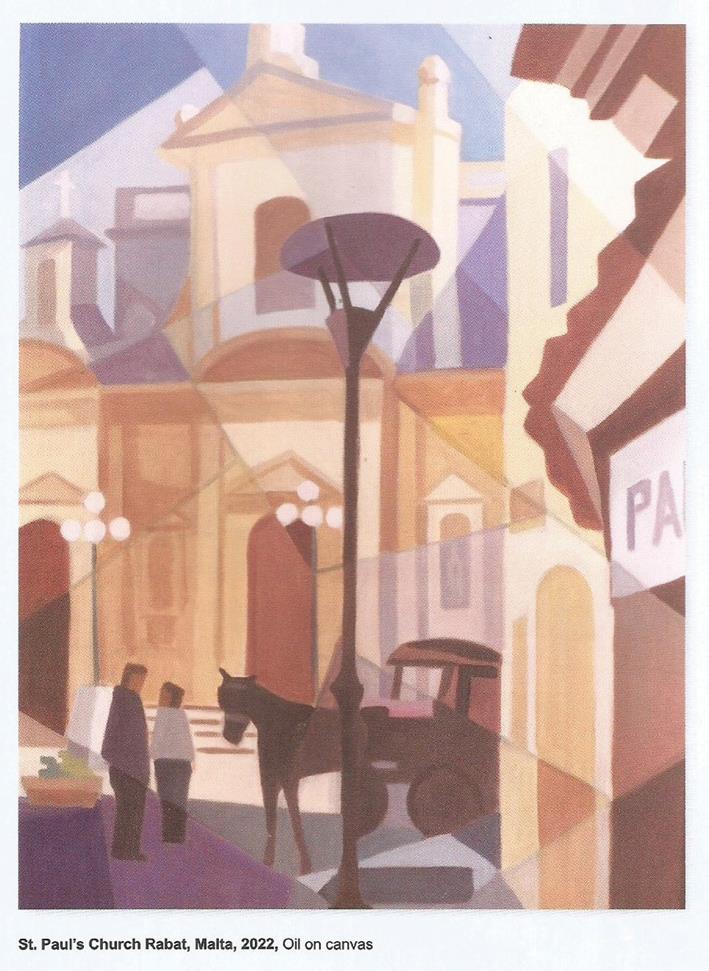
The streets, churches, and historic buildings that populate his compositions are excellent examples of this approach. In striking works such as Palazzo Ferreria (2025) and St Paul's Church, Rabat (2022), Pulo translates iconic local architecture into complex arrangements of interlocking planes. Valletta's grand fortifications, narrow side streets, traditional wooden balconies, and limestone facades are reorganised into a visual syntax that is simultaneously ordered and dynamic. Here, light and shadow are completely reimagined as bold, chromatic contrasts rather than naturalistic gradients. His use of colour, often bold, sometimes entirely unexpected, does not seek to imitate the visible world, but rather to reconstruct it, allowing the familiar elements of our daily lives to appear newly resolved and transformed.
While his engagement with hard-edge painting safely situates Pulo within a broader international art historical trajectory, recalling the reductive clarity of Ellsworth Kelly, the graphic immediacy of Patrick Caulfield, the spatial stylisations of David Hockney, or the balanced planar divisions of Richard Diebenkorn's abstracted spaces, the Maltese environment remains his true anchor. His canvases radiate the specific warmth, density, and unique architectural character of the Mediterranean.
Form, fragmentation, and understated narrative
What is particularly striking to any viewer exploring the gallery space is the effortless consistency with which this mathematical language extends into genres like portraiture and nature. In his portraits, including self-portraiture and depictions of local cultural figures, the human form is treated with the exact same formal economy. Physical features are systematically reduced to essential shapes, bodily volumes are flattened into intersecting planes, and identity emerges through the careful orchestration of colour and structure rather than tedious detail. These works intentionally resist dramatic psychological overstatement, instead offering a contemplative stillness that invites prolonged, quiet viewing.
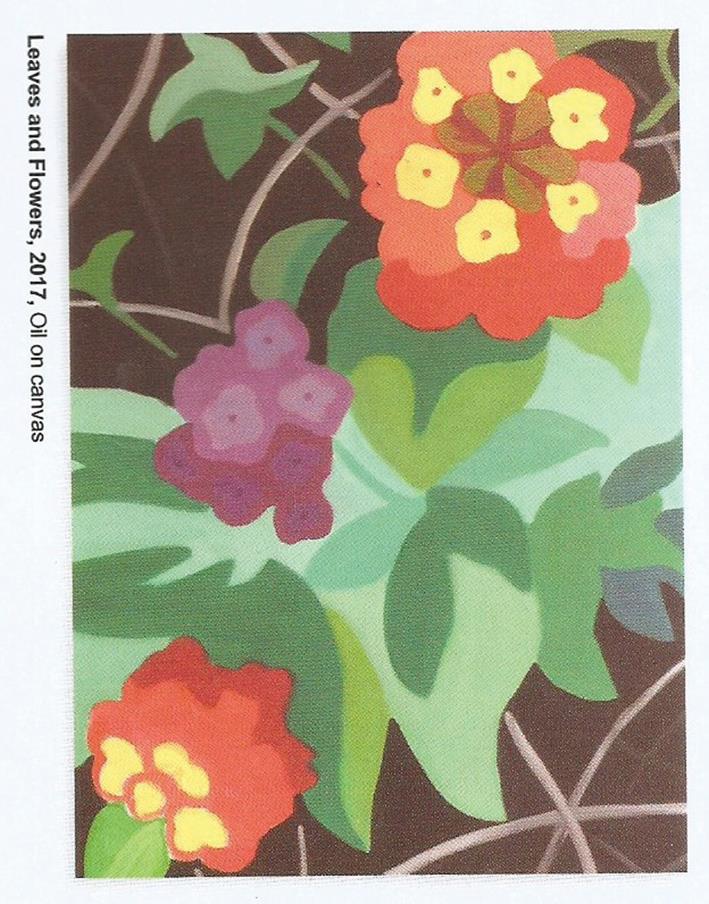
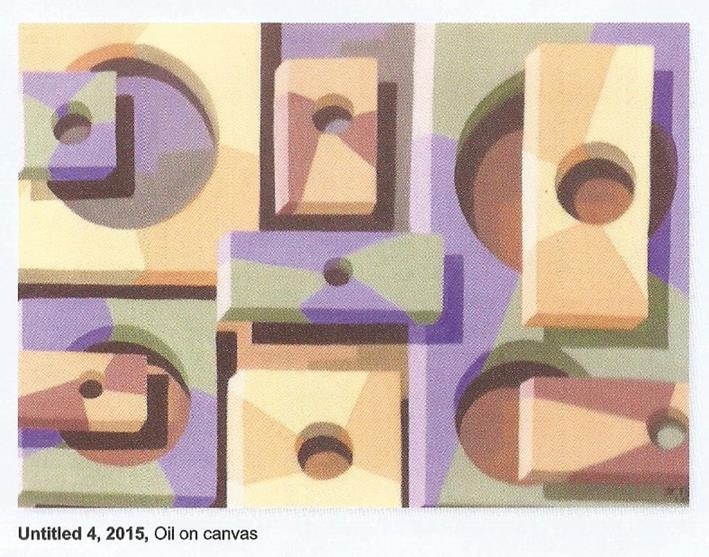
Similarly, Pulo's floral compositions, such as Leaves and Flowers (2017), and his purely abstract geometric works, like Untitled 4 (2015), are not random departures from his core practice, but natural extensions of it. Flowers are rendered as rhythmic constellations of colour; their organic forms neatly translated into geometric harmonies. His abstract paintings foreground the underlying principles present throughout his entire career: balance, repetition, and the intricate interplay of positive and negative space. Across all these subjects, the artist maintains a delicate equilibrium between rigid control and organic vitality.
A particularly fascinating aspect of this specific exhibition is Pulo's exploration of fragmentation and reconfiguration. Several paintings on display are derived from isolating small details or segments of much larger compositions. By framing a single architectural fragment, a passage of colour, or a specific structural rhythm, the artist allows these individual components to function autonomously as standalone abstract pieces, while still retaining a phantom dialogue with their original context. This method introduces a subtle tension between the whole and the part, encouraging the newspaper reader and gallery visitor to consider how meaning shifts entirely through framing and scale.
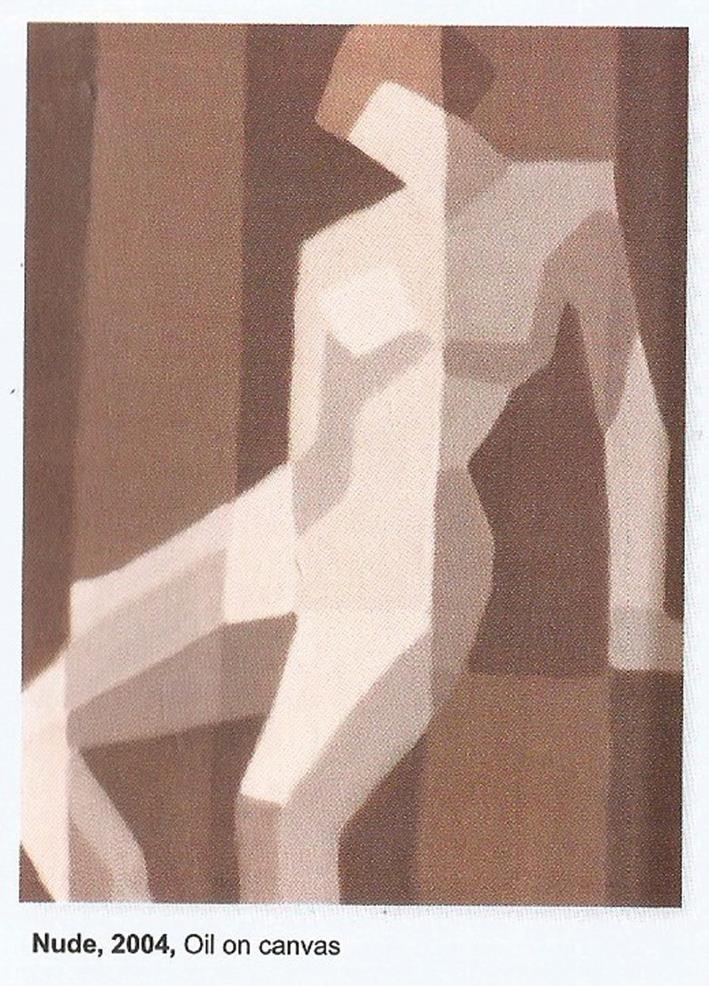
Even in his depictions of everyday life, whether capturing bustling market activities, maritime settings, traditional horse-drawn carriages, or a classic Nude (2004), the narrative element remains brilliantly understated. Human figures, boats, stalls, and urban elements are integrated directly into the overarching geometric framework, becoming equal parts of the overall composition rather than dominant subjects.
An exploration of seeing
Ultimately, Pulo's artistic practice can be understood as a profound exploration of seeing itself, a masterclass in how the world may be entirely reordered through clarity, reduction, and balance. Moving effortlessly between abstraction and representation, his paintings function simultaneously on multiple levels: as evocative images of a specific place, as academic studies of form, and as meditations on the very act of human perception.
This exhibition successfully affirms Pulo's lifelong commitment to a coherent, yet continually evolving artistic vision. Whether you are engaging with the architectural heritage of Malta, the intimacy of his portraiture, or the expressive potential of his geometry, his work remains unified by a disciplined hard-edge sensibility that continues to refine and expand its possibilities. It is an exhibition that demands a slow walk, rewarding the viewer with a renewed perspective on the world we see every day.
Prof. Louis Laganà PhD (Lough) is an academic, curator and practising artist