There's a new weight-loss craze taking hold in Malta, and it makes Ozempic look slow.
Retatrutide, the peptide its own online community has nicknamed the "miracle in a bottle", is faster acting, unlicensed, and increasingly easy to get hold of - be it through a website, a TikTok page, or a Facebook grapevine, rather than a doctor.
But if it sounds too good to be true, it usually is. The drug remains unregulated and is still going through clinical trials, with no approval yet for human use anywhere in the European Union.
Superintendent of Public Health Charmaine Gauci has warned against the use and consumption of the drug, saying that products obtained from illegal or unauthorised sources may be falsified, substandard, contaminated, improperly stored or contain incorrect ingredients or doses, exposing users to serious and unpredictable health risks ranging from treatment failure and infection to severe adverse reactions.
An extensive investigation by The Malta Independent on Sunday delves into the craze, revealing how social media is being used as an underground marketplace, how demand has left some pharmacies struggling to keep syringes in stock, and how the drug does not always deliver the results users are hoping for.
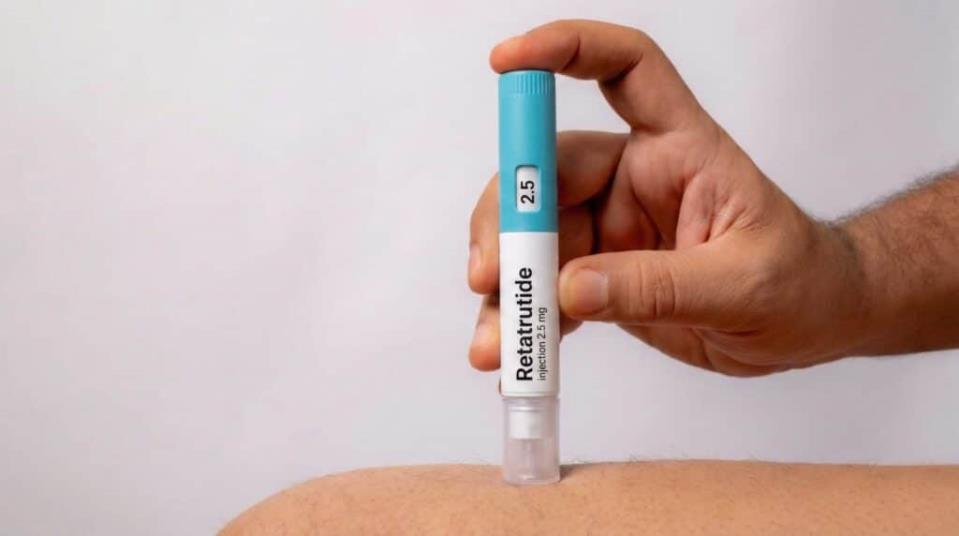
What is Retatrutide?
Retatrutide, dubbed "Reta" by the online community that has formed around it, is a triple-receptor agonist developed to treat obesity and related metabolic conditions.
It has not been granted marketing authorisation by the European Medicines Agency or the UK's Medicine and Healthcare Products Regulatory Agency and remains in Phase 3 clinical trials - meaning that it has not been approved for human use.
Yet it is being brought, injected and discussed by ordinary people in Malta.
Retatrutide works by simultaneously activating three hormone receptors, GLP-1, GIP and glucagon, distinguishing it from single or dual-action medicines such as Ozempic and Mounjaro, which are both licensed for use in the EU.
It is mainly administered by injection. Users typically have a vial containing the liquid substance and use a syringe to draw out the required dose, which is usually 5 milligrams per week.
The drug is associated with almost extreme weight loss: a phase 2 trial published in the New England Journal of Medicine in 2023 recorded a mean body weight reduction of roughly 24% over 48 weeks in participants on the highest dose.
Researchers involved in that trial however were explicit in their conclusion that the result was from quite a small study, and that larger Phase 3 trials were needed before the substance could be considered for approval.
The limited Phase 2 data that does exist about the drug however lists several possible side effects of Retatutride as a compound: nausea, vomiting, diarrhoea, constipation and reduced appetite - generally the symptoms are mild to moderate, though severe or persistent vomiting or diarrhoea carries a risk of dehydration and acute kidney injury.
Researchers also flagged other points that needed further investigation: increases in resting heart rate; a heightened hypoglycaemia risk for people also taking insulin or sulfonylureas; delayed gastric emptying; thyroid C-cell tumours which were seen in rodent studies; and an increased risk of gallstones.
The drug's manufacturer has not yet submitted retatrutide for approval to either the FDA or the EMA, with a decision not expected before 2027 at the earliest.
Until then, retatrutide remains, in regulatory terms, an experimental drug rather than a medicine - meaning none of the manufacturing, batch-testing, or post market surveillance requirements that apply to a licensed product currently apply to it at all.
Malta's social media Retatrutide sounding board
The fact that Retatrutide remains unapproved, however, has not deterred members of the Maltese general public, with people drifting to social media for advice on how the drug works, and whether they should take it.
One post on the popular Facebook group, Are You Being Served, for instance, attracted 442 comments - some answered that the substance is not yet approved, others answered with their weight-loss journey through the drug.
Another post drew 47 comments, with the answers similarly varied: one commenter warned that "you don't know exactly what you're buying", because the drug is not yet approved - but others spoke of their experiences using the drug.
One person said that she had lost four kilograms in three weeks using Reta, but felt very tired and nauseous whenever they ate anything "not healthy". Another said that she had lost six kilograms with no side effects at all. A third said that she had lost four-and-a-half kilograms, but warned that people needed to be careful about regaining weight once they stopped taking the drug.
Posts were rife in another popular Facebook group called Women for Women as well.
Here, one person said that they had been referred to a nail salon to purchase the drug from, while others asking directly where they can buy Reta from were met with users telling them to message them privately - something which is a repeated pattern on posts such as these.
Not everyone's experience was positive, though. One commenter on a post in the group Women for Women wrote "Don't take it! I just went under surgery with twisted bowels because of Reta".
Other commenters had concerns about the product itself. Some posted asking whether the substance they'd receive was "transparent or white", having seen two visibly different versions in circulation - a discrepancy buyers have no reliable way of explaining without any laboratory oversight.
These concerns were of no deterrent to some, however.
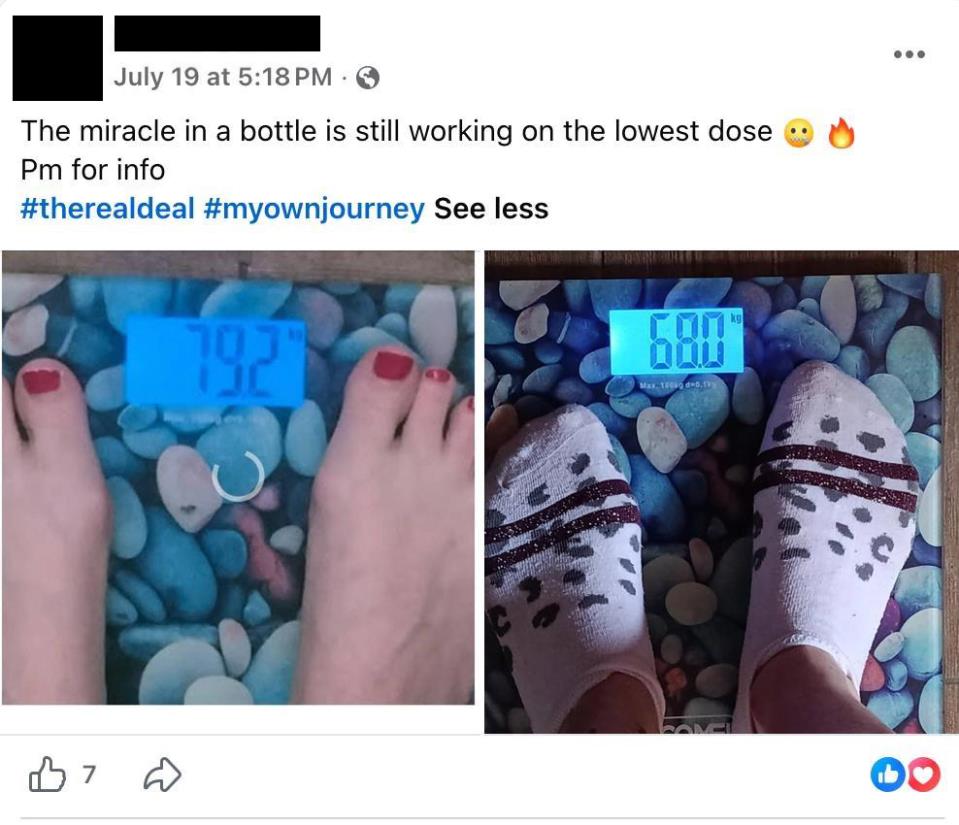
One person who claims to sell Reta posted two pictures showing her weighing scales and a weight loss of 11 kilograms. "The miracle in a bottle is still working on the lowest dose," she wrote, inviting those interested to message her for information.
Asked how the weight loss had been achieved, she replied by simply naming Retatrutide.
Websites, TikTok, and AI-generated promotional material
While some sellers prefer to carry out their dealings with would-be buyers privately, there are others who outright advertise the drug.
One such selling source is a website called "new-u.io" - a website offering what it describes as "research compounds", including Retatrutide. The drug's prices start from around €50 for a 5mg vial to over €300 for a 60mg pack of 10.
The listings are for freeze dried powder that buyers then must reconstitute themselves using bacteriostatic water; the site provides its own guide instructing customers to draw up the powder using insulin syringes with 29 to 31 gauge needles and alcohol swabs to sterilise the vial top.
The website's small print states that all products sold there are "designated for research use only" and that purchase is "restricted to business or institutional customers and/or qualified professionals".
Yet, there is no such verification required at the point of sale.
The more common source, however, seems to be via TikTok. The Malta Independent on Sunday found no less than four TikTok profiles which claim to sell Retatrutide.
The one with the highest following is an account named Péptiva Malta, operating under the handle @peptiva.malta, and branded with the slogan "Research, Optimise, Elevate".
The account is filled with AI-generated graphics which make sweeping health claims about Retatrutide that go well beyond its use as a weight-loss treatment.
One post, titled "5 Conditions. 1 Molecule", claims Retatrutide addresses fat loss, the liver, insulin, inflammation, satiety and "brain signalling" all at once. Another links it to "brain decline & Alzheimer's", claiming it "may help protect the brain the same way it protects the liver" - a claim with no basis in the drug's published Phase 2 data, which does not examine neurodegenerative outcomes at all.
Other posts claim that Retatrutide drives down cholesterol and blood pressure, helps with diabetes, that it "cuts liver fat by 82%", and that "Ozempic didn't show this level of effect" - a comparison that the drug's own trial data explicitly cautions against making.
The same account also has posted photographs, watermarked with its handle, of vials labelled "Péptiva Retatutide" together with other peptides. Each vial is marked as "research peptides" and as being "for research purposes".
The account also has shared pictures of boxes of disposable syringes and alcohol pads stacked by the dozen.
A blacked out certificate, and €120 per vial
How easily can this drug be obtained, though?
Posing as a potential customer, The Malta Independent on Sunday contacted Péptiva Malta directly through TikTok - and the conversation quickly moved to WhatsApp.
Asked about what information was available on the drug itself, the seller sent a few lines of marketing copy and AI-generated promotional posters, followed by an assurance that "I source it from one of the best compound pharmacies in the world so rest assured it is always produced fresh".
From this seller, the drug is priced at €120 for 20mg and €240 for 40mg.
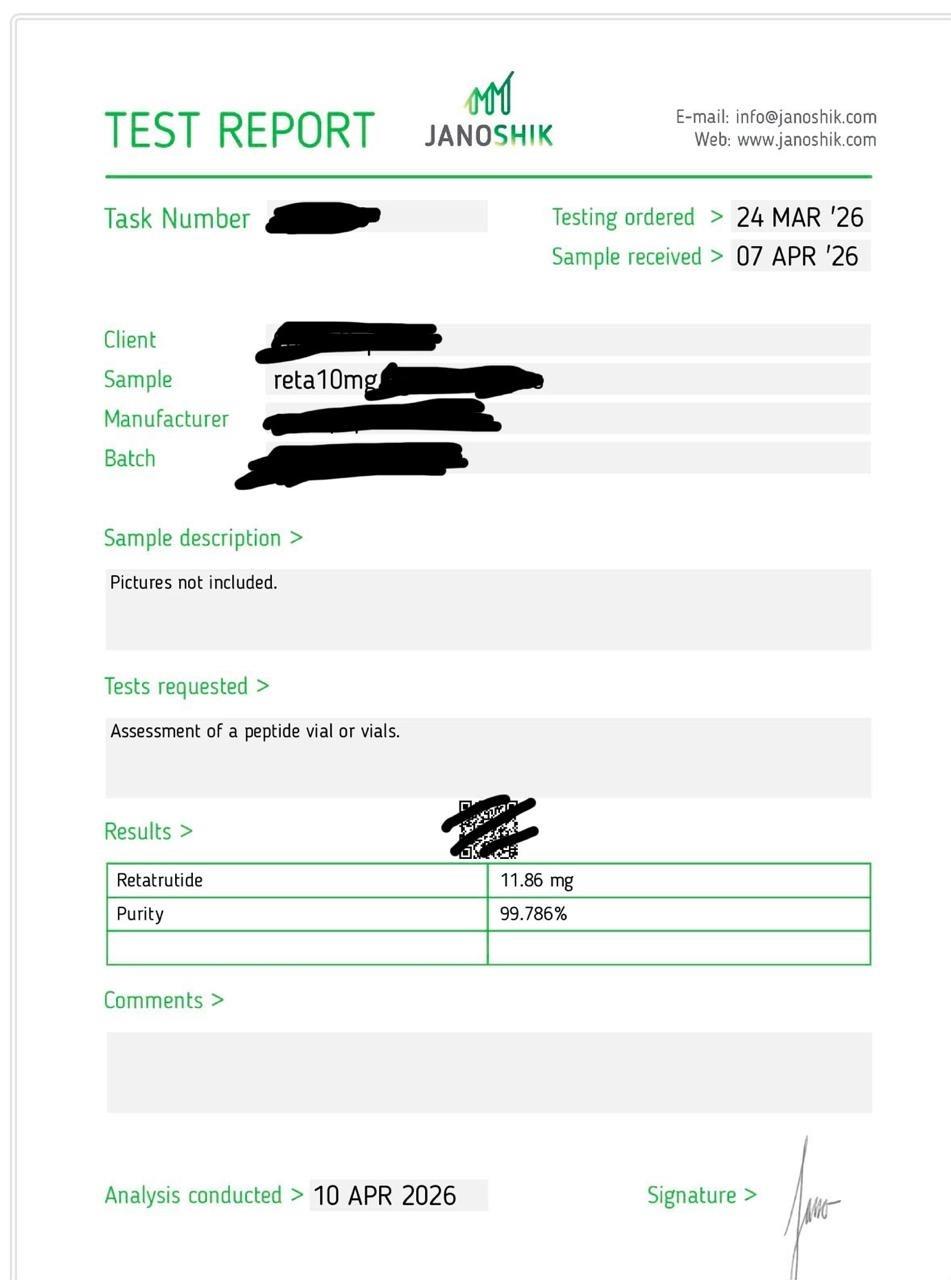
Asked for the name of the compounding pharmacy behind the product, the seller was reticent, saying that the most they could share was the certificate with the batch name blurred "because I would like to keep it private" - but they say that they did "three months research on where is the best place to buy".
Eventually, the seller sent a report from a testing laboratory in the Czech Republic. The manufacturer, batch number, and QR code for the results, however, were blacked out.
All the certificate shows is a sample described only as "reta10mg", recording a result of 11.86mg of Retatrutide at 99.786% purity. The certificate also has three dates: when the testing was ordered, on 24 March 2026, when the sample was received, on 7 April 2026, and when the analysis was conducted on 10 April 2026.
The Malta Independent on Sunday also posed as an interested customer to an individual who actively promotes the drug to her own followers on Facebook.
She did not identify a seller, but said: "I got mine from a research peptide seller, but because Reta is still a research peptide and not an approved medication in most countries, I made sure to choose a supplier that provided third party testing."
She said that she had "minimal side effects", but acknowledged that "everyone reacts differently".
The conversation did not go forward from there.
Craze means pharmacies are facing major demand for syringes
There is no data to indicate how widespread the usage of Retatrutide is in Malta, but there is evidence that points towards it become quite common.
Two pharmacists who spoke to The Malta Independent on Sunday both said that they are frequently met by clients who come into a pharmacy seeking to buy syringes specifically to use with Retatrutide.
Such has been the frequency that pharmacies have struggled to keep syringes in stock.
One of the pharmacists said: "People are buying syringes non-stop... I don't think I've ever sold so many syringes."
They said that a sales representative for one of the supplier of syringes had told them that they had reached their sales commission target for the year in April.
They recalled one client visiting the pharmacy and asking to be shown how to inject Retatrutide after it had been recommended to her by her sister.
This new phenomenon has left an effect on others suffering from medical issues: one person who suffers from a rare illness and requires frequent self-administered injections as treatment told The Malta Independent on Sunday that they could not find the right-sized syringe in stock.
The person instead had to opt for a differently-sized syringe, which is more painful and carries risks of complications.
Warning from health authorities: Retatrutide is not authorised for public use
This new phenomenon has not gone unnoticed from State authorities either.
The Superintendence of Public Health and the Malta Medicines Authority issued a public advisory in June warning that products claiming to contain Retatrutide were being circulated to consumers through "unverified and unauthorised sources, including online platforms, social media, and informal sellers" and said enforcement action was under way to identify, withdraw and remove such products from the market.
In the advisory, dated 12 June, the two authorities stated plainly that "Retatrutide is not authorised for public use, and no product containing this substance has been approved for use", warning that such products were unregulated and "may be falsified, counterfeit, improperly stored, or of unknown origin and quality".
The public was urged to buy medicines only from licensed pharmacies and to be cautious of anything sold through "unofficial online channels or social media, or marketed as "research", "experimental" or "not for human consumption".
Such products, the authorities warned, "may pose serious risks, including adverse health effects, allergic reactions, contamination, toxicity, infection, and other potentially harmful consequences".
When contacted by The Malta Independent on Sunday, Superintendent Gauci said that the warning was prompted by growing concerns over the availability and promotion of unauthorised Retatrutide products through online platforms and other unregulated channels.
She emphasised that, despite promising clinical trial results attracting international interest, Retatrutide remains an investigational medicine still undergoing clinical development.
Unlike authorised medicines such as semaglutide and tirzepatide, which have received marketing authorisation for use, Retatrutide has not yet completed the regulatory process and therefore cannot legally be supplied as a medicinal product in Malta or elsewhere in the EU, she said.

The Superintendence warned that products obtained from illegal or unauthorised sources may be falsified, substandard, contaminated, improperly stored or contain incorrect ingredients or doses, exposing users to serious and unpredictable health risks ranging from treatment failure and infection to severe adverse reactions.
It added that anyone who has already used an unauthorised Retatrutide product and experiences persistent vomiting, severe abdominal pain, chest pain, palpitations, dizziness, an injection-site infection or signs of an allergic reaction should seek medical attention immediately, disclose the product used to their healthcare professional, and contact the Malta National Poisons Centre on 1774.
Legally, the position is very straightforward: without marketing authorisation from the EMA, Retatrutide cannot be lawfully prescribed or sold anywhere in the EU, Malta included.
Just this week, the police arrested four people over the illegal sale of peptides, steroids and other illegal substances. More than 2,100 units of illegal substances were seized along with around €8,000 in cash and electronic devices.
Among the pictures of the seized substances shared by the police was one showing vials labelled as Retatrutide.
Maltese patients seeking help with weight-loss do have other legal options that they can resort to.
Several GLP-1 and dual agonist medicines - Ozempic, Wegovy, Mounjaro and Saxenda among them - are already EMA approved and available in Malta on prescription.
This was something recognised by several commenters on social media posts where users were seeking information about Retatrutide. They urged people considering the drug to either wait for it to be officially approved, or opt for an already-licensed alternative - precisely because, as one person put it, with Retatrutide, "you don't know what you're buying".