In the 1927 General Elections the Nationalist Party gained a relative majority of votes, though not of seats in the Assembly, but only in the Senate, and lost power to Lord Strickland's Compact with Dr. Boffa's Labour Party. We know what Ugo Mifsud did after the 1927 elections. In 1928 he attended and presided over a session of the International Aerial and Radio Law Committee (Comité Internationale Technique d'Experts Juridiques Aériens) at a Conference in Warsaw, and, immediately after that, represented the Opposition in the Parliament of Malta at a Conference convened in Canada by the Empire Parliamentary Association. From Warsaw he went by train to Paris and from Paris to Cherbourg, from where he embarked to travel through the Atlantic, to the New World.
We have some record of these events and the ensuing journey through Canada in a small number of letters that Sir Ugo (he had been knighted in 1927) sent to my father, Dr. Carmelo Mifsud Bonnici, who, before the elections had been his Minister of the Treasury. The letters are in Sir Ugo's handwriting, and were jotted down mostly on hotel stationery. I have transcribed them because I feel they are of some interest and throw light on a certain phase in the development of our democracy before the achievement of Independence. There are also some indications of the incipient emigration of Maltese in Canada. The letters show Sir Ugo as conscious of the need of establishing a good name for Malta and its politicians, in the world at large. He is travelling in body abroad and very far away but his thoughts return to Malta at every stop of the itinerary.
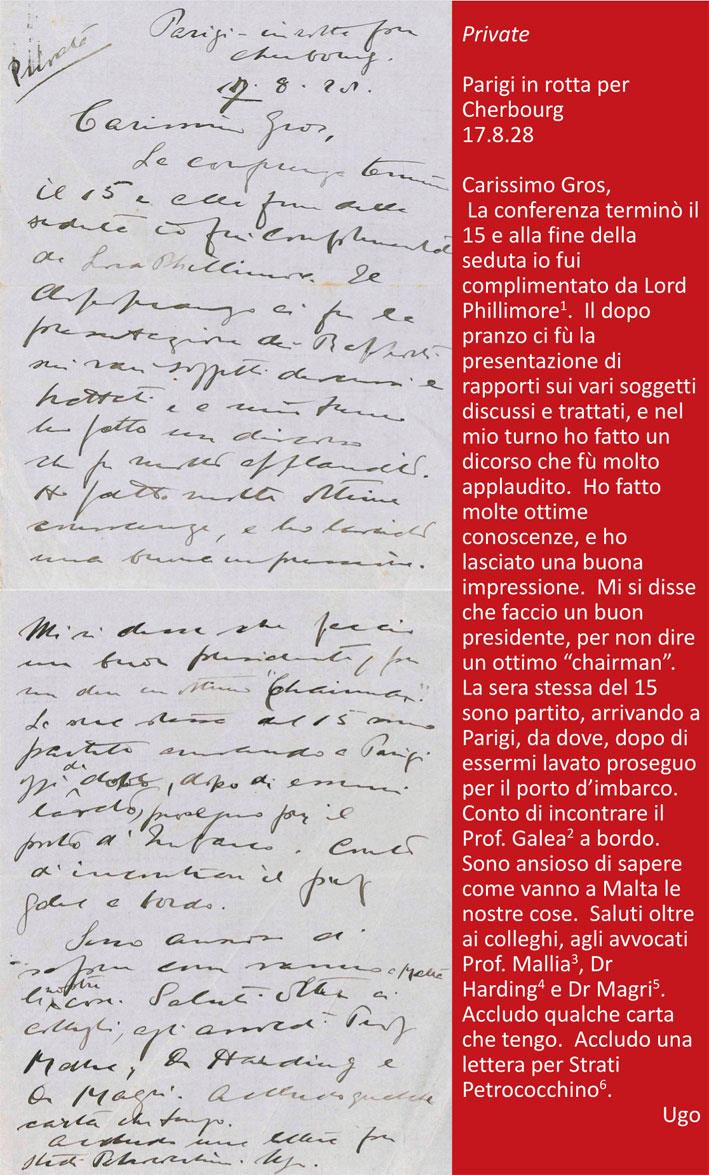
The first letter is from Paris and is in Italian:
The next letter was sent from Edmonton, Alberta and is dated the 8th September 1928. One of the first Acts of the Maltese Parliament in 1922 was to enact a Law establishing the Eighth of September as National Feast of Malta in memory of the Victory in the Great Siege of 1565.
The letter was written in English:
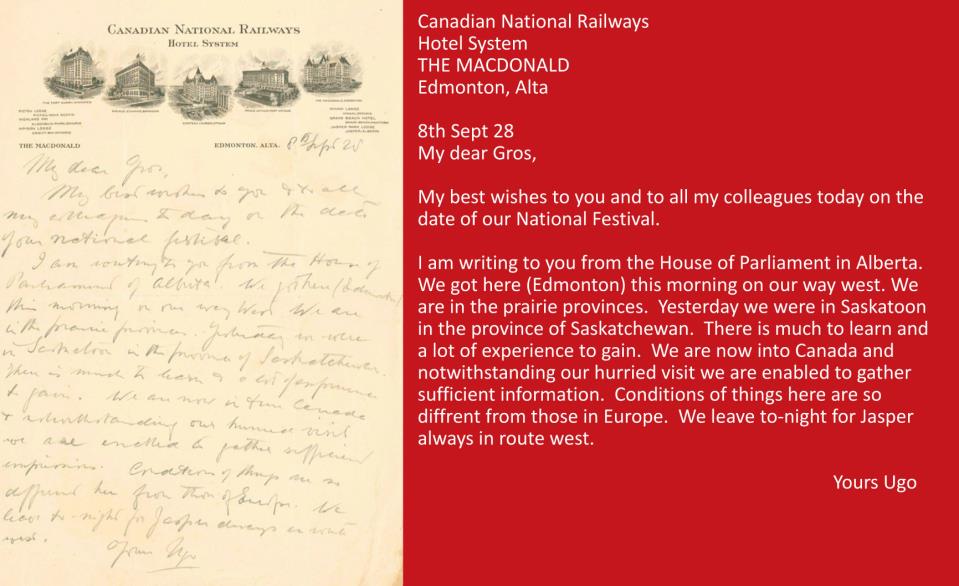
Sir Ugo was physically in Canada but thinking very nationally.
The next letter was sent from the Hotel Saskatchewan in Regina, an important city, infact capital of the province of Saskatchewan.
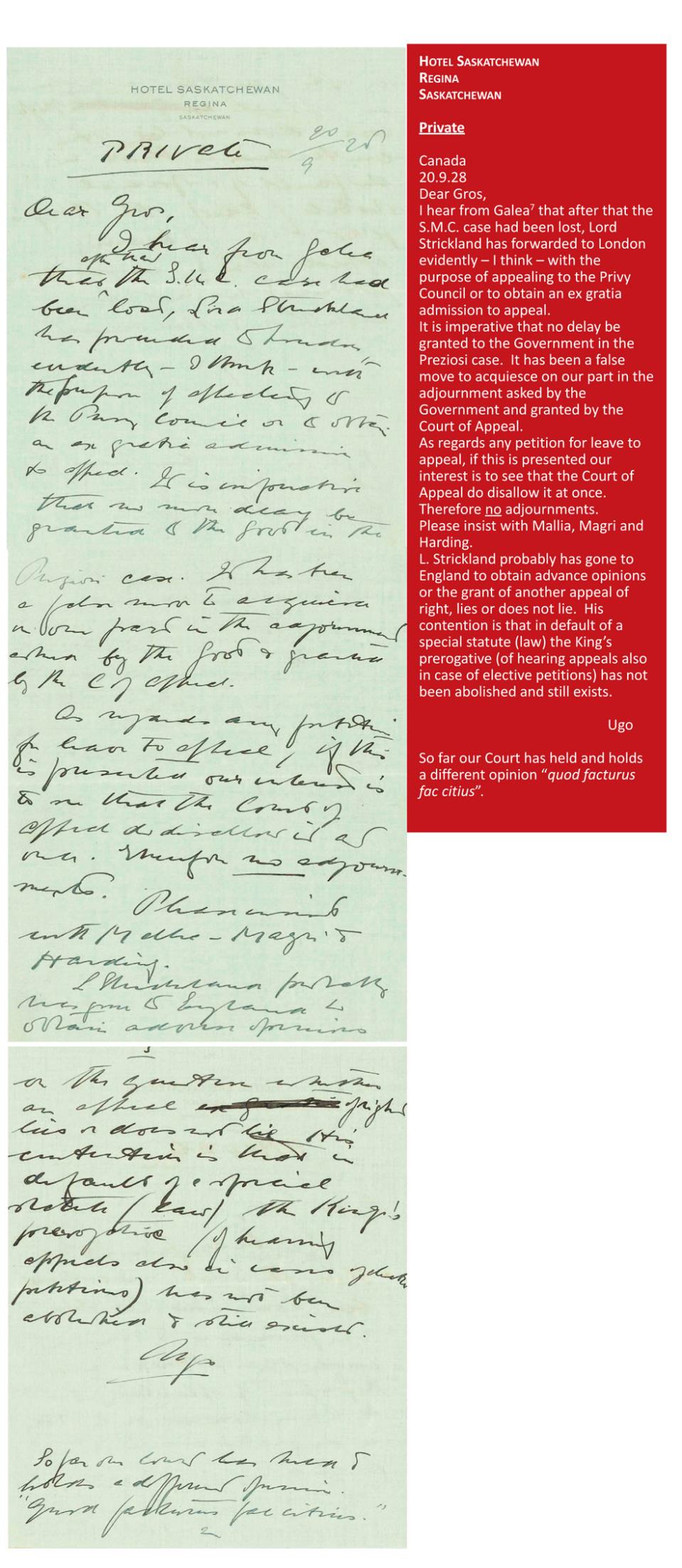 This letter is indicative of the interest that Sir Ugo continues to harbour with regard to the Court case then just decided concerning the validity of laws passed with the concurrence of the votes of two 'senators' whose election had been declered null and void by the Courts of Malta. There was a fundamental point of Constitutional Law involved: whether the Courts of Malta could sanction the legality of laws passed by the Maltese Parliament and acceded to by the Governor. There were heated but also learned debates in Parliament and in the Courts, concerning the functions of the judiciary vis a vis legislation passed by the legislative organ and promulgated by the head of Government. It seems that the position at Common Law was different from that held by our Court of Appeal. At Common Law, it seemed that the Courts did not possess the power to sanction Parliamentary Statutes. Lord Strickland's recourse to the Privy Council had two principal strategic and tactical aims. Pending the Appeal to the Privy Council the two pseudo-senators would continue to sit in the Senate and continue to take part in the passing of legislation, rendering the Court of Appeal judgement not a complete 'res judicata', and finally, the Privy Council could decide that the Maltese Courts had no power to decide on the 'legality' of laws passed by the Maltese Legislature. The point at issue was one of constitutional principle: whether the supremacy of Parliament meant that it was not subject to the Rule of Law.
The following letter was written the next day:
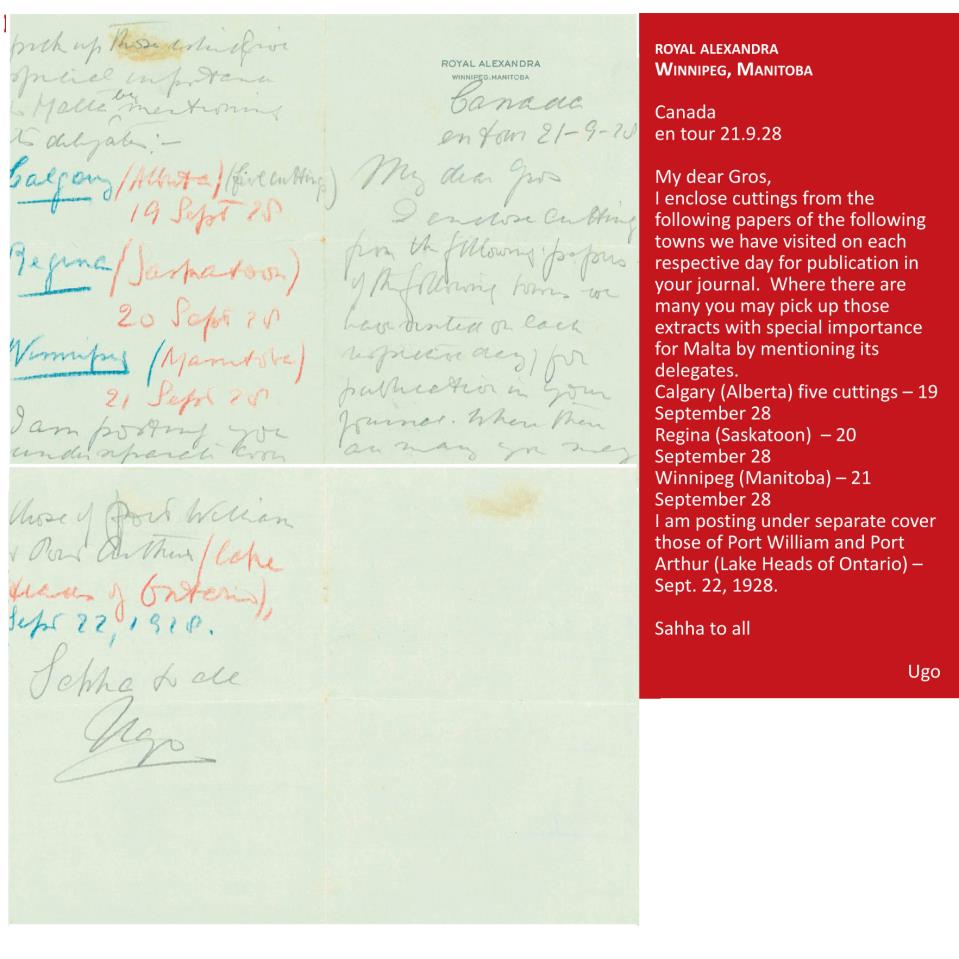
It seems that Sir Ugo's political instincts must have prompted him into realising that he needed to keep the Maltese people informed of where their Leader of Opposition was and what he was doing so far away. So he sends cuttings from the press of the various cities the Parliamentary delegation visited, presumably covering activities in which they were involved. Carmelo Mifsud Bonnici's paper Mid-Day News was the only English Language newspaper that would be interested in reproducing the contents of these press cuttings.
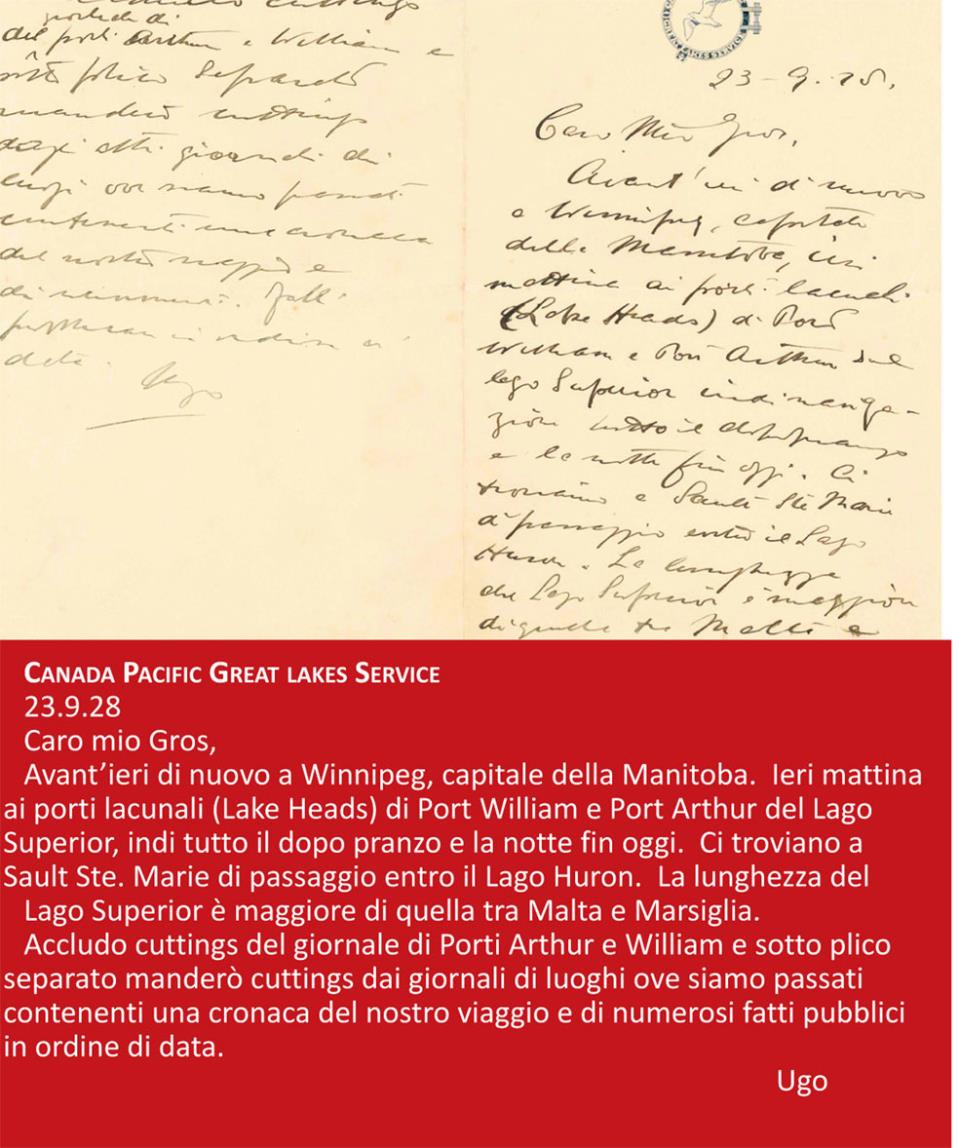
The next letter is affectionately addressed to 'Caro mio Gros' in Italian and dated 23.9.28.
It seems that they were now returning back towards the East.
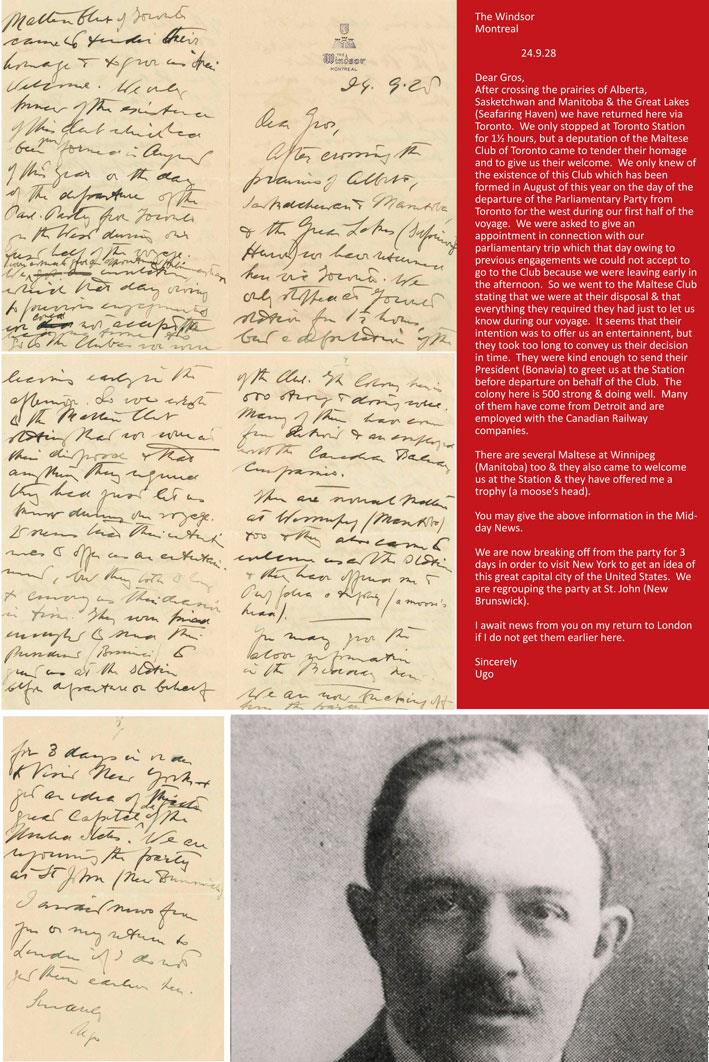
It is interesting to note that notwithstanding the incandescent political atmosphere in Malta (one has to remember that the day after the election results in August 1927, Sir Ugo's and my father's offices and residences were searched by the Police}, the reference to Professor Robert Galea and exchanges of information with him, show a normality of personal relations, at least between them. The way that the Maltese communities in Canada received the Maltese members of the Parliamentary party (Leader of the Opposition and Minister of Health) shows that abroad, national feeling transcended any partisan feeling. This has continued to be mostly the case when Maltese politicians visited North America and Australia. The letters also prove that long decades before Independence, the Maltese Leaders considered they were standing on the world stage and they had to maintain ties and attend to the interests of all Maltese, even those who had moved away from these Islands.
Unfortunately, no copies of letters from Carmelo Mifsud Bonnici to Sir Ugo in this connection are extant.
Sir Ugo came back and coordinated a strong opposition in the Assembly in the years leading to the aborted elections of 1930 and a vigorous campaigning for the return to democracy, after the suspension of the Constitution conducted from the streets and squares in the two following years. He achieved a great success in seats and votes in the 1932 General Elections. After a year and a half in office, his ministry was dismissed in October 1933 when the Constitution was again suspended. Sir Ugo met his destiny in 1941 when he succumbed to an ichtus in the Tapestry Chamber after a resounding speech for the maintenance of the Rule of Law delivered to defend those who had been interned without being charged and who were about to be illegally deported from these Islands.