"As I listen to Francis, many memories come back to me, and not just of my recent experience of lockdown, but of my childhood much of which was spent at the Moulay Youssef hospital in Rabat the capital of Morocco.
I belong to a family of doctors. A Maltese great-grand father on my mother's side, another great-grand father on the paternal side, plus my father and his elder brother who toiled for many years in Morocco in the days of the French Protectorate (1912-1956) and after.
All of them belonged to generations of doctors for whom the risk of epidemics was an everyday concern. And rightly so as, more often than not, the risk turned into reality, sometimes at their own expense or their family. Let me quote a few anecdotes to illustrate the point.
At the end of WW2, my uncle Charles Sanguy, then head of Casablanca's sanitary services, was confronted with an outbreak of the bubonic plague. He nipped the problem in the bud not because he had the drugs, which were even less available than today in those early post-war times, but thanks to some very drastic measures interestingly reminiscent of those currently implemented.
The resident general, then the highest authority of the Protectorate, gave him permission to have the economic capital of Morocco sealed off by the army. Only those carrying food supplies and other essentials were allowed into the city and this only after their clothes had been disinfected and they had had a shower. This to make sure they would not be bringing in the fleas which pass on the virus to humans. They were also given a free meal.
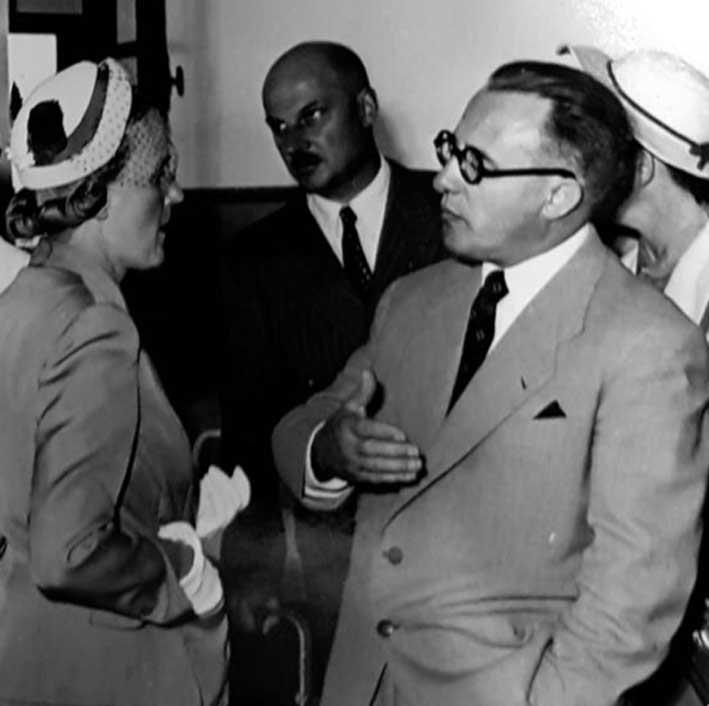
Dr Charles Sanguy, inspector general of Public Health with his Resident general’s wife
Our younger, or not so young readers, especially those who object to wearing face-masks etc., not to mention the many who think ill of vaccines when they exist and are outraged when they don't, may find the above shocking and infringing on individual liberties. Especially coming from a colonial power. No doubt they have a point here and a serious one especially if they are historians. But they must also remember that, just as there is no real treatment for the more acute cases of Covid19 today, antibiotics were not available worldwide until the second half of the 20th century. Like today hygiene and prevention were the medical professions' obsession, whether colonial or not. And this for very good reasons as once contaminated a patient's chances of avoiding death were almost nil. When they did even doctors were tempted to regard it as something of a miracle. Again let me give instances of this drawn from family lore.
Ten years before the Casablanca plague, my uncle Charles had been rushed with Cholera to the hospital at Agadir upon returning from a vaccination campaign in the Sahara. Contrary to all expectations, he survived after having received the last sacraments.
In 1949 my baby sister Martine aged two also had typhus. Her survival was deemed so miraculous by her own father, yet a medical doctor like his brother, that the entire family went on a pilgrimage to Lourdes and that the little girl wore white and blue the Virgin's colours until her 16th birthday.
************************
My memories go further back in time. As an old man born during WWII I grew up surrounded by people who had lived through WWI and had very vivid memories which they passed on to us.
One of my French great-grandfathers, a medical doctor trained in Montpellier who had saved other children from diphtheria was unable to save his own 4-year old little boy. The miracle did not take place the baby died. The father fell into a fatal depression. He took his own life and was denied a Christian funeral.
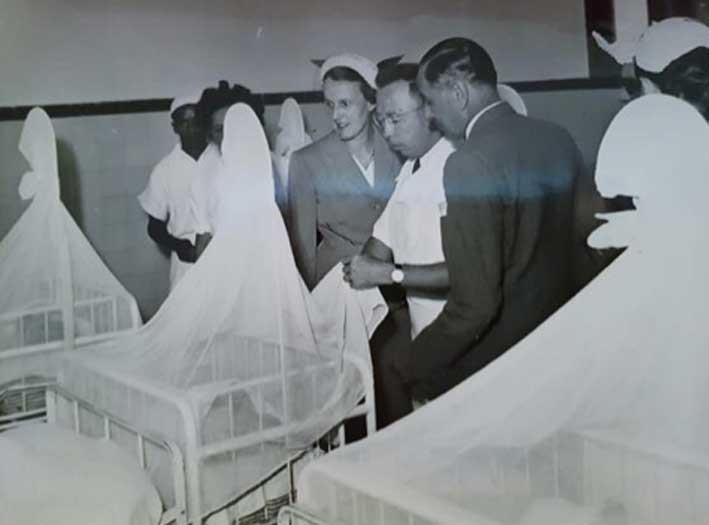
Dr Pierre Sanguy guiding the Resident general’s wife in the Maternity
On the Maltese side of the family, they too remembered with a sigh no miracle could save my grand-mother's sister Annie although her father Enrico Magro, rector of the university was also a medical doctor. Like millions of others across the planet she fell victim to the second wave of the Spanish flu which hit Malta in the last months of 1919.
In those days the Maltese remembered with gratitude and respect the work of Temi Zammit who worked so hard to teach the Maltese farmer how to protect themselves and the rest of the island's population from the then rampant Malta fever and eradicate it.
Wash your hands, brush your nails, avoid contacts with people who cough or sneeze, make sure you eat or drink safe food, fruit and vegetables, only use clean dishes and cutlery, how many times a day were we repeated the same injunctions. Microbes and viruses are everywhere, epidemics can strike like thunder. Tuberculosis, malaria, cholera, polyomelitis, to name but a few were ever present and there was no way one could stress enough the necessity of protecting oneself.
********************************
Curiously, the lesson was lost after the discovery of antibiotics and generations grew up under the delusion that every single disease could be cured and that hygiene no longer needed to be as strictly observed as before.
Much of the disaster we have experienced this year, and are still experiencing as I write now, is in my opinion due to the now sadly ingrained idea that public health is the responsibility of those in power and the medical profession and nobody else's. Individuals are not to be expected to take their share of the burden and trouble themselves with the masks, social distancing etc. demanded by the prophets of doom and gloom and other killjoys.
Meanwhile, many of those who will not wear a face-mask, or clean their hands as they walk into a shop, will blame the epidemic on foreigners and are outraged if they themselves are treated like foreigners when they travel. Let's forget about the problem, they will tell you, I read on the Internet that a doctor somewhere had found a miracle cure, a vaccine is in the offing and will soon solve the problem altogether and it will soon be life as usual. We are no cowards and the best thing we can do is live as if the danger did not exist.
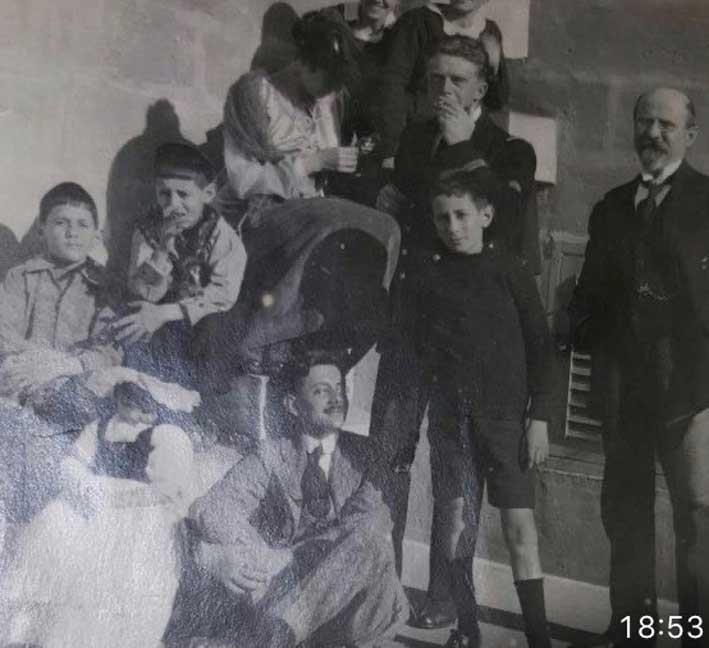
Valletta - November 1918: Ethel Magro with her fiance Gaston Vincot of the French Navy surronded by her numerous Caruana Galizia cousins. Seated Victor Caruana Galizia, later Professor in Law and president of the Casino Maltese
Sigmund Freud once said that we humans are torn between the conflicting principles of pleasure and reality. Accommodating illnesses is, whether we like it or not, part of reality. Living in denial of this hard fact will not lead us anywhere except to greater individual and collective disasters.
In 1909 a French doctor named Charles Nicolle, director of the Institut Pasteur's branch in Tunis, discovered that just as fleas could transmit the plague to humans, lice did the same with the typhus. He then spent the rest of his life pleading for hygiene and the right prophylactic measures. His work was acclaimed worldwide and he received the Nobel prize of medicine in 1928.
His remains are buried on the premises of the Institut Pasteur in Tunis where he is still revered as a national hero who fought illnesses on all sides and not just the typhus.
In 1933, three years before his death, Charles Nicolle wrote the following prophetic lines:
'There will therefore exist new diseases. That is a fact and it is inevitable. Just as inevitable is the fact that we will not be able to detect and trace them as soon as they appear. When we shall have a notion of those diseases they will already have reached so to say their final form and adulthood'. Destin des maladies infectieuses, 1933.
It is perhaps time to remember and meditate his words."
Editor's note: Patrice's mother, Denise, was born in Valletta in 1920 the daughter of a French naval officer and who had married the daughter of the then rector of the Royal Malta University, Dr Magro. She was related to the Caruana Galizia family.
[email protected]
[email protected]