This exhibition marks a return to your 'celebrated roots'. What drew you back to this subject now?
This show follows a very experimental - and thankfully well‑received - figurative exhibition that took me far outside my usual terrain. Even while working on that project, I knew I would return to landscapes at the first opportunity. This exhibition is that homecoming, and I'm approaching our coastline with a renewed sense of energy and curiosity.
How has your relationship with the Maltese coast evolved since your earlier work?
Malta grows busier every year. Much of the inland has been eroded by relentless commercial development, but the coastline - those precious few metres where land meets sea - has remained remarkably intact, even world‑class in its beauty. My canvases, too, have changed: once almost empty of people, they are now increasingly populated, reflecting the life that still pulses along the shore.

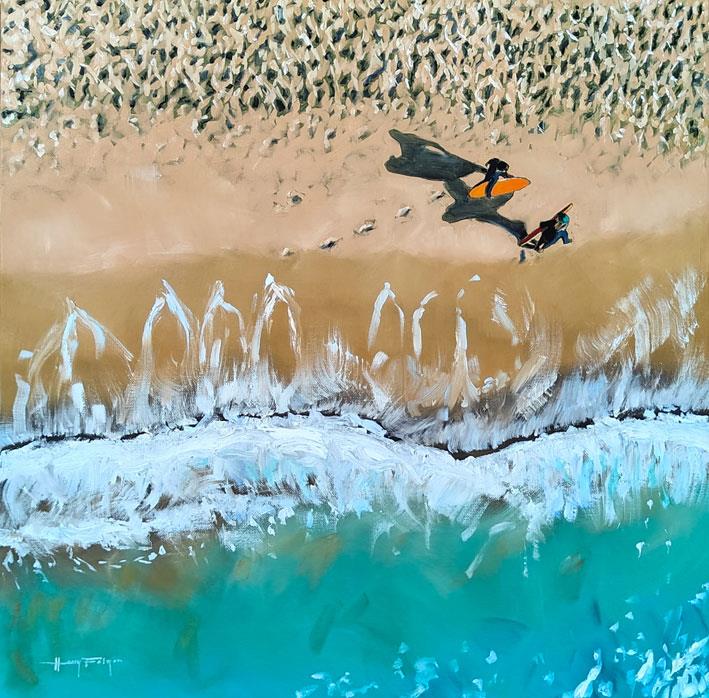
Your new works adopt what you call 'angelic perspectives', almost as if seen from above. What inspired this shift?
Since childhood, I've been fascinated by the idea of celestial beings watching us from above. That belief, combined with my love of cartography, naturally led me to explore top‑down perspectives. Maps are tools of understanding and control, and this viewpoint places me in a unique, uncompetitive position - alone in the sky, looking down at a world that becomes mine to interpret.
From above, people lose their labels and hierarchies. They're not tall or short, white or black - they're simply human. The perspective has a timeless quality that excites me, especially now that technology allows me to capture fleeting aerial moments to translate onto canvas.
Does this vantage point change the emotional or narrative intention behind the paintings?
Absolutely. It strips away prejudice, familiarity, and the quick assumptions we make when we see people at eye level. At a time when the global order feels fragile and conflict‑ridden, I'm drawn to seeing humanity without divisions - just people, moving through their lives.
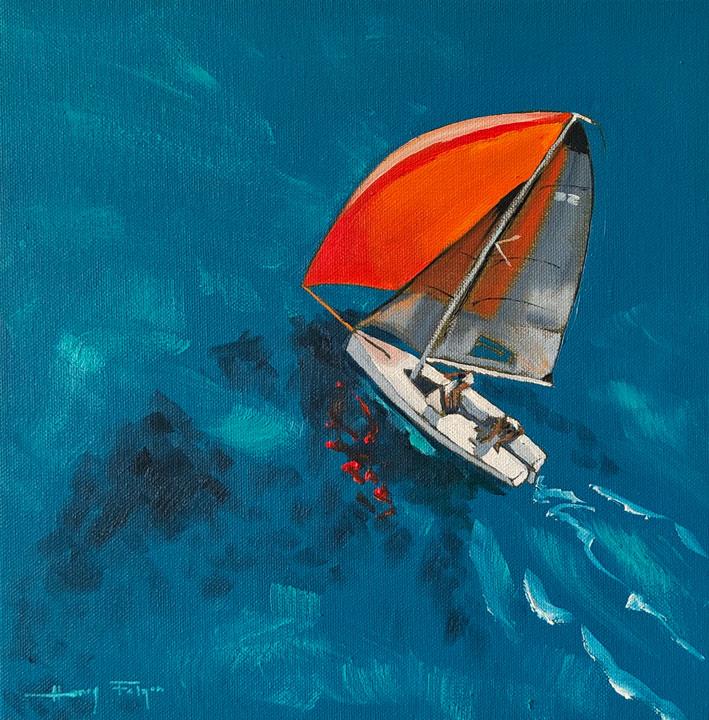
Many associate the Maltese coast with summer, yet you focus on the winter sea. What does winter reveal that summer does not?
The winter coastline has its own stark charm. It's quieter, more introspective, and it attracts people who seek exactly those qualities. Winter surfers, for instance, have fascinated me - their energy, resilience, and joy. Winter sunseekers appear on bright February days, shadows stretch longer, and the sea turns green rather than blue. Storms pound the coast with a force that is both violent and exhilarating.
You describe the winter sea as 'a precious property fully owned by the Mediterranean itself'. What do you mean by that?
The sea belongs to no one. As we've seen recently at Lapsi, it reclaims whatever man oversteps. Rust, waves, storms - the sea undoes human arrogance in its own time. On boats, it finds your weakest point and humbles you unless you approach it with respect. It is nature's great equaliser.
You challenge the idea that the winter coast is deserted. What fascinates you about its winter visitors?
Winter attracts a different kind of presence - quieter, more reflective. If summer is jovial, winter is melancholy, but never dull. A cross‑section of people still seek the coast, even in smaller numbers, drawn by its solitude and beauty.
You work almost exclusively in oil on canvas. What does oil give you that other media cannot?
Oil allows me to remove all barriers between the viewer and the painted surface. At the same time, it supports longevity: treated pine stretchers, triple‑primed cotton canvas, and hand‑made colours crafted in Wales using traditional formulas. Oil gives me freedom - in scale, in texture, in expression - and allows the work to stand independently, without the need for framing.
How does oil help you convey the violence and rhythm of winter storms?
Oil is wonderfully versatile. It can be thin and delicate, detailed and precise, fluid for broad passages, or thick and impasto for visceral impact. Winter storms demand all these modes - especially the last.
You mention 'secret canvases' that act as seeds for future ideas. What role does experimentation play in your practice?
I've included a few offset canvases that serve as teasers for future directions. Their success - or failure - may influence where I go next. I won't reveal which ones they are; that's my private laboratory.
Are these experimental works private, or do they form part of a dialogue with your audience?
Certainly, they form part of a dialogue. I don't believe art exists in a vacuum. My canvases are extensions of my conversation with the world, and I rely on the energy and feedback of viewers. If the audience didn't matter, I'd paint in a cellar and burn the work afterwards - which is clearly not what I am doing.
You're known for pushing boundaries. Which limits are you currently challenging?
My work is an ongoing exploration. I don't follow a conscious agenda, but I do have a hunger for discovering life in all its forms. My paintings often become veiled autobiographies disguised as landscapes. I only realise the shifts I've made when I look back and see the subtle turns in my path.
How do you balance instinctive emotion with the technical demands of such complex perspectives?
Painting rewards both emotional instinct and technical discipline, but the former is far more important. Technology can help fill technical gaps, but nothing replaces self‑critique. Before painting, I spent 10 years in fine‑art photography, which demands constant self‑evaluation. Even today, I don't draw as well as many contemporary draughtsmen - but painting involves far more than just drawing.
Gallery 23 has become a kind of home base for me. Alexia and Rachel know my work - and me - exceptionally well. Many gallerists are professional, but few invest in the artist as a person. I'm not perfect, and they support me even when things get difficult.
Did the space influence the scale or mood of the pieces?
Not the artistic content, but certainly the practical parameters: size, quantity, and thematic combinations. Working with a familiar space makes the process smoother.
After this exhibition, where is your artistic compass pointing?
I feel drawn back to figurative work, though I want to continue moving between landscapes and figures - two areas that often intersect. As time passes, I'm increasingly sensitive to the human condition. Both genres reflect who we are, how we live, what drives us, and the eternal "why" that keeps me thinking about humanity.
'Henry and the Sea' is being held at Gallery 23, Balzan between 19 April - 1 May
Open Days: Sundays: 10.30am to 1pm and Wednesdays: 6am to 8pm
For more information please call on 9942 8272 or email: [email protected]